Afghan My Lai — Robert Bales was not alone
March 31, 2012 § 7 Comments
That is according to Afghan child witnesses interviewed by Yalda Hakim for Australia’s SBS Dateline. (h/t Shaheen)
Hakim, who was born in Afghanistan and immigrated to Australia as a child, is the first international journalist to interview the surviving witnesses. She said American investigators tried to prevent her from interviewing the children, saying her questions could traumatize them. She said she appealed to village leaders, who arranged for her to interview the witnesses.
Noorbinak, 8, told Hakim that the shooter first shot her father’s dog. Then, Noorbinak said in the video, he shot her father in the foot and dragged her mother by the hair. When her father started screaming, he shot her father, the child says. Then he turned the gun on Noorbinak and shot her in the leg.
Above the Drone of War, Voices for Peace
March 25, 2012 § Leave a Comment
by Davis Smith-Ferri

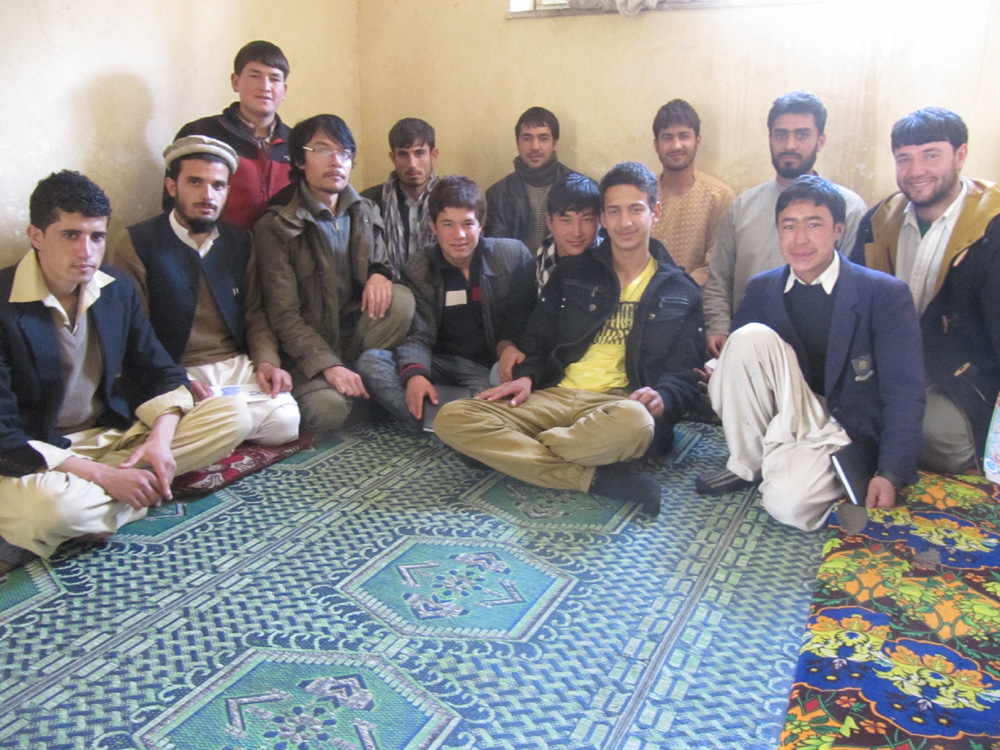
Afghan Youth Peace Volunteers from Kabul and Bamiyan visiting with Afghan youth at Nangarhar University in Jalalabad.
In 1876, at the so-called Battle of the Little Bighorn when U.S. Cavalry regiments attacked an Indian village along the Little Bighorn River in Wyoming, the first casualty was a ten-year old Lakota Sioux boy named Deeds. Unaware that U.S. troops were nearby planning an attack, he and his father were combing a hillside looking for a lost pony when U.S. troops encountered and killed him. The next casualties were six Lakota women and four children, who were murdered while in a field gathering wild radish bulbs, one of the many indigenous plants that Native people depended on for their livelihood, and hardly a threatening activity.
I think of these events today because of the recent killings of Afghan civilians, not only the 17 women and children killed in villages outside Kandahar, but also two recent and less publicized atrocities resulting from NATO airstrikes that killed civilians in Kapisa Province, including eight Afghan boys who were tending their sheep. Sheepherding, of course, is an activity as integral to their livelihood as gathering indigenous plants was to Lakota people.
Kandahar ‘killing-spree’ militarism
March 13, 2012 § Leave a Comment
A call for U.S. and Afghan citizens to question the Strategic Partnership Agreement.
By the Afghan Youth Peace Volunteers
13th March 2012 – The Afghan Youth Peace Volunteers question the presumption that the U.S. military strategy in Afghanistan is necessary for American or Afghan peace.
Tragedies like the Kandahar killing spree which massacred 16 Afghan civilians in their sleep ( including 6 children and 3 women ) are tragedies repeated in any war, including the U.S. war in Afghanistan. This failed military strategy that is designed for U.S. power and economic interests is being sold to the U.S. electorate through the mainstream media doublespeak of ‘withdrawal’ and ‘negotiations’, but is quietly being pursued in what President Obama and President Karzai called ’progress’ towards the signing of the U.S Afghanistan Strategic Partnership Agreement. The Agreement will entrench U.S. military presence in Afghanistan till 2024 and beyond and is based on the same militarism that has resulted in the pathologicalurinating on Afghan corpses by U.S. soldiers, the morbid keeping of severed finger-trophies by the Kill Team, the burning of the Quran and many other ‘unforgiveable’ tragedies.
Heart & Mind-O-Matic
February 17, 2012 § Leave a Comment
From the great, Pulitzer-Prize winning political cartoonist Mark Fiore.
Learn all about the US drone program in Pakistan and other lucky countries across the globe! See how fortunate one young villager is to have the US looking out for him and fighting extremism. Never mind the attacks on funerals and rescuers. A Mark Fiore political animation.
Cold, Cold Heart
February 14, 2012 § 2 Comments
by Kathy Kelly
It’s Valentine’s Day, and opening the little cartoon on the Google page brings up a sentimental animation with Tony Bennett singing “why can’t I free your doubtful mind and melt your cold, cold heart.”
Here in Dubai, where I’m awaiting a visa to visit Afghanistan, the weather is already warm and humid. But my bags are packed with sweaters because Kabul is still reeling from the coldest winter on record. Two weeks ago, eight children under age five froze to death there in one of the sprawling refugee camps inhabited by so many who have fled from the battles in other provinces. Since January 15, at least 23 children under 5 have frozen to death in the camps.
And just over a week ago, eight young shepherds, all but one under 14 years of age, lit a fire for warmth on the snowy Afghan mountainside in Kapisa Province where they were helping support their families by grazing sheep. French troops saw the fire, and acted on faulty information, and the boys were all killed in two successive NATO airstrikes. The usual denunciations from local authorities, and Western apologies, followed. (Trend News, February 10, 2012).
Pakistani FM on the regional crises
February 9, 2012 § 1 Comment
Pakistani foreign minister Hina Rabbani Khar speaks about drones, Afghanistan, Iran, Syria and more.
American drones hitting targets on Pakistani territory is illegal, and involvement of the Pakistani spy agencies with Taliban not even worthy of comment, said Hina Rabbani Khar, Pakistan’s Foreign Minister, exclusively to RT.
Afghanistan’s last Jew
January 30, 2012 § 1 Comment
Having lived through Communism, the mujaheddin and the Taliban, Zebolon Simontov is the last remaining Jew in Afghanistan.
The Colossal Folly of War in Afghanistan
January 24, 2012 § 3 Comments
by Ralph Nader
The U.S. war in Afghanistan is testing so much futuristic detect and destroy weaponry that it can be called the most advanced all-seeing invasion in military history. From blanket satellite surveillance to soldiers’ infra-red vision to the remotely guided photographing, killer drones to the latest fused ground-based imagery and electronic signal intercepts, the age of robotic land, sea, and air weaponry is at hand.
U.S. and NATO soldiers and contractors greatly outnumber the Taliban, whose sandals and weapons are from the past century. Still, with the most sophisticated arsenals ever deployed, why are U.S. generals saying that less than 30,000 Taliban fighters, for almost a decade, have fought the U.S. led forces to a draw?
Perhaps one answer can be drawn from a ceremony that could be happening in various places in that tormented country. That is, a Jirga of elders awarding a young fighter the Jirga medal of honor for courage on the battlefield, which often happens to be their village or valley.
Much to Forgive: The Story of Bibi Sadia
January 4, 2012 § 1 Comment
by Kathy Kelly and the Afghan Youth Peace Volunteers

Bibi and her granddaughter.
Kabul - Bibi Sadia and her husband Baba share a humble home with their son, his wife and their two little children. An Afghan human rights advocate suggested that we listen to Bibi’s stories and learn more about how a Pashto family has tried to survive successive tragedies in Kabul.
Holding her three year old granddaughter in her arms, Bibi adjusted her hijab and launched into a narrative that began during the Soviet occupation. The mujahideen had asked Baba to bring them medicines two or three times a week for those injured in the war. For each batch of medicines that Baba delivered, the mujahideen paid him a small sum of money. When the Russian occupiers discovered what he was doing, they beat him severely. After that, the mujahideen accused him of spying for the Russians and they also beat him badly.
The vicious beatings gave him perforated ear drums requiring six operations and left him permanently hard of hearing.
They also left him mentally unsound, so that Bibi became the sole breadwinner for the family. “During the time of the Taliban,” Bibi tells us with a soft smile, “I used to make bread, wash clothes and reap other people’s wheat to earn a living,” The mujahideen, having ousted Russia’s favored government and its army, were now in power and frowned on women working. “I used to work by the moonlight, sewing clothes from animal hide”.