What Laila Sees

by David Smith-Ferri

Kabul, Afghanistan – “We live in constant fear of suicide attacks,” said Laila, an Afghan woman who lives in Kandahar city and who visited with us yesterday. “When will the next one strike and where?”

“Twelve days ago,” she continued, “a good friend was walking home from the mosque. A four-minute walk. An IED was detonated, and my friend lost half his face. Another man lost his leg, and his son lost his leg, too. We live with that kind of uncertainty, when you don’t know what is going to happen from one moment to the next.”

Laila’s descriptions of living with fear and violence in Kandahar contradict the mild U.S. descriptions of the “security situation” there. “The Taliban do not control the city,” said Army General Stanley McChrystal, in a May 13, 2010 briefing concerning a “much-anticipated” military operation in Kandahar. “You can walk around the streets of Kandahar, and there is business going on. It is a functioning city.”

Compare McChrystal’s blithe comments with Laila’s experience. “In Kandahar city, you don’t know what’s going to happen, minute to minute. Every single minute that we live – if you can call it living – every single second there is the thought that this is going to be my last second.”

Laila went on to illustrate this graphically. “A good friend of mine had a ticket to travel to Canada to visit her mom for a family wedding. She dressed in a burqa, and went to say goodbye to some colleagues. When she returned home, traveling by rickshaw, she saw a neighbor outside. So she stood for two minutes to talk to her. In those two minutes, two men on a motorcycle drove up. One man shot her in the head and killed her, and the other man drove them away.”

Continue reading “What Laila Sees”

The US Democratic Party Debacle and the Demise of the Left-Center Left: A Worldwide Trend

by James Petras

Introduction

The November 2, 2010 electoral debacle of the Democratic Party in the US cannot be solely ascribed to the failed policies of President Obama, the Congressional leadership or their senior economic advisers. Nor is the demise of what passes for the American “center-left” confined to the US – it is a world-wide pattern, expressed in countries as diverse as Greece, Portugal, Spain, Great Britain and Japan.

The central question is why the left-center left governing parties are everywhere in crisis and will be for the foreseeable future?

The Left-Center Left: Past Winners, Present Losers

In the past leftist parties had been the beneficiaries of capitalist crises: Incumbent conservative regimes, which had presided over economic recessions or had been held responsible for military debacles, were ousted from power by leftist parties prepared to make large-scale, long-term public investments, funded by progressive taxes on wealth and capital, and to impose austerity programs on the rich and wealthy.

In contrast, today the left/center-left (L-CL) regimes preside over crisis-ridden capitalist economies and administer regressive socio-economic policies designed to promote the recovery of the biggest financial and corporate enterprises while rolling back wages, social programs, pensions and unemployment benefits.

As a result, the L-CL has become the prime political loser in the current economic crisis, reaping hostility and rejection from the great mass of its former working class and salaried supporters.

Continue reading “The US Democratic Party Debacle and the Demise of the Left-Center Left: A Worldwide Trend”

Bush Admits he Authorized Torture – Does Anyone Care?

by Andy Worthington

With just days to go before George W. Bush’s memoir, Decision Points, hits bookstores (on November 9), and with reports on the book’s contents doing the rounds after review copies were made available to the New York Times and Reuters, it will be interesting to see how many media outlets allow the former President the opportunity to try to salvage his reputation, how many are distracted by his spat with Kanye West or his claim that he thought about replacing Dick Cheney as Vice President in 2004, and how many decide that, on balance, it would be more honest to remind readers and viewers of the former President’s many crimes — including the illegal invasion of Iraq, and the authorization of the use of torture on “high-value detainees” seized in the “War on Terror.”
As I fall firmly into the latter camp, this article focuses on what little has so far emerged regarding the President’s views on Guantánamo, and, in particular, on his confession that he authorized the waterboarding of “high-value detainee” Khalid Sheikh Mohammed, which is rather more important than trading blows with a rapper about whether or not his response to the Katrina disaster was racist, as it is a crime under domestic and international law.

On Guantánamo

On Guantánamo, the only comments in the book that have so far emerged are insultingly flippant, which is disgraceful from the man who shredded the Geneva Conventions and authorized an unprecedented program of arbitrary detention, coercive interrogation and torture. In addition, Bush’s baleful legacy lives on in the cases of the 174 men still held, in the recent show trial of Omar Khadr, and in the complacency regarding the basis for detaining prisoners of the “War on Terror” — the Authorization for Use of Military Force, passed by Congress the week after the 9/11 attacks — on which Barack Obama continues to rely, despite its formidable shortcomings.

As Michiko Kakutani explained in a review of the book for the New York Times:

He tries to play down the problems of Guantánamo Bay, writing that detainees were given “a personal copy of the Koran” and access to a library among whose popular offerings was “an Arabic translation of Harry Potter.”

Continue reading “Bush Admits he Authorized Torture – Does Anyone Care?”

Ali’s Story

Al Jazeera – Ali, a Palestinian veteran of the intifada, went to Saudi Arabia for medical treatment after an Israeli settler shot him in the leg.

While there, he learned that his younger brother Yusef had been killed by an Israeli soldier.

Ali had spent years in Israeli prisons for actions like demonstrating against the occupation, throwing stones, and being a member of a political party.

Continue reading “Ali’s Story”

Learning From Latin American Social Movements: Introduction to Dancing with Dynamite Book

The following is an excerpt from the introduction to Benjamin Dangl’s new book Dancing with Dynamite: Social Movements and States in Latin America, (October, 2010, AK Press), recommended by Democracy Now! host Amy Goodman:

Ben Dangl breaks the sound barrier, exploding many myths about Latin America that are all-too-often amplified by the corporate media in the United States.  Read this much-needed book.”

***

The motorcycle thundered off the highway onto a jungle road of loose red dirt framed by trees, families lounging in front of their farmhouses, and small herds of disinterested cows. We pulled up to a dusty store to buy food for our stay in the rural community of Oñondivepá, Paraguay, and asked the woman behind the counter what was available. She nodded her head, picked up a saw, and began hacking away at a large slab of beef. We strapped the meat and a box of beer on to the back of the motorcycle and roared off down the road.

A volleyball game was going on when we arrived in the area where landless activist Pedro Caballero lived. His wife offered us fresh oranges while his children ran around in the dirt, playing with some wide-eyed kittens. The sun had set, so Caballero’s wife lifted a light bulb attached to a metal wire onto an exposed electric line above the house, casting light on our small gathering of neighbors. Suddenly, the dogs jumped to action, joining in a barking chorus, and lunged toward the edge of the woods. They had found a poisonous snake, a common cause of death in this small community far from hospitals.

Continue reading “Learning From Latin American Social Movements: Introduction to Dancing with Dynamite Book”

Tariq Ali assesses Obama’s record

Our dear and respected friend Tariq Ali on the Riz Khan Show.

Planting the Seeds

by Kathy Kelly

Nur Agha Akbari and his family live in Kabul, on an unpaved, pitted street lined by mud brick homes. When we visited him this week, his oldest son, age 13, led us to a sitting room inside their rented two-story apartment, furnished with simple mats and pillows. The youngster smiled shyly as he served us tea. Then his father entered the room.

Mr. Akbari is a robust, energetic, well educated man from a respected, academic Afghan family. In the late 1970s, Nur had gone to study agriculture in the UK and remained there, becoming an organic farmer. His four brothers had instead remained in Afghanistan, or else returned there after studies abroad. His two eldest brothers had trained in the Soviet Union – one as an engineer, one as a nuclear scientist – and had received early warning of the likelihood of what came to be the 1979 Soviet invasion. They spoke out publicly about their fears as the invasion grew more and more imminent.

On December 27 of that year, Soviet troops occupied major government, media and military buildings in Kabul, initiating a nine-year war between a nationalist/fundamentalist resistance (the “Mujahideen”) and the Soviet occupiers. Soviet officials fired Nur’s oldest brother from his cancer research work at Kabul University and blacklisted him. He found himself unable to work, and soon joined the resistance. Nur doesn’t know much about what happened to him then, but he was among thousands of people bulldozed into mass graves after capture and execution by the Soviets. All told Nur knows very little about the fates of his three older brothers, all killed in the war. But their tragedy would largely shape his life.

Continue reading “Planting the Seeds”

Elections: The day after

by Robert Jensen

November 2 is going to be a big day in our political lives.

But November 3 will be far more important.

On mid-term Election Day, voters will choose between candidates with different positions on health-care insurance, withdrawal from Afghanistan, and CO2 levels that drive global warming. The politicians we send to the legislatures and executive offices will make — or avoid making — important decisions. Our votes matter.

But Election Day is far from the most important moment in our political lives. The radical changes necessary to produce a just and sustainable society are not on the table for politicians in the Republican or Democratic parties, which means we citizens have to commit to ongoing radical political activity after the election.

I use the term “radical” — which to some may sound extreme or even un-American — to mark the importance of talking bluntly about the problems we face. In a political arena in which Tea Partiers claim to defend freedom and centrist Democrats are called socialists, important concepts degenerate into slogans and slurs that confuse rather than clarify. By “radical,” I mean a politics that goes to the root to critique the systems of power that create the injustice in the world and an agenda that offers policy proposals that can change those systems.

In previous essays in this campaign series on economics, empire, and energy I argued that the conventional debates in electoral politics are diversionary because painful realties about those systems are unspeakable in the mainstream: capitalism produces obscene inequality, U.S. attempts to dominate the globe violate our deepest moral principles, and there are no safe and accessible energy sources to maintain the affluent lifestyles of the First World.

Continue reading “Elections: The day after”

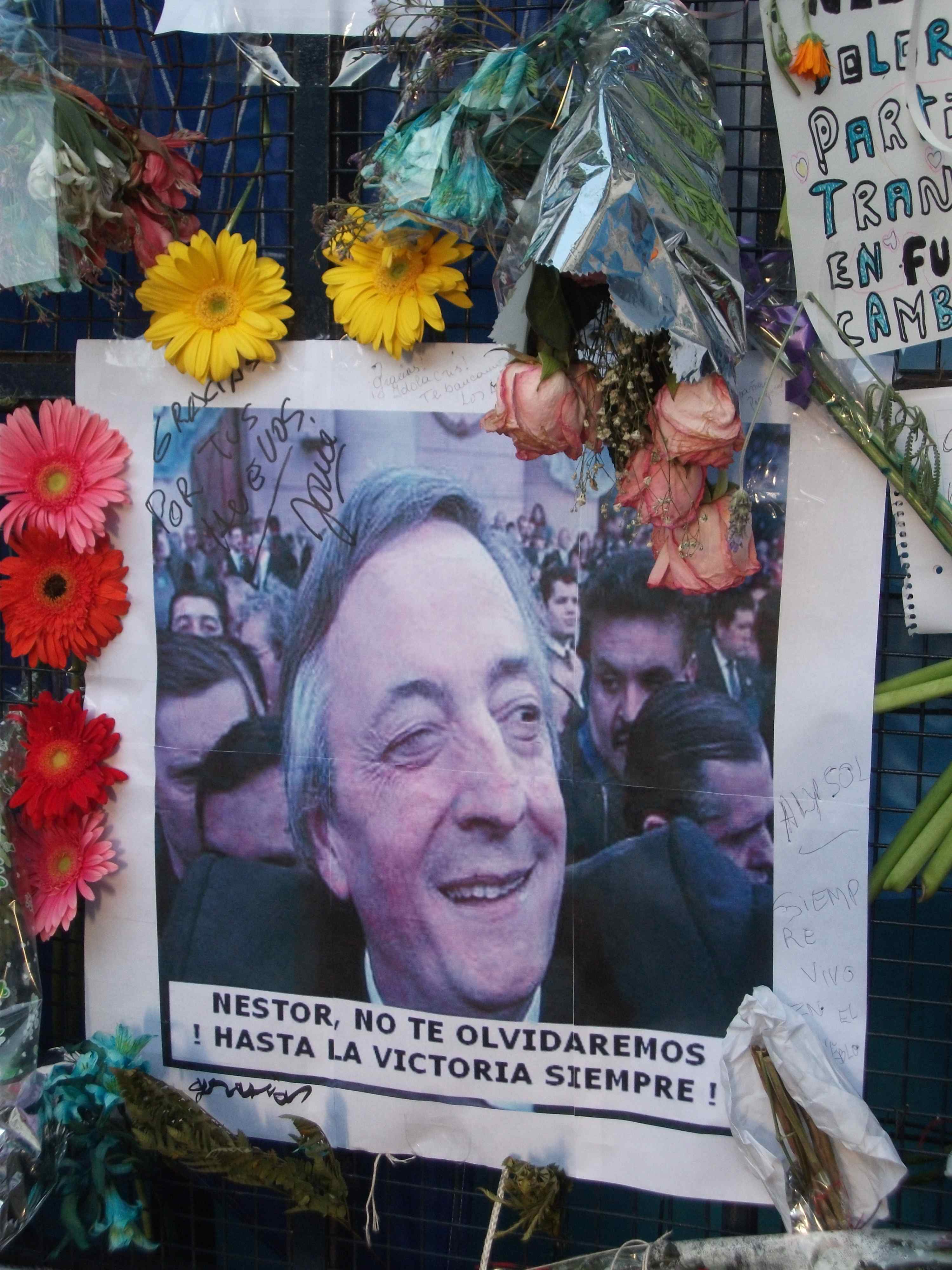
Gracias Nestor

(Photo: Kurt Fernández)

by Kurt Fernández

At a cocktail party a few weeks ago, a young lady from Mississippi studying here in Buenos Aires asked: ”Where are the Padres?”

A good question. The Madres—the Mothers of the Plaza de Mayo—are everywhere. With their signature white head kerchiefs, they are the mothers of youths who were tortured and killed by the terrorist military dictatorship that lasted from 1976 until 1983 and disappeared an estimated 30,000 people in Argentina. The fathers, however, have been largely invisible.

Except one: Nestor Kirchner, president of Argentina from 2003 to 2007, who passed away October 27.

Kirchner was too young, of course, to qualify as an actual father. In fact, as a youth he was a militant leftist and could easily have been disappeared himself. When he became president, 20 years after the restoration of democracy in Argentina, the dictators and their lackeys were leading the good life, protected by an amnesty. Kirchner pushed the government and the courts to shake off their laissez-faire treatment of the mass murderers who had set aside all concept of law and decency to destroy mostly young student and labor militant activists.

Continue reading “Gracias Nestor”

“Is This Normal?”

by David Smith-Ferri

Editor’s Note: American peace activists Kathy Kelly, Jerica Arents and David Smith-Ferri are part of a 3 person delegation currently travelling in Afghanistan. Find more entries from their travelogues on PULSE.

In a small storage shed at the edge of town, we watched as fourteen-year-old Sayed Qarim signed a simple contract agreeing to borrow and repay a no-interest, 25,000 afghani loan (roughly $555). Daniel from the Zenda Company, the loan originator, counted out the crisp bills and handed them to Qarim, who smiled broadly and shook hands. Qarim, whose family farms potatoes and wheat, plans to use the funds to purchase a cow and her calf. “There are great benefits of owning a cow,” Qarim explains. “Our family gets to use the milk, and we can sell the calf for a good profit.”

No one walking by outside on the narrow dirt road would have known an important business transaction had just occurred, one that could in fact help a young man and his family gain economic traction and greater security. The transaction didn’t take place in a bank. No village leaders were present. Only a fourteen-year-old boy, the representative of a private business company, and a witness. And while the signed agreement constitutes a business relationship, the Zenda Company sees it as primarily personal.

Qarim was recommended for a loan by Faiz and Mohammad Jan, two other young men who live in his village and who have themselves recently received and repaid loans. Following this recommendation, Zenda spent much time getting to know Qarim, meeting with him, assessing his knowledge, his resources (such as access to grazing land), and his character, answering his questions, and describing to him his responsibilities as a borrower.

Now that the transaction is complete, Qarim is required to send a picture of the cow and her calf as “proof” that the money was used as agreed. In addition, Hakim, another Zenda Company representative living in Bamiyan, who is fluent in Dari, the local language, will visit Qarim periodically. Along with Faiz and Mohammad Jan, he will try to provide whatever support Qarim needs to succeed.

Continue reading ““Is This Normal?””