Freedom of the press is guaranteed only to those who own one
Author: Idrees Ahmad
I am a Lecturer in Digital Journalism at the University of Stirling and a former research fellow at the University of Denver’s Center for Middle East Studies. I am the author of The Road to Iraq: The Making of a Neoconservative War (Edinburgh University Press, 2014). I write for The Observer, The Nation, The Daily Beast, Los Angeles Review of Books, The Atlantic, The New Republic, Al Jazeera, Dissent, The National, VICE News, Huffington Post, In These Times, Le Monde Diplomatique, Die Tageszeitung (TAZ), Adbusters, Guernica, London Review of Books (Blog), The New Arab, Bella Caledonia, Asia Times, IPS News, Medium, Political Insight, The Drouth, Canadian Dimension, Tanqeed, Variant, etc. I have appeared as an on-air analyst on Al Jazeera, the BBC, TRT World, RAI TV, Radio Open Source with Christopher Lydon, Alternative Radio with David Barsamian and several Pacifica Radio channels.
Neda Soltani was killed by the Basij. This is cowardly and despicable. I hope the perpetrators are brought to justice and dealt with severely. It was reported the other day that some of the Basijis were being arrested. I hope that is true.
Death — by Harold Pinter
Where was the dead body found?
Who found the dead body?
Was the dead body dead when found?
How was the dead body found?
Who was the dead body?
Who was the father or daughter or brother
Or uncle or sister or mother or son
Of the dead and abandoned body?
Was the body dead when abandoned?
Was the body abandoned?
By whom had it been abandoned?
Was the dead body naked or dressed for a journey?
What made you declare the dead body dead?
Did you declare the dead body dead?
How well did you know the dead body?
How did you know the dead body was dead?
Did you wash the dead body
Did you close both its eyes
Did you bury the body
Did you leave it abandoned
Did you kiss the dead body
It appears Robert Fisk — who I have often referred to as the greatest living journalist — is trying to redeem himself for the overly credulous reporting in his last article (for which he was chided here yesterday). “It’s said that the cruel ‘Iranian’ cops aren’t Iranian at all. They’re Hizbollah militia”. These and other equally silly rumors Fisk lays to rest in this return to his usual uncompromising journalism.
Protesters attacked by the Basij
At around 4.35 last Monday morning, my Beirut mobile phone rang in my Tehran hotel room. “Mr Fisk, I am a computer science student in Lebanon. I have just heard that students are being massacred in their dorms at Tehran University. Do you know about this?” The Fisk notebook is lifted wearily from the bedside table. “And can you tell me why,” he continued, “the BBC and other media are not reporting that the Iranian authorities have closed down SMS calls and local mobile phones and have shut down the internet in Tehran? I am learning what is happening only from Twitters and Facebook.”
Patrick Doherty, Deputy Director of the American Strategy Program at the New America Foundation, discusses the Iranian government crackdown that reinforces the perception of electoral fraud, the popular Iranian discontent with autocracy, the dearth of legitimate polling in Iran that increases uncertainty and how Ahmedinejad’s tough negotiating with the U.S. is seen by some as the Persian equivalent of Nixon going to China.
Hamid Dabashi is one of our truly valued friends, a man of integrity, courage and extraordinary genius. I consider him the true heir to Edward Said’s indefatigable spirit. Like us, he is clearly inspired by the determination of those protesting in Iran’s streets. However, unlike us, he appears somewhat cavalier in his dismissal of the preferences of the part of the population which voted for Ahmadinejad, even though he concedes that they may indeed be the majority. (See by comparison Seumas Milne’s comments on this subject).
(CNN) — In a recent article published both in the Washington Post and the Guardian, Ken Ballen and Patrick Doherty reported that according to their “nationwide public opinion survey of Iranians three weeks before the vote … Ahmadinejad [was] leading by a more than 2-to-1 margin — greater than his actual apparent margin of victory in Friday’s election.”
That may or may not be the case, but the abiding wisdom of Aesop’s fable of “The Boy Who Cried Wolf” or its Persian version, “The Lying Shepherd,” has now made any such Monday-morning quarterbacking an academic exercise in futility.
The assumption that the government has rigged the election has become a “social fact” that millions of Iranians believe. On the basis of that belief, they have put their lives on the line, with reported casualties of dozens injured and at least one, perhaps up to nine, people killed.
Pankaj Mishra is one of the most astute analysts of South Asian politics. In the following he argues that ‘Unless the US president can break his hardline posture, the wars in Afghanistan and Pakistan could prove his Vietnam’.
Last month Richard Holbrooke, the US state department’s special representative, met students from Pakistan’s north-west tribal areas. They were enraged by drone attacks, which – according to David Kilcullen, counterinsurgency adviser to General Petraeus – have eliminated only about 14 terrorist leaders while killing 700 civilians. One young man told Holbrooke that he knew someone killed in a Predator drone strike. “You killed 10 members of his family,” he said. Another claimed that the strikes had unleashed a fresh wave of refugees. “Are many of them Taliban?” Holbrooke asked. “We are all Taliban,” he replied.
Describing this scene in Time, Joe Klein said he was shocked by the declaration, though he recognised it as one “of solidarity, not affiliation”. He was also bewildered by the “mixed loyalties and deep resentments [that] make Pakistan so difficult to handle”. One wishes Klein had paused to wonder if people anywhere else would wholeheartedly support a foreign power that “collaterally” murders 50 relatives and friends from the air for every militant killed.
Stephen Colbert was recently on a USO tour of Iraq to entertain the illegal occupiers of the country. The show however went far beyond entertainment, and verged on pro-war propaganda. Among other things it included interviews with Ray Odierno, the fellow whose units according to Thomas Ricks were responsible for much of the abuses in the initial phase of the war, and with the Kurdish boot-licker they have installed as Iraq’s deputy prime minister, a truly execrable creature. Surprisingly, no one has spoken out against this supposed enlightened ‘liberal’ whitewashing Bush’s genocidal war. That is, until now. Here is Danny Schechter, the News Dissector’s open letter to Colbert.
Operation Iraqi Stephen
Dear Stephen Strong:
Welcome home, soldier. Your week in Iraq is all over, but the war, of course, isn’t. At least your presence there reminded us that Americans troops are still there. I am sure your presence gave them something fun to do, but hey, Nation, shouldn’t we think a little deeper about this fused exercise in military promotion and self-promotion?
Al Franken went on such a tour when Bush was in command although I noticed that W appears along with other former POTUS’s to endorse your cheerleading for our “service members.”
In his latest column, John Pilger de-codes the Obama’s “historic” speech in Cairo “reaching out to the Muslim world”. However seductive, its content was as morally bankrupt as any of Bush’s spiels.
At 7.30 in the morning on 3 June, a seven-month-old baby died in the intensive care unit of the European Gaza Hospital in the Gaza Strip. His name was Zein Ad-Din Mohammed Zu’rob, and he was suffering from a lung infection which was treatable.
Denied basic equipment, the doctors in Gaza could do nothing. For weeks, the child’s parents had sought a permit from the Israelis to allow them to take him to a hospital in Jerusalem, where he would have been saved. Like many desperately sick people who apply for these permits, the parents were told they had never applied. Even if they had arrived at the Erez Crossing with an Israeli document in their hands, the odds are that they would have been turned back for refusing the demands of officials to spy or collaborate in some way.
9 June 2009, Waziristan — In Jayne Anne Phillips’ Lark and Termite, the skies over Korea, in 1950, are described in this way:
“The planes always come…like planets on rotation. A timed bloodletting, with different excuses.”
The most recent plane to attack the Pakistani village of Khaisor (according to a Waziristan resident who asked me to withhold his name) came twenty days ago, on May 20th, 2009. A U.S. drone airplane fired a missile at the village at 4:30 AM, killing 14 women and children and 2 elders, wounding eleven.
The tireless and wonderful Kathy Kelly is visiting refugee camps in Pakistan with Dan Pearson. Here is her first dispatch (Mahmood Mamdani recently told me that apparently Arundhati Roy is also in Swat these days):
In Pakistan’s Swabi district, a bumpy road leads to Shah Mansoor, a small village surrounded by farmland. Just outside the village, uniform size tents are set up in hundreds of rows. The sun bores down on the Shah Mansoor camp which has become a temporary home to thousands of displaced Pakistanis from the Swat area. In the stifling heat, the camp’s residents sit idly, day after day, uncertain about their future. They spoke with heated certainty, though, about their grievances.As soon as we stepped out of the car, men and children approached us. They had all arrived from Mingora, the main city of Swat, 15 days prior. One young man, a student, told us that bombing and shelling had increased in their area, but, due to a government imposed curfew, they weren’t allowed to leave their homes. Suddenly, the Pakistani Army warned them to leave within four hours or they would be killed. With the curfew lifted long enough for them to get out of Mingora, they joined a mass exodus of people and walked for three days before reaching this camp.
Editor’s note: In 2009 when I read Mahmood Mamdani’s book, I accepted many of its arguments uncritically. Since then I’ve had occasion to reappraise my position and regret many of the things I wrote. Darfur was not my specialisation and I should not have passed confident judgments on it. I should not have doubted the good faith of the many people trying to bring attention to Darfur’s tragedy. Nor should I have been so eager to accept the geopolitical arguments to downplay the real atrocities being committed on the ground. The Bashir regime’s actions in Darfur were unjustifiable, tantamount to genocide, and I should have rejected any argument that downplayed the crimes. The years since 2011 have been an education and I am glad to be rid of the infantile contrarianism that defined my past politics. I am immensely grateful to the influence of the late Tony Judt who guided me towards what is hopefully a more humane and reflective politics. I hereby repudiate this piece and offer my unreserved apologies to the people of Darfur.
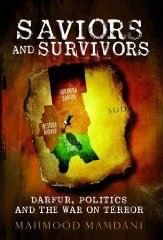
Saviors and Survivors: Darfur, Politics and the War on Terror by Mahmood Mamdani, Verso, 2009.
“Saviors and Survivors: Darfur, Politics and the War on Terror” by Mahmood Mamdani
In Errol Morris’s 2004 film The Fog of War, former US Defense Secretary Robert McNamara recalls General Curtis LeMay, the architect of the fire-bombings of Japan during WWII, saying that “if we’d lost the war, we’d all have been prosecuted as war criminals.” LeMay was merely articulating an unacknowledged truism of international relations: power bestows, among other things, the right to label. So it is that mass slaughter perpetrated by the big powers, from Vietnam to Iraq and Afghanistan, is normalized as “counterinsurgency,” “pacification” and “war on terror,” while similar acts carried out by states out of favor elicit the severest of charges. It is this politics of naming that is the subject of Mahmood Mamdani’s explosive new book, Saviors and Survivors: Darfur, Politics and the War on Terror.
Like the Middle East, parts of Africa have been engulfed in conflict for much of the post-colonial period. While the media coverage in both cases is perfunctory, in the case of Africa it is also sporadic. To the extent that there is coverage, the emphasis is on the dramatic or the grotesque. When the subject is not war, it is usually famine, disease or poverty—sometimes all together, always free of context. The wars are between “tribes” led by “warlords,” that take place in “failed states” ruled by “corrupt dictators.” Driven by primal motives, they rarely involve discernible issues. The gallery of rogues gives way only to a tableau of victims, inevitably in need of White saviors. A headline like “Can Bono save Africa?” is as illustrative of Western attitudes towards the continent as the comments of Richard Littlejohn, Britain’s highest-paid columnist, who wrote at the peak of the Rwandan genocide “Does anyone really give a monkey’s about what happens in Rwanda? If the Mbongo tribe wants to wipe out the Mbingo tribe then as far as I am concerned that is entirely a matter for them.”


 P U L S E