The Autumn of the Patriarch

Brother Leader

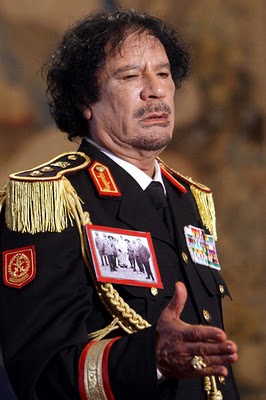
Muammar al-Qaddafi is neither a president nor a king (although he did call himself ‘King of Kings’ at one Arab summit). No, what he is, as well as Colonel, is the Brother Leader, and the Guide of the First of September Great Revolution of the Socialist People’s Libyan Arab State-of-the-Masses (he invented the Arabic word jamahiriyya for the last chunk). I’ll refer to him here as Qaddafi.

Qaddafi is famous for grandstanding – his female bodyguards, his tent, his flamboyant dress. In interviews he growls and flicks his hands. At Arab League meetings he puts his feet on the desk, smokes cigarettes, gets into shouting matches, dramatically swans out. Sometimes he says things worth saying, and he’s often provided a laugh for Arabs who don’t live in Libya.

Qaddafi thinks he’s a lady-killing revolutionary of Guevara proportions and a tyrant of the stature of Mao; hence his Green Book (not to forget his fiction). At the same time, he thinks the people, not he, are in control of Libya’s destiny. And perhaps – we can hope after Tunisia and Egypt – he’s right.

Ideologically he’s swung from Arabism to Islamic socialism to pan-Africanism, but it’s all been hot air. His hosting of a diversity of ‘revolutionary’ groups, including religious cults, reinforced the impression that he was either stupid or insane.
Continue reading “The Autumn of the Patriarch”

Bahrain Rising

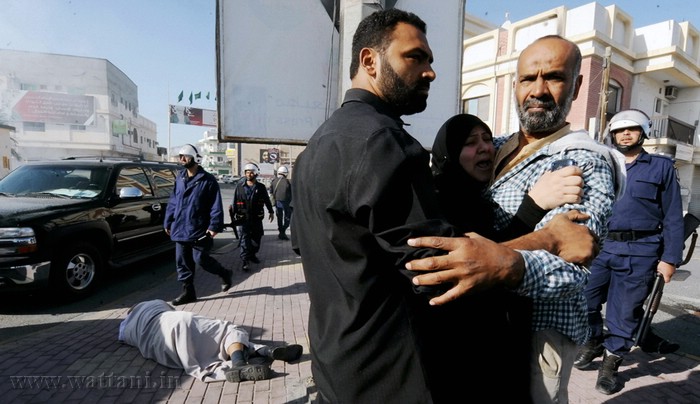
On the tiny island state of Bahrain an intelligent, highly politicised Shia majority is ruled by an actively sectarian Sunni ‘king’ and his mercenary police force. To ensure minimum fraternisation, and to shrink the Shia majority, Sunni Arabs from such countries as Syria, Jordan and Yemen are awarded citizenship after loyal service in the police.

Bahrain was known to Sumerians as Dilmun, a possible location for the Garden of Eden. Today it’s known to Americans as the home of the Fifth Fleet, one of the more essential bases for guarding the Gulf. It’s linked by causeway to Saudi Arabia, which provides it with security and thousands of drunk young men on Thursday nights. It is likely that Saudi Arabia would intervene if Bahrain went the way of Egypt.

Unlike other Gulf countries, Bahrain has always been notable for its angry mass demonstrations against assaults on Iraq, Lebanon and Palestine. Not surprising, then, that February 14th’s Day of Anger attracted a wide section of Bahraini society, including Sunnis. There’s nothing sectarian about the protestors’ democratic demands – one of their chants is Not Sunni Not Shii Just Bahraini – but we can expect sectarian mobilisation by the regime and Saudi-owned media if protests continue, as they doubtless will. The Bahraini people will be described as an unwitting front for Shii-Persian assault. For this reason, the Iranian leadership would do well to remain silent as events unfurl (Iran’s comments on the Tunisian and Egyptian revolutions, after all, have been inaccurate and propagandistic.)

Continue reading “Bahrain Rising”

Hossam el-Hamalawy on The Workers and The Military

Egypt’s revolution could go in any direction in the months and years to come. It could end up in a tame army-supervised semi-democracy under the presidency of Amr Moussa, with the army running foreign policy. More likely, the result will be far more interesting than that.

The Supreme Military Council has decided not to lift the state of emergency. The core of the old system remains in place. And Communique Number Five calls for an end to industrial action. But oil and gas workers continue to strike, as well as transport, textiles and media workers. More significantly, workers are refusing the authority of Mubarak-era union officials, and are organising to represent themselves. Another instance of spreading revolutionary fervour: state TV workers chased the head of the news department out of the building.

Writing for Jadaliyya, Egyptian blogger Hossam el-Hamalawy examines the role of the working class in the revolution. He concludes: “We have to take Tahrir to the factories now. As the revolution proceeds an inevitable class polarization is to happen. We have to be vigilant. We shouldn’t stop here.”

Continue reading “Hossam el-Hamalawy on The Workers and The Military”

Arab Earthquake

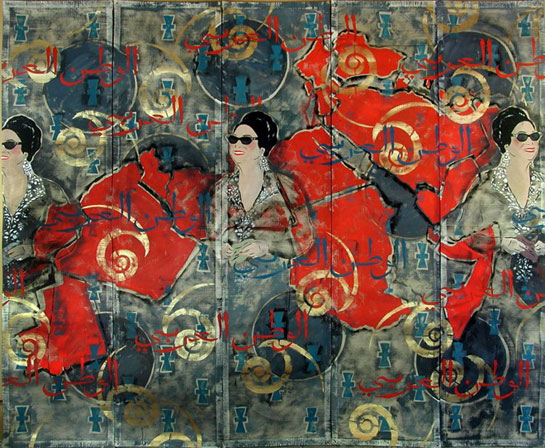
'al-Watan al-Arabi' by Chant Avedissian

Throughout yesterday messages were sent out from within the Egyptian regime to the effect that Husni Mubarak was about to resign. Millions went onto the night streets to celebrate the victory. Then, incredibly, Mubarak repeated his intention to stay. He lied about his contributions to Egyptian sovereignty and addressed the Egyptians as his children, to screams of derision. Despicable as he is, there was something of the tragic hero about him, tragic in the Greek or Shakespearean sense. The very traits which had thrust him to greatness – stubborness, brutishness, contempt for the people – were condemning him, with every word, to the most ignominious humiliation. He spoke from the gravel of his octogenarian throat, a man of the past adrift in a strange new world.

Tragic or not, it was certainly theatre – directed by the military. Communique Number One had already been delivered. Then this evening Omar Suleiman made a curt admission of defeat, for he too has been deposed (although he announced only Mubarak’s fall). The military’s Supreme Council is in charge.

Continue reading “Arab Earthquake”

The Imitator

picture by Ali Farzat

He copies phrases from foreign newspapers into a notebook. Then he copies his notes into a larger notebook with a flag and a band of gold on the front.

His mouth imitates the words of the state TV channel, and the words of undead clerics, and the words of puff-eyed men who sit in cafés.

He curses his country’s backwardness. At the same time he proclaims that the world was brighter when his grandfather was still a rheum-eyed boy.

At school he wrote poems praising his teacher. At work he writes letters praising his boss. When the time is right he writes reports denouncing his colleagues.

He is embarrassed by his social station. In the presence of his inferiors he imitates his superiors. He swings his belly like a wealthy businessman, preens his moustache like a tribal chief, avoids eye contact like a distracted poet or professor, or establishes it, beneath beetling brows, like a policeman. He aims to provoke fear. He is scared of everything.

Continue reading “The Imitator”

Regaining Momentum

8th February. AP photo.

Until today the earthshaking Egyptian revolution appeared to be losing momentum. Regime propaganda, repeated on state TV and in Saudi-owned regional media, appeared to be convincing significant sections of the population that the protests were responsible for diminished security (although it was the regime that freed violent criminals and pulled police off the streets) and economic destabilisation (although it was the regime again which closed the internet, halted the trains, and dealt perhaps a long-term blow to tourism by encouraging mobs to attack foreigners). As 40% of Egyptians rely on daily wages for survival, success of regime propaganda in this area could fatally undermine the revolution.

The United States clearly believed that Mubarak, Suleiman and the military, having weathered the initial shock, were slowly but surely regaining control. After meeting the ruling clique, Obama’s envoy and Mubarak-business partner Frank Wisner praised Mubarak and insisted that he “must stay in office to steer” a process of achieving “national consensus around the preconditions” for the future. The White House said Wisner was speaking in a personal capacity, but didn’t contradict him. Hillary Clinton, meanwhile, expressed support for Vice President Omar Suleiman’s transitional leadership. Suleiman’s credentials for midwifing democracy include personal supervision of execution by torture, a rock solid reputation with Israeli intelligence, and his oft-stated belief that Egyptians are not yet ready for democracy.

Even as the regime and its American sponsor speak of dialogue, reform and transition, arrests of opposition activists and harrassment of journalists continue, as does the decades-old state of emergency. In one hand the stick, and in the other the carrot: state salaries and pensions have been increased by 15%, and the public sector has announced it will employ the unemployed. The regime has had neither the time nor the inclination to reorder the economy to benefit the working class, so it’s most probable that Egyptians are about to benefit from a temporary cash injection from Saudi Arabia and other terrified Gulf states.

Continue reading “Regaining Momentum”

Breaking Knees

by Ali Farzat

Zakaria Tamer’s “Breaking Knees” tugs us rushing straight into the Big Topics: religion, politics, sex and death. It deals with imprisonment, literal and figurative, its characters entrapped in unhappy marriages and by their personal inadequacies, ignorances and fears, as well as by dictatorship, bureaucracy and corrupt tradition. It sounds grim, but “Breaking Knees” is a very funny book.

Tamer is a well-known Syrian journalist and writer of children’s books. His literary reputation, however, rests on his development of the very short story (in Arabic, al-qissa al-qasira jiddan), of which there are 63 here. Each is a complex situational study, a flash of life or nightmare, each with at least one beginning, middle and end. Some are as clear as day; some are seriously puzzling. Some are no more than extended, taboo-breaking jokes.

It’s certainly satire. Tamer uses an elegant, euphemistic language (referring, for instance, to “that which men have, but not women”) to tell some very plain tales. Delicious irony abounds. In bed an adulterous woman begs her lover “not to soil the purity of her ablutions.” In the street afterwards she frowns at a woman without a headscarf and says “in a voice full of sadness that immoral behaviour had become widespread.”

Continue reading “Breaking Knees”

Democracy in Action

The Guardian publishes Ahdaf Soueif’s dairy from Cairo. “What we have here,” she writes, “is the opposite of a vacuum; we have democracy in action on the ground in Tahrir Square. We are full of hope and ideas, and our gallant young people are guarding our periphery.”

As you start reading this, you will know something I don’t: you will know how this day – Friday 4 February – has turned out for us. I’m writing this at 7am. I slept in my brother’s house last night, so now I’m hearing different patterns of birdsong and muffled conversation from the street. The renewed pro-democracy protests are set to start soon and we shall all make our way to Tahrir Square. We shall be families – with the young people in the lead. We’ve called friends who’ve spent the night in the square. They say everything’s quiet.

On Thursday the new vice-president said the protests had to end. And the new prime minister stated he had no idea how violence came to happen on Wednesday in Tahrir, but that it would be investigated and, meanwhile, he was apologising to the people. And meanwhile, also, the government’s battalions of violent-crime-record personnel and plainclothes security forces were being moved around the city, yelling and brandishing banners and weapons and confronting protesters.

But let’s do this in sequence. These are short extracts from my diaries of these days …

Continue reading “Democracy in Action”

The Dogs of The State

At 0.50 a police vehicle drives into a peaceful crowd, eliciting cries such as “the dogs of the state!” This is the regime apparatus that co-opted sections of the Egyptian elite and their international backers are trying to save, with or without Husni Mubarak.

Zionism’s Fear of Arab Movement

making the middle east safe for zionism. AP photo

Tony Blair, with the blood of Iraq, Lebanon and Palestine dripping from his fingers, says Egyptian dictator Husni Mubarak is “immensely courageous and a force for good.” The opinion is based on working “with him on the Middle East peace process.” Mubarak’s record on the pacification process involves helping the Palestinian Authority transform itself into a (stateless) police state apparatus, obstructing Fatah-Hamas reconciliation, and constructing, in concert with US army engineers, a metal wall underneath the Gaza border.

Under Nasser’s police state Egypt had no popular sovereignty, but it did have national independence. This was lost at Camp David in 1979, when Sadat signed peace with Israel, retrieved the occupied Sinai peninsula, and received the promise of billions of dollars of annual American aid. After Israel, Egypt is the second largest recipient of US aid. American funding of the military is the reason why top officers remain loyal to the regime despite all the humiliations (for Egypt lost its Arab leadership role long ago) and committed to the peace treaty, although Israel has reneged on its Camp David undertaking to provide a just solution to the Palestinian problem.

Continue reading “Zionism’s Fear of Arab Movement”