ISIS: Hassan/Weiss versus Cockburn

isisThe review below was published at the Guardian. Unfortunately the heart of the review was cut from the published version. I’ll put it here first of all, because it shows that Patrick Cockburn actually makes stuff up in order to defend Assad and Iran and to slander the Syrian people. Here it is:

“There is no alternative to first-hand reporting,” he nevertheless opines; and “journalists rarely fully admit to themselves … the degree to which they rely on secondary or self-interested sources”. Which brings us to the question of Cockburn’s reliability. In the book he states, in early 2014, “I witnessed [Nusra] forces storm a housing complex … where they proceeded to kill Alawites and Christians.” This alleged massacre was reported by Russian and Syrian state media (Russia is Assad’s imperial sponsor, providing his weapons and defending him at the Security Council); yet international organisations have no record of it. But Cockburn’s original report of the incident, in a January 28, 2014 column for The Independent, states that, rather than witnessing it, he was told the story by “a Syrian soldier, who gave his name as Abu Ali”.

And now here’s the whole thing:

ISIS feeds first on state dysfunction, second on Sunni outrage. In Iraq – where its leadership is local – Sunni Arabs are a minority displaced from their privileged position by America’s invasion. Their revanchism is exacerbated by the sectarian oppression practised by the elected but Iranian-backed government. In Syria – where most ISIS leaders are foreign – Sunnis are an oppresssed majority, the prime targets of a counter-revolutionary tyranny headed by mafias but claiming and exploiting Alawi sectarian identity.

Under other names, ISIS first grew in Iraq as it would later in Syria, by exploiting resistance to occupation, American in one case, that of a delegitimised regime in the other. Drawing on research by the Guardian’s Martin Chulov as well as their own, Michael Weiss and Hassan Hassan show how Syria’s regime collaborated with Iraqi Baathists and Salafist extremists, facilitating the passage of bombers to Iraq who would do more to precipitate civil war than to shake off American occupation. This was a message to America to leave Syria alone.

Popular disgust and the US-backed Awakening movement eventually drove al-Qaida out of Sunni Iraq. The jihadists waited; their moment returned when peaceful Sunni protests were repressed by live fire in 2013. Heading a Baathist-Islamist coalition, ISIS then captured huge swathes of the country and set about its reign of terror.

Weiss and Hassan have produced a detailed and immensely readable book. Their informants include American military officials, American, Jordanian and Iraqi intelligence operatives, defected Syrian spies and diplomats, and – most fascinating of all – Syrians who work for ISIS (these are divided into such categories as politickers, pragmatists, opportunists and fence-sitters). They provide useful insights into ISIS governance – a combination of divide-and-rule, indoctrination and fear – and are well placed for the task. Hassan, an expert on tribal and jihadist dynamics, is from Syria’s east. Weiss reported from liberated al-Bab, outside Aleppo, before ISIS took it over.

Cockburn’s book, on the other hand, is more polemic than analysis. While Weiss and Hassan give a sense of the vital civil movements which coincide with jihadism and Assadism in Syria, Cockburn sees only an opposition which “shoots children in the face for minor blasphemy”. He concedes the first revolutionaries wanted democracy, but still talks of “the uprising of the Sunni in Syria in 2011”. The label doesn’t account for (to take a few examples) the widespread chant ‘The Syrian People are One’, or Alawi actress Fadwa Suleiman leading protests in Sunni Homs, or Communist Christian George Sabra leading the Syrian National Council.
Continue reading “ISIS: Hassan/Weiss versus Cockburn”

Progressive Except For Syria? Take The Test!

We’ve experienced those who are Progressive-Except-For-Palestine. And now we’re experiencing the Progressive-Except-For-Syria syndrome. Are you worried you may be a sufferer? The ‘We Write What We Like’ blog has invented a self-diagnostic test. Here are the first ten questions:

For the rest, visit the page here.

A Leftist Syrian Point of View

“I am afraid that it is too late for the leftists in the West to express any solidarity with the Syrians in their extremely hard struggle. What I always found astonishing in this regard is that mainstream Western leftists know almost nothing about Syria, its society, its regime, its people, its political economy, its contemporary history. Rarely have I found a useful piece of information or a genuinely creative idea in their analyses. My impression about this curious situation is that they simply do not see us; it is not about us at all. Syria is only an additional occasion for their old anti-imperialist tirades, never the living subject of the debate … We, rank-and-file Syrians, refugees, women, students, intellectuals, human rights activists, political prisoners … do not exist … But honestly I’ve failed to discern who is right and who is left in the West from a leftist Syrian point of view … Before helping Syrians or showing solidarity with Syrians, the mainstream Western left needs to help themselves. Their views are totally misguided, and the Syrian cause was only a litmus test of their reactionary and decadent perspectives.”  – Yassin al-Haj Saleh

Read the full interview here.

Brothers Blood

Damascus-Syria-2009I’m honoured that the wonderful poet Golan Haji has translated the prologue to my novel-in-progress for al-Arabi al-Jadeed. Here it is:

دم الشقيق
روبن ياسين قصاب

3 فبراير 2015

كلُّ اسم هنا يعني شيئاً، لكنّ بعض الأسماء قديمة جداً فنُسيت معانيها. قد تعني دمشق في الآرامية “التراب الأحمر”، وربما كانت تعني “قِربة النبيذ” لدى الإغريق والرومان. تسمية أخرى متداولة محلياً اشتُقت من “دم الشقيق”، لأن قابيل قتل هابيل في مكانٍ ما من الأرجاء المجاورة. يقع مزار هابيل في قمة قاسيون، والقبر في داخله عملاق الحجم لأن رجال تلك الأيام كانوا عمالقة حقاً. والعشق هو فرط الحب، وهكذا ثمة احتمال آخر لأصل الاسم هو “دم العشق
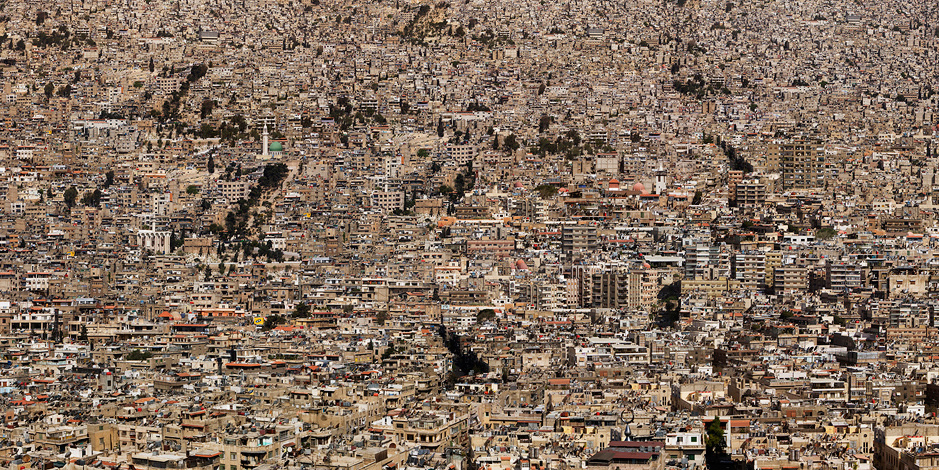
المدينة في تجويف إناء أسفل الجبال، وتترامى عبر السهل، وتزحف إلى أعالي المنحدرات، كتلةً كبيرة من المساكن، أبراجاً بيضاء ورمادية وبنية تعلو وتنخفض. واجهاتُ رخام وقبابٌ وأسطحة قرميد أحمر. حمام يحتشد في أسراب مرفرفاً ويحطّ على أعشاش السطوح.
أزقةٌ مغلقةُ المصاريع، متاهات، جدران عالية من ضوضاء السيارات. عالياً فوق هذه الجدران حلّقْ وانظرْ تحت.
سهامٌ من مصابيح ملونة تشير إلى محلات الشواء؛ شاشاتُ تلفزيون تومض عبر النوافذ المفتوحة، في المكتب، في الدكان، أو على الأرصفة حين يكون الطقس دافئاً؛ شاشات مليون هاتف جوّال (يملكها جميعاً الشخصُ نفسه)، تتحرك بمستوى الرؤوس، أو في الأحضان، أو على السرير؛ والصحون اللاقطة؛ ومقاهي الإنترنت.
محلات المثلجات، الحدائق العامة، العوائل الكريمة البدينة التي تفصص البذور. البنوك، الصرّافون، مكاتب الاستيراد والتصدير. سيارات الأجرة والسرافيس. رجال في زي موحد. رجال يدخنون السجائر.
عشاق، متزوجون، جمهرةٌ من راهبات متجهمات في محل أزهار يبيع باقاتٍ سريالية الحجم، محلٌ ضيق لتاجر بسطرمة، تاجر بُنّ في بنايةٍ لائقة، أضِفْ مطحنته وأضِفْ غبارَ القهوة، وصفٌّ من محلات الألبسة، كلها للفتيات، واجهاتها نيون كلّها أزرق ووردي وذهبي، أغنية آر أند بي أميركية Do Me You Do Me You Can Do Me ترجُّ الرصيف، نساء يضايقهن الأطفال محجباتٌ ويلبسن الأردية الطويلة يعبرن تحت مكبرات الصوت، أمام صاحب محل سيديهات ملمَّع الشعر مصفَّفه وراء زجاج مدخّن، ثم باعة محلات الأحذية بأباريق الشاي والابتسامات، تتوالى باباً لصق باب، جدران من صناديق الأحذية تعلو، وبين الجدران: متاهات.
ساحة مركز المدينة. الفنادقُ المواخير، الراقصات النَوَريّات. البدو يعطفون على كؤوس الشاي، لا يزال بعضهم يضفرون جدائلهم، أخاديد ثلّمتْ بها الريح وجناتِهم. جدران من الأقفاص في سوق الطيور، وبين الجدران: متاهات.
كذلك ألقِ بالاً إلى ما لم يكن أو ما لن يكون. حفرٌ لم تُردَمْ، هياكل ما بُنيت، مواسير شبه منسية، ثغرات. هدم غير محسوب، إنشاءات من دون مخطط، منازل عشوائية لم تصِرْ بيوتاً، ومنازل أخرى غائبة موجودة على الورق. ثقوب طلقات لم يجمعها الفرنسيون. نهرٌ أصبح ممشى من الإسمنت المسلح، نفقاً ومستنقعاً آسناً. بساتين مبتورة الجذوع، مخنوقة، مسوَّرة.
ألف مليون كيس نايلون.
صِبيةٌ موشومون، رجال بسواعد مشعرة، أقدام برتقالية تهتزّ بعضها إلى جوار بعض في صفوف المصلّين في مسجد عند الزاوية.
الفنادق الجديدة الفخمة في المدينة القديمة، الخانات والقصور، المطاعم: بعض من ألذّ العشاءات في الشرق الأوسط، في العالم.
الحشد. يلتئم ويتفرّق، يتجمهر ويتبعثر. على عجل.
شبان يبدؤون حيواتهم، يعانون، يحملون الكتب، يقعون في الحب، يشعرون بأنهم محبوسون، يزرّرون عيونهم ليروا طريقاً يجنون عبره بعض المال. شبان في منتصفات أعمارهم يتآكلهم الطموح والفشل، وأولئك المسحوقون بالعار يزرّرون عيونهم أيضاً ليروا طريقاً يجنون عبره بعض المال. العجائز يشتكون أو ييأسون أو يرضون أو يأملون، لا يزالون يزرّرون عيونهم ليروا طريقاً من أجل أبنائهم وأحفادهم يجنون عبره بعض المال. العجائز القانعون بشيخوختهم. العجائز المصلُّون.
في الزحام امرأة تعضُّ شفتها إلى أن تدمى لتمنع نفسها من الصراخ.
عبق الجنس. عبق الياسمين والمازوت والغبار.
فوحُ خَبزِ الخُبز. دوائر ساخنة من الخبز مكوَّمة خارج الأفران، أو ملمومة في أكياس نايلون شفافة لتبني جدراناً، وبين الجدران: متاهات.
فندق الشام والفصول الأربعة. دور السينما والمراكز الثقافية. الملاعب والمسابح. الأبراجُ السجون. المآذن وذروات الأبنية.
الحيّ الشيعي والحيّ المسيحي. المخيمات الفلسطينية. الناحية الدرزية. الأكراد المكدَّسون على السفح الذي يحمل اسمهم منذ عهد صلاح الدين الأيوبي.
الجيوب العلوية التي تتقدم صوب المدينة.
سائح، متغافل عن توترات الحاضر، يقصدُ التمشّي عبر حارة اليهود.
جبال نصلت في الشمس، أذْوَتها الرياحُ القارسة، قوّضتها رشقاتُ المطر، غصّتْ بتكرار الثلوج، وكلّستها مؤخراً أربعة عقود من الجمود.
الألوان على الجبل مرهونة بالغيم، بمواقيتِ النهار، بموضعِ الشمس. وردية، برتقالية، حمراء، بيضاء، سوداء. لون التلوث البني معلّقٌ ولا يُرى إلا من بعيد. ثم هواء يتخلخل في كل اتجاه، فوق الجبال والهضبة والسهل المقفر، هواء رقيق وجاف، مادّةُ الملائكة.
شيء ما مضطرب في الجو يشي بوصول اللحظة. لحظة ستبقى.
تحت السماء، فوق دمشق: الفرقة الرابعة متوارية نسبياً. المدفعية وراء المتاريس. مدافع ضخمة مثبتة في الجبل. القوات الإسرائيلية على قمة جبل الشيخ، بذروته المكتسيةِ ثلجاً في المدى المنظور. وأربعة ملايين سوري، تحت، في المدينة

Arab Jazz

arabjazzThis review was published at the Guardian.

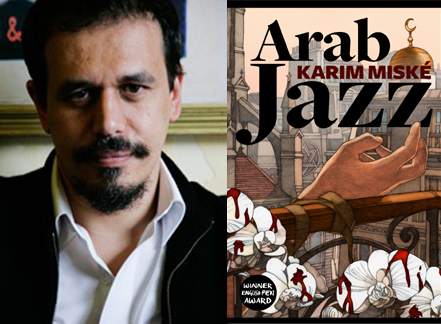
“Arab Jazz” – already the winner of the English PEN award – is a brilliant debut, both from Karim Miské and the very capable translator Sam Gordon.

The setting – “between the Lubavitch school complex, the Salafist prayer room and the evangelical church” in north east Paris, home turf of the Charlie Hebdo and kosher supermarket killers – couldn’t be more topical.

And Ahmed Taroudant, the novel’s main protagonist, is in some respects a typical French Arab – religiously non-observant, confused about his identity, haunted by the past, and now set up to take the blame for murder.

Immensely likeable despite his neuroses, Ahmed aims “to lose himself by devouring the whole world in a single, uninterrupted story written by others.” The metaphor fits fundamentalists perfectly, but in Ahmed’s case it’s more literal: he’s a crime fiction fanatic who tries to buffer himself from reality with a wall of books. He’s reading on his balcony when blood drips down from the corpse of his upstairs neighbour Laura, whose love he might have reciprocated had he been clear-headed enough to notice.

Ahmed, of course, wants to understand what’s happening. He’s the book’s third detective; the first two are Lieutenants Rachel Kupferstein and Jean Hamelot, an atheist Ashkenazi Jew from the neighbourhood and a Breton of Communist heritage; both, like Ahmad, are well versed in crime fiction, and both are “intellectual, cinephile types”. Karim Miské, the French-Mauritanian author, is a film-maker himself; his book is crammed with genre, literary and film references. One scene is set in ‘Chaim Potok high school’, for instance; the title alludes to James Ellroy’s novel “White Jazz”; and – as if the book were already a film – there’s a playlist of songs at the back.

The characters are strong and various, from the young, second-generation Muslim and Jewish north African immigrants – the girls generally better adjusted than the boys – through such predictable figures as a Turkish kebab-shop proprieter and a Portuguese concierge, to the more surprising – an Armenian anarchist, for instance, or a Hasidic Rastafarian who produces a messianically-sanctioned MDMA-variant called Godzwill.

There’s an implicit commentary here on the new phenomenon of gangster-Salafism: “craving the validation of others … they were frequently tempted to reverse the feeling of stigma, to brand themselves proudly with the very religion which brought them such relentless contempt.” But the implicit critique of religion itself – of “those who clog up their depths, their inner space, with the concrete of certainty” – extends to political and social certainties too. Everyone’s been damaged by their heritage; everyone’s vulnerable to inner darkness and the explanatory narcotic of grand narrative.

“Arab Jazz” is a genre novel in the same way that “Pulp Fiction” is a genre film – superceding the form even as it pays homage. It’s a trans-continental identity novel, dramatising the painful contradictions and fertile syntheses of contemporary multicultural life, focussing on racial discrimination in Morocco as well as Paris. And it’s certainly a well-achieved literary novel, detailed with colours, tastes and flavours, sustaining a light and energetic comic tone even when the material is unrelentingly grim.

The settings are particularly rich, as Miské journeys confidently from his prime location as far as Crown Heights, Brooklyn, or to New York’s Watchtower, global HQ of the Jehovah’s Witnesses, and back and forth in time.

The dialogue can be somewhat clumsy, occasionally rendering the plot machinery too visible and the characters too obviously functional. In general there’s a little too much telling rather than showing – in the improbably self-revealing monologues of the police’s interviewees, for example, or the perfectly overheard street sermonising. Perhaps, as a detective story, the novel suffers a glut of too-easily-flowing information. This may irritate some genre readers, but it should be forgiven. “Arab Jazz” should be read charitably as a pushing beyond realism rather than a failure to achieve it. There’s something theatrical in Miské’s world; it’s as if the detective-readers witness performances, or discover texts, instead of teasing out meaning from an inscrutable and intransigent reality. Miské is a writer enjoying himself, playing on his scales, improvising sometimes, his subplots and walk-on acts fed deftly into the whole. The monologues are instrumental solos; the rhythms are propulsive. Like jazz, it’s complicated, but sounds beautifully simple.

This review was published at the Guardian.

The Road to Iraq

The Road to Iraq book coverA slightly shorter version of my review of Pulse editor Idrees Ahmad’s devastating dissection of the neoconservatives and their deeds appeared at the National.

Meticulously researched and fluently written, Muhammad Idrees Ahmad’s “The Road to Iraq: The Making of a Neoconservative War” is the comprehensive guide to the neoconservatives and their works. The book’s larger story is of the enormous influence wielded by unelected lobbyists and officials over the foreign policies of supposed democracies, their task facilitated by the privatisation and outsourcing of more and more governmental functions in the neoliberal era. (Similar questions are provoked by the state-controlled or corporate media in general, as it frames, highlights or ignores information.) The more specific story is of how a small network of like-minded colleagues (Ahmad provides a list of 24 key figures), working against other unelected officials in the State Department, military and intelligence services, first conceived and then enabled America’s 2003 invasion and occupation of Iraq, a disaster which continues to overshadow regional and global relations today.

The first crop of neoconservatives emerged from a Trotskyist-tinged 1930s New York Jewish intellectual scene; they and their descendants operated across the political-cultural spectrum, in media and academia, think tanks and pressure groups. Hovering first around the Democratic Party, then around the Republicans, they moved steadily rightwards, and sought to form a shadow defence establishment. During the Cold War they were fiercely anti-Soviet. Under George Bush Jr. they shifted from the lobbies into office.

The neoconservative worldview is characterised by militarism, unilateralism, and a firm commitment to Zionism. Even the Israel-friendly British Foreign Secretary Jack Straw said of neocon Irving Libby: “It’s a toss-up whether Libby is working for the Israelis or the Americans on any given day.” The neoconservatives aimed for an Israelisation of American policy, conflating Israeli and American enemies, and adopting their doctrine of ‘pre-emptive war’ from Israel’s 1967 war on the Arabs. Continue reading “The Road to Iraq”

Shock and Awe versus Dentists, Farmers and Students

binladensWhatever the hearts-and-minds rhetoric at the United Nations, in Syria the Obama administration is feeding the flames of Sunni extremism, and proving once again the truism that the American state is an enemy of the Syrian people (as it’s an enemy, like all states, of all peoples, including the American).

We expected strikes on ISIS. Some of the strongest strikes (and the strikes are far stronger than in Iraq), however, have been aimed at Jabhat al-Nusra (the Victory Front), the organisation from which ISIS split. Nusra is certainly an extremist Salafist group, and is openly linked to al-Qa’ida. Because its ideology terrifies not only minorities but also huge swathes of the Sunni population, it’s also a strategic obstruction in the way of the Syrian revolution. In August 2013 it participated (with ISIS) in the only documented large-scale massacre of Alawi civilians in the conflict. On the other hand, Nusra (unlike ISIS) was until yesterday actually fighting the regime, not other rebel groups. From January, along with every rebel formation, it’s been fighting ISIS too. And its leadership is entirely Syrian. Many Syrians, not necessarily extremist Salafists themselves, admire Nusra’s victories against their most immediate enemy – the Assadist forces dropping barrel bombs and raping and torturing at checkpoints. A sensible answer to Nusra would be to provide weapons and funds to Free Army forces who would then be in a position to gradually draw men from the organisation, slowly making it irrelevant (most men don’t care about the ideology of their militia’s leadership; they care about food and ammunition). But the Americans are allergic to working with the people on the ground most immediately concerned by the outcome, and bomb from the air instead. Nusra is now abandoning front line positions (in some areas the regime may be able to take immediate advantage). One Nusra leader has already spoken of an alliance with ISIS against the Americans.

Syria’s new daily routine: the Americans and Gulf Arabs bomb the Salafist extremists while Assad bombs the Free Army and Islamic Front (and of course civilians – as usual it isn’t being reported, especially not now the televisual US war is on, but about a hundred are being killed every day). The headline in regime newspaper al-Watan reads “America and its Allies in One Trench with the Syrian Army against Terrorism”. The opposition reads it this way too. Several demonstrations yesterday condemned the American strikes, called for America’s fall, and for solidarity with ISIS and Nusra. A sign at one protest read: “Yes, It’s an International Coalition Against Sunnis.”

Continue reading “Shock and Awe versus Dentists, Farmers and Students”

Three Monsters

threemonstersPart of me, of course, is happy to see bombs fall on the heads of the international jihad-fascists tormenting the Syrian people (I refer to ISIS, not the Shia jihad-fascists fighting for Assad, who I’d love to see bombed too). Mostly, I’m just disgusted. In the name of disengagement the West not only refused to arm and supply the democratic Syrian opposition – even as Assad launched a genocide against the people – the United States actually prevented other states from providing the heavy weapons and anti-aircraft weaponry the Free Army so desperately needed. It was obvious what would happen next. The Free Army – and the Syrian people – were increasingly squeezed between Assad and the ISIS monster. And now the Americans are bombing both Iraq and Syria. This is where ‘disengagement’  and ‘realism’ has brought us.

ISIS, like Assad, can be hurt from the air but defeated only on the ground. Obama and the Congress have just agreed to spend $500 million on training 5000 vetted members of the Free Syrian Army – the same people that Obama mocked as irrelevant “pharmacists, farmers and students” a few months ago. The training won’t be finished for eight months, and anyway will be of little use. The Free Army now houses some of the best, most battle-hardened fighters in the world. They don’t need training; they need weapons. In the present balance of forces, in any case, the wounds inflicted by America’s photogenic bombing run may not translate into any improvement on the ground. Only Syrians can improve things on the ground.

The West was not moved to act by 200,000 (at least) slaughtered, or nine million homeless, or by barrel bombs, rape campaigns, starvation sieges or sarin gas. It was only moved when an American was beheaded. The inconsistency is noted well by Syrians. In some quarters, an assault on ISIS which is not accompanied by strikes on Assad and aid to the Free Army will be perceived as a Western-Shia-Assadist alliance against persecuted Sunnis. This could increase the appeal of ISIS and successor Sunni extremist groups.

ISIS has many parents, but the first of these, in Syria at least, is Assad. He released extremists from prison while he was assassinating unarmed democrats. He sectarianised the conflict by setting up sectarian death squads and by bringing in Iran-backed Shia militias from Iraq and Lebanon. His scorched earth policy made normal life impossible in the liberated areas, creating the vacuum in which organisations like ISIS thrived. And until this June, he had an effective non-aggression pact with ISIS, not fighting it, buying oil from it. From January, on the other hand, all opposition militias – the Free Army groups and the Islamic Front groups – have been fighting ISIS (and losing thousands of men in the struggle). These fighters are not about to become an on-the-ground anti-ISIS militia, as the Americans seem to want. They know the truth – that both states, the Assadist and the psychotic-Islamist, are absolute enemies. There’s no destroying one without the other. And both must be destroyed by Syrian hands, not by foreign planes.

Continue reading “Three Monsters”

Fathers of ISIS

There’s no need to stoop to conspiracy theories to understand the ISIS phenomenon. In this brilliant summary, first published here, Ziad Majed explains the organisation’s origins.

The organization abbreviated as ISIS (Islamic State in Iraq and Syria) is not new in the region, nor is it a newfound expression of the crises afflicting Arab societies at a moment of profound transformations, initiated by 2011 revolutions.

To the contrary, ISIS is the offspring of more than one father, and the product of more than one longstanding and widespread sickness. The organization’s explosive growth today is in fact the result of previously existing, worsening conflicts that were caused by the different fathers.

ISIS is first the child of despotism in the most heinous form that has plagued the region.


Therefore, it is no coincidence that we see its base, its source of strength concentrated in Iraq and Syria, where Saddam Hussein and Hafez and Bashar Al-Assad reigned for decades, killing hundreds of thousands of people, destroying political life, and deepening sectarianism by transforming it into a mechanism of exclusion and polarization, to the point that injustices and crimes against humanity became commonplace.

ISIS is second the progeny of the American invasion of Iraq in 2003, both the way in which it was initially conducted and the catastrophic mismanagement that followed. Specifically, it was the exclusion of a wide swath of Iraqis from post invasion political processes and the formation of a new authority that discriminated against them and held them collectively at fault for the guilt of Saddam and his party, which together enabled groups (such as those first established by Abu Musab al-Zarqawi) whose activities have been resumed by ISIS to get in touch with some parts of Iraqi society and to establish itself among them.

ISIS is third the son of Iranian aggressive regional policies that have worsened in recent years — taking Iraq, Lebanon, and Syria as its backyard, feeding (directly or indirectly) confessional divisions and making these divides the backbone of ideological mobilization and a policy of revenge and retaliation that has constructed a destructive feedback loop.

ISIS is fourth the child of some of the Salafist networks in the Gulf (in Saudi Arabia and other states), which emerged and developed throughout the 1980s, following the oil boom and the “Afghan jihad”. These networks have continued to operate and expand throughout the last two decades under various names, all in the interest of extremism and obscurantism.

ISIS is fifth the offspring of a profound crisis, deeply rooted in the thinking of some Islamist groups seeking to escape from their terrible failure to confront the challenges of the present toward a delusional model ostensibly taken from the seventh century, believing that they have found within its imaginary folds the answer to all contemporary or future questions.

ISIS is sixth the progeny of violence, or of an environment that has been subjected to striking brutality, which has allowed the growth of this disease and facilitated the emergence of what could be called “ISISism”. Like Iraq previously, Syria today has been abandoned beneath explosive barrels to become a laboratory, a testing ground for violence, daily massacres and their outcomes.

ISIS, an abominable, savage creature, is thus the product of at least these six fathers. Its persistency depends on the continuation of these aforementioned elements, particularly the element of violence embodied by the Assad regime in Syria. Those who think that they should be impartial toward or even support tyrants like Assad in the fight against ISISism fail to realize that his regime is in fact at the root of the problem.

Until this fact is recognized — that despotism is the disease and not the cure — we can only expect more deadly repercussions, from the Middle East to the distant corners of the globe…

Continue reading “Fathers of ISIS”

Updates

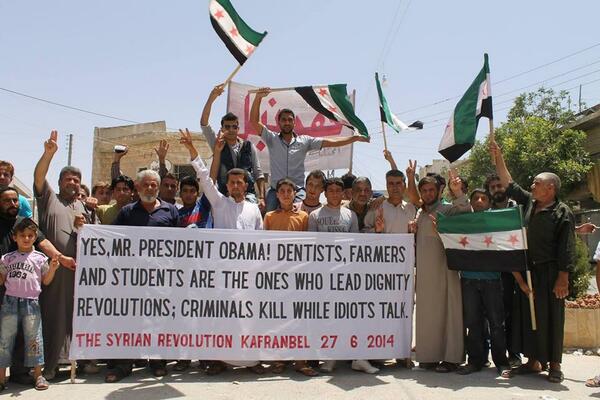
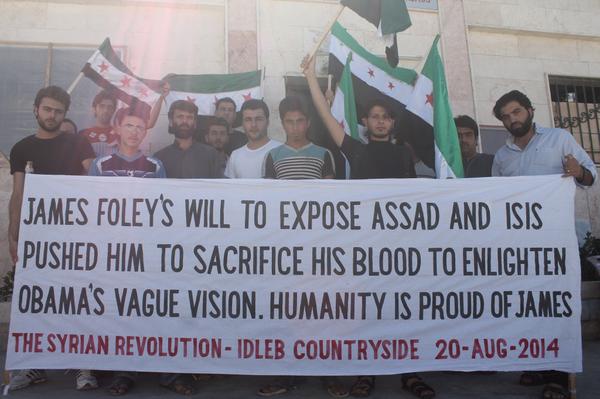
Liberated Kafranbel, abandoned to Assad's bombs, pays tribute to James Foley
Liberated Kafranbel, abandoned to Assad’s bombs, pays tribute to James Foley

Everything’s burning from Libya to Iran. I’m working on fiction, so not responding except in Facebook bursts. Here are a few status updates, starting with today’s:

A year ago Assad’s fascist regime sprayed sarin gas over the Damascus suburbs, killing over 1400 men, women and children in five hours. Hundreds more died from the effects in the following weeks. Obama had given Assad effective permission to use tanks, artillery, missiles and war planes against the Syrian people (and had ensured that the people remained unarmed), but made large-scale chemical attacks a ‘red line’. We soon saw that the red line meant nothing. An alliance of the British Labour Party, Tory back benchers, UKIP, the BNP, the US Congress and the Tea Party helped Obama step away, and to hand the Syria file to Putin’s Russia – the same power arming the criminal. So the genocide continued, and continues, to the mood-music accompaniment (in the liberal-left press) of absurd conspiracy theories, racist slanders, and willed deafness to the voices of those suffering.

(On absurd conspiracy theories, read this. And here is one of the best accounts of the Syrian revolution and counter-revolutions I’ve read.) It would be great if the US were really ‘withdrawing’ from the region, as some claim Obama is doing, leaving the people there to solve their problems independently. But Washington is not withdrawing – it continues to back the murderous coup junta in Egypt, and the Israelis as they pummel the refugees in the Gaza ghetto yet again for no more than psycho-symbolic reasons. Washington actively prevented states which wanted to aid the Syrian resistance from providing serious weapons. The result is the Islamic State (or ISIS) phenomenon – also provoked by Malki’s Iran-backed sectarianism in Iraq, and the US occupation and sanctions beforehand, and Saddam Hussain before that – and now American bombing runs in northern Iraq. Obama’s ‘withdrawal’ is as illusory as the Stop the War Coalition’s Putinesque ‘pacifism’.

This was from yesterday:

Continue reading “Updates”