The Net Delusion

In this brilliant lecture Evgeny Morozov asks if free information means free people? The event was recorded on 19 January 2011 in LSE’s Sheikh Zayed Theatre. It was moderated by Alison Powell.

Available as: mp3 (38 MB; approx 82 minutes)

At the start of the twenty-first century we were promised that the internet would liberate the world. We could come together as never before, and from Iran’s ‘twitter revolution’ to Facebook ‘activism’, technological innovation would spread democracy to oppressed peoples everywhere. We couldn’t have been more wrong. Morozov destroys this myth, arguing that ‘internet freedom’ is an illusion, and that technology has failed to help protect people’s rights. Not only that – in many cases the internet is actually helping authoritarian regimes. From China to Russia to Iran, oppressive governments are using cyberspace to stifle dissent: planting clandestine propaganda, employing sophisticated digital censorship and using online surveillance. We are all being manipulated in more subtle ways too – becoming pacified by the net, instead of truly engaging. This event marks the publication of Evgeny Morozov’s new book The Net Delusion: How Not to Liberate The World.

Continue reading “The Net Delusion”

Wikileaks as a modern challenge

by Farid Farid

One of Australia’s most acclaimed authors, Tim Winton, has re-released Land’s Edge: A Coastal Memoir. Through a series of autobiographical reflections, Winton describes how Australia is a littoral society always on “the edge of things” – floods, bushfires, riots etc… Winton talks about the sensuality of water being central to the Australian imaginary. Through his prose about surfing and sharks, readers can also envision human cargo packed on a floating boat teetering between life and death.
It is perhaps then fitting that this was underscored a couple of days ago by the enthusiastic reception by foreign minister Kevin Rudd and defence minister Stephen Smith of their British counterparts William Hague and Liam Fox at the HMAS Watson on a naval base in Sydney harbour. In an ironic scene on the water, the Australian government’s foreign image untarnished by floods or asylum seekers was tactfully kept and strategic interests were shared between “cousins on opposite sides of the world” according to Hague and Fox.

Hague & Fox in their joint opinion piece for the Sydney Morning Herald opt for a turgid title that spells out their foreign policy objectives — ‘Stronger alliance required to meet modern challenges’. They probably had Wikileaks in mind as one of these trans-national challenges with both countries agreeing to tighten intelligence cooperation against cyber crimes.

Continue reading “Wikileaks as a modern challenge”

WikiLeaks: Why it Matters. Why it Doesn’t?

A panel of leading thinkers explore WikiLeaks and its implications for access to information, security, first amendment rights, innovation, and more. Moderated by The Real News founder Paul Jay and presented by the Churchill Club, the panel speakers are Daniel Ellsberg, Clay Shirky, Neville Roy Singham, Peter Thiel and Jonathan Zittrain.

Facebook in Gaza

by Karma Nabulsi

Last weekend the Observer carried a dramatic account of ‘The Gaza Youth Manifesto’, written in English by a handful of young people in Gaza and posted on Facebook. Given the thousands of people in the West who have said they ‘like’ it on Facebook or posted positive comments, the manifesto is said to herald a new movement for change in occupied Palestine.

Because of Palestinians’ lengthy predicament of expulsion, dispossession and military occupation, there is a rich tradition of Palestinian manifestos and declarations: hundreds of them have been written since 1948. ‘Bayan Harakatina’ (‘Our Movement’s Statement’, 1959) played an important role in recruiting the first wave of young people to the Palestinian National Liberation Movement-Fateh, and in unifying their political consciousness. It was distributed clandestinely, ‘entrusting’ its readers with the key ideas of the new movement. Later documents, such as the founding manifesto of the Popular Front for the Liberation of Palestine (1967), were distributed more openly. These manifestos were written by organised Palestinian youth as mobilising documents, exclusively for young Palestinians.

Manifestos have been written by everyone: ‘Workers of Palestine Unite’ was issued by the General Provisional Committee of the Workers of Palestine in 1962; the Unified National Command of the Intifada released 46 communiqués between 1988 and 1990; ‘The Palestinian Civil Society Call for Boycott, Divestment and Sanctions against Israel’ was published on 9 July 2005; ‘The Palestine Manifesto’ was published last year by the National Committee for the Defence of the Inalienable Rights of the Palestinian People; dozens of statements have been issued by right of return committees in the refugee camps since 1998; Palestinian political prisoners in Israeli jails, from all parties, released the now famous ‘National Reconciliation Document’ in 2006.

Continue reading “Facebook in Gaza”

Former Prisoner Omar Deghayes on 9th Anniversary of Guantánamo

First posted by Andy Worthington

I’m delighted to reproduce below a statement by my friend, the former Guantánamo prisoner Omar Deghayes, which was read out at a rally (at which I spoke) outside the White House on January 11, 2011, the 9th anniversary of the opening of the prison. Omar, whose testimony is at the heart of the documentary film, “Outside the Law: Stories from Guantánamo,” which I co-directed with Polly Nash, was held in US custody from May 2002 until December 2007, and spent most of that time at Guantánamo, after being held first in Pakistan and in Bagram, Afghanistan.

His comments provided a powerful conclusion to the rally, and a reminder not only of how justice still eludes the 173 men still held, but also of how the American people are prevented from hearing about the injustices of Guantánamo first hand, as Omar, and every other cleared prisoner, is prevented from visiting the US to meet people and to tell their stories, and the Obama administration, Congress and the D.C. Circuit Court have all made sure that no cleared prisoner will be allowed to live in the US, even if they face torture in their home countries, and no other country can be found that is prepared to offer them a new home.

A statement from Omar Deghayes, January 11, 2011

Two years ago, President Barack Obama pledged to bring an end to the anomaly that is Guantánamo within a year, and to thereby restore America’s moral standing in the world. Yet today, on January 11, 2011, we are marking the beginning of the tenth year since the first prisoners were transferred to Camp X Ray — and Guantánamo remains open, Obama’s promise in ruins.

Continue reading “Former Prisoner Omar Deghayes on 9th Anniversary of Guantánamo”

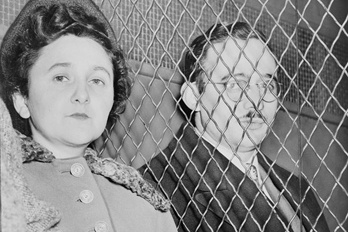
Robert Meeropol, son of the executed Rosenbergs, on WikiLeaks

by Dennis Bernstein

U.S. citizens Julius and Ethel Rosenberg were executed under the 1917 Espionage Act in 1953.

The U.S. Justice Department is now considering charging WikiLeaks’ founder Julian Assange with espionage under the 1917 Espionage Act. In a recent interview, syndicated on PacificaRadio’s Flashpoints show, I spoke to  Robert Meeropol, founder of the Rosenberg Fund For Children. Meeropol is the son of Julius and Ethel Rosenberg, the only U.S. citizens to be executed under the 1917 Espionage Act. In a strong defense of Wikileaks, Assange and Bradley Manning, Meeropol released a statement stating:

My parents were executed under the unconstitutional Espionage Act, here’s why we must fight to protect Julian Assange.

In the following interview he talks about the history of the 1917 espionage Act, the execution of his parents and some of the political “Echoes” from the 1950’s red scare days that are reverberating today. Meeropol also talks movingly about how his parents’ unwillingness to cave  in the face of government intimidation, even at the cost of their lives.

I think that resistance is inspirational.  When people resist, they inspire others and if you combined the resistance with the inspiration you end up building a movement of support.

DB: Let’s begin this way, Robert Meeropol.  The U.S. Congress is back in session, the Republicans are in charge of the House, and today they read the Constitution. Would that be relevant in your defense of Julian Assange?

Continue reading “Robert Meeropol, son of the executed Rosenbergs, on WikiLeaks”

Popular Committee Leader: “My Next Letter Will Likely Be Written From Inside A Prison Cell”

Mohammad Khatib, Jawaher Abu Rahmah, Abdallah Abu Rahmah, Jonathan Pollak

New Year’s greetings from Mohammad Khatib, one of the remaining Bil’in popular committee leaders:

At the threshold of the New Year, I write to wish you a new year of freedom and liberation. This has been an unbelievable year for me in both highs and lows. A year during which I have witnessed how, despite repression, ordinary people all across Palestine take to the streets for freedom.

Continue reading “Popular Committee Leader: “My Next Letter Will Likely Be Written From Inside A Prison Cell””

New Year’s Day in Bil’in: Israel kills female protester

Press release from the Popular Struggle Coordination Committee.

Jawaher Abu Rahmah, 36, was evacuated to the Ramallah hospital yesterday after inhaling massive amounts of tear-gas during the weekly protest in Bil’in, and died of poisoning this morning. Abu Rahmah was the sister of Bassem Abu Rahmah who was also killed during a peaceful protest  in Bil’in on April 17th, 2010.

Doctors at the Ramallah hospital fought for Jawaher Abu Rahmah’s life all night at the Ramallah Hospital, but were unable to save her life. Abu Rahmah suffered from severe asphyxiation caused by tear-gas inhalation yesterday in Bil’in, and was evacuated to the Ramallah hospital unconscious. She was diagnosed as suffering from poisoning caused by the active ingredient in the tear-gas, and did not respond to treatment.

Jawaher Abu Rahmah was the sister of Bil’in activist, Bassem Abu Rahmah, who was shot dead with a high velocity tear-gas projectile during a demonstration in the village on April 17th, 2009. See here for a video of his shooting.

Continue reading “New Year’s Day in Bil’in: Israel kills female protester”

The Persecution of Bradley Manning

From Dylan Rattigan’s excellent show on MSNBC, an interview with one of Bradley Manning’s friends who describes the conditions under which he is being held.

By comparison, following is Al Jazeera’s Patty Culhane, a second rate journalist who generally recycles the consensus view of the Washington punditocracy with little in the way of scepticism or original thought. You can tell from the report below that she even manages to render critical reports in the language of the beltway hack.

Stephen Harper’s Sermon on the Hill

Editor’s Note: This essay was written in response to Canadian Prime Minister Stephen Harper’s speech at the Ottawa Conference on Combating Antisemitism on November 8th.

by Terry Greenberg

                                    Blessed art the war mongers
                                                            For they are hastening the Second Coming;
                                                Blessed art the ethnic-cleansers
                                                            For they are fulfilling the prophecy;
                                                Blessed art the soldiers of Zion
                                                            For they are doing God’s Work;
                                                Blessed art the enemies of free speech
                                                            For they are silencing the Devil.

On Parliament Hill in Ottawa on November 8, 2010 the Prime Minister of Canada delivered a sermon on good and evil to an international gathering of supporters of Israel in which he clearly articulated his view that all support for Israel is “good” and all animosity toward Israel is “evil”. In true Bible-thumper style he offered no middle ground, denouncing this as “moral ambivalence”. It was clear in his preaching that he believed Israel was God’s Plan, and any opposition to Israel was the Devil’s work.

It should be terrifying to Canadians that their Prime Minister would have such a fundamentalist and extremist world view. If we want to understand our current government’s foreign policy and the danger it poses to Canada’s welfare, it would be worthwhile to examine our Prime Minister’s “Sermon on the Hill”. All Canadians should read it for themselves and shudder. 

Harper’s speech was remarkable in a number of ways which are outlined below:

Continue reading “Stephen Harper’s Sermon on the Hill”