From Beirut to Kabul: War, Occupation, Resistance

One of the world’s best frontline reporters, Nir Rosen recently returned from a six week trip to seven of Iraq’s provinces. He discussed post civil war Iraq and also his experiences reporting on Sunni-Shiite strife in Lebanon and on the situation in Afghanistan at The University of Texas at Austin on November 17, 2010.


What Laila Sees

by David Smith-Ferri

Kabul, Afghanistan – “We live in constant fear of suicide attacks,” said Laila, an Afghan woman who lives in Kandahar city and who visited with us yesterday. “When will the next one strike and where?”

“Twelve days ago,” she continued, “a good friend was walking home from the mosque. A four-minute walk. An IED was detonated, and my friend lost half his face. Another man lost his leg, and his son lost his leg, too. We live with that kind of uncertainty, when you don’t know what is going to happen from one moment to the next.”

Laila’s descriptions of living with fear and violence in Kandahar contradict the mild U.S. descriptions of the “security situation” there. “The Taliban do not control the city,” said Army General Stanley McChrystal, in a May 13, 2010 briefing concerning a “much-anticipated” military operation in Kandahar. “You can walk around the streets of Kandahar, and there is business going on. It is a functioning city.”

Compare McChrystal’s blithe comments with Laila’s experience. “In Kandahar city, you don’t know what’s going to happen, minute to minute. Every single minute that we live – if you can call it living – every single second there is the thought that this is going to be my last second.”

Laila went on to illustrate this graphically. “A good friend of mine had a ticket to travel to Canada to visit her mom for a family wedding. She dressed in a burqa, and went to say goodbye to some colleagues. When she returned home, traveling by rickshaw, she saw a neighbor outside. So she stood for two minutes to talk to her. In those two minutes, two men on a motorcycle drove up. One man shot her in the head and killed her, and the other man drove them away.”

Continue reading “What Laila Sees”

Tariq Ali assesses Obama’s record

Our dear and respected friend Tariq Ali on the Riz Khan Show.

Planting the Seeds

by Kathy Kelly

Nur Agha Akbari and his family live in Kabul, on an unpaved, pitted street lined by mud brick homes. When we visited him this week, his oldest son, age 13, led us to a sitting room inside their rented two-story apartment, furnished with simple mats and pillows. The youngster smiled shyly as he served us tea. Then his father entered the room.

Mr. Akbari is a robust, energetic, well educated man from a respected, academic Afghan family. In the late 1970s, Nur had gone to study agriculture in the UK and remained there, becoming an organic farmer. His four brothers had instead remained in Afghanistan, or else returned there after studies abroad. His two eldest brothers had trained in the Soviet Union – one as an engineer, one as a nuclear scientist – and had received early warning of the likelihood of what came to be the 1979 Soviet invasion. They spoke out publicly about their fears as the invasion grew more and more imminent.

On December 27 of that year, Soviet troops occupied major government, media and military buildings in Kabul, initiating a nine-year war between a nationalist/fundamentalist resistance (the “Mujahideen”) and the Soviet occupiers. Soviet officials fired Nur’s oldest brother from his cancer research work at Kabul University and blacklisted him. He found himself unable to work, and soon joined the resistance. Nur doesn’t know much about what happened to him then, but he was among thousands of people bulldozed into mass graves after capture and execution by the Soviets. All told Nur knows very little about the fates of his three older brothers, all killed in the war. But their tragedy would largely shape his life.

Continue reading “Planting the Seeds”

“Is This Normal?”

by David Smith-Ferri

Editor’s Note: American peace activists Kathy Kelly, Jerica Arents and David Smith-Ferri are part of a 3 person delegation currently travelling in Afghanistan. Find more entries from their travelogues on PULSE.

In a small storage shed at the edge of town, we watched as fourteen-year-old Sayed Qarim signed a simple contract agreeing to borrow and repay a no-interest, 25,000 afghani loan (roughly $555). Daniel from the Zenda Company, the loan originator, counted out the crisp bills and handed them to Qarim, who smiled broadly and shook hands. Qarim, whose family farms potatoes and wheat, plans to use the funds to purchase a cow and her calf. “There are great benefits of owning a cow,” Qarim explains. “Our family gets to use the milk, and we can sell the calf for a good profit.”

No one walking by outside on the narrow dirt road would have known an important business transaction had just occurred, one that could in fact help a young man and his family gain economic traction and greater security. The transaction didn’t take place in a bank. No village leaders were present. Only a fourteen-year-old boy, the representative of a private business company, and a witness. And while the signed agreement constitutes a business relationship, the Zenda Company sees it as primarily personal.

Qarim was recommended for a loan by Faiz and Mohammad Jan, two other young men who live in his village and who have themselves recently received and repaid loans. Following this recommendation, Zenda spent much time getting to know Qarim, meeting with him, assessing his knowledge, his resources (such as access to grazing land), and his character, answering his questions, and describing to him his responsibilities as a borrower.

Now that the transaction is complete, Qarim is required to send a picture of the cow and her calf as “proof” that the money was used as agreed. In addition, Hakim, another Zenda Company representative living in Bamiyan, who is fluent in Dari, the local language, will visit Qarim periodically. Along with Faiz and Mohammad Jan, he will try to provide whatever support Qarim needs to succeed.

Continue reading ““Is This Normal?””

The Women’s Harvest

by Jerica Arents

Editor’s Note: American peace activists Kathy Kelly, Jerica Arents and David Smith-Ferri are part of a 3 person delegation currently travelling in Afghanistan. Find more entries from their travelogues on PULSE.

Autumn in Bamiyan

Kabul, Afghanistan – After a week visiting Bamiyan, a rural Afghan Province, one thing has been made abundantly clear to me: the experience of being a woman in this country is much different than being a woman in the United States. Here, the inescapable and indelible fact of gender colors social interactions, far more so than back home. But being a woman has also created safe spaces of inclusion within the village’s maternal system, from which I would have otherwise been kept at a distance.

Time and time again, after meeting with the men in the family, I was led into a separate room to visit with the women, who had gathered there and were waiting eagerly for us with their children. Immediately, an exchange began, a series of greetings, smiles, thanksgivings, and comments about the style of my clothes, quality of my hands, or strangeness of my backpack. Daughters and granddaughters would join us, children at their feet, each little face more beautiful than the last.

When we met with women and men together, the men tended to be the focal point, dominating the conversation. In the absence of their male counterparts, the women, adorned in vibrant cloths, filled the sparsely furnished rooms with stories and laughter. In this conservative Afghan village, one woman shared with us the heartbreaking experience of having her husband kidnapped and killed by the Taliban – and raising her kids, now teenagers, without the breadwinner of the house. She looked down at her wrinkled hands and paused before telling us of her struggles with depression. “We age so quickly here” she reflected, looking up at me, circles under her eyes. Her skin was weathered and worn, bearing the years of harsh living conditions and inadequate nutrition. I would have guessed she was in her late 50s – she is in fact only 38.

Continue reading “The Women’s Harvest”

“Tell them to come to Afghanistan and make friends”

by David Smith-Ferri

Editor’s Note: American peace activists Kathy Kelly, Jerica Arents and David Smith-Ferri are part of a 3 person delegation currently travelling in Afghanistan. Find more entries from their travelogues on PULSE.

Again and again in this isolated Afghan province, when visiting Afghan people in their homes or when talking with members of the Afghan Youth Peace Volunteers (AYPV), we have heard this message: “We want to know the people of the world, and we want the world to know that we are human beings, not animals.”

On our first night in Bamiyan, we joined the AYPV at a restaurant on the main street in town. The restaurant, unlike those I am accustomed to visiting, served groups of customers in separate, rooms. So we walked down an alley, around the back of the restaurant, up a steep flight of metal stairs to a narrow landing which opened onto several small, windowless rooms. Inside one of them we arranged ourselves as comfortably as possible on the floor and along the walls, eleven Afghan youth and three Americans.

At the outset of the conversation, fourteen-year-old Ali asked us, “How do Americans know we are bad?” The question burst out of him, without preamble, as though he’d been carrying it for years, waiting for this opportunity. He followed it with a statement: “We want Americans to know we are not animals.” Later, while he held my arm and walked me home in the dark, I asked Ali about this belief regarding American perceptions of Afghan people. “Why else would they bomb us?” he said. There wasn’t anything more to say.

Today, two days later, we again gathered for a shared meal, this time in twenty-year-old Moh’d (short for Mohammad) Jan’s home, in a village outside Bamiyan. We piled into a van, and drove out over rocky, pitted, unpaved mountain roads, following the fickle course of a narrow river. High, red-rock cliffs loomed above us, and wherever there was flat land, it was cultivated. “Would you like to leave the car here and walk to my home along the river?” Moh’d Jan asked. We readily agreed.

Stenciled on nearby rocks in the Dari language were words warning people that the hills above are laced with landmines. We left the road and followed a creek lined with willow and cottonwood trees, along the edge of cultivated plots – apple orchards, potato fields being harvested, swaths of thickly-sown, bright green pea plants – the autumn sun pouring into the valley with sweet abundance, as though time had stopped and it would always be like this.

Continue reading ““Tell them to come to Afghanistan and make friends””

Creating a new Courage

by Jerica Arents

Editor’s Note: American peace activists Kathy Kelly, Jerica Arents and David Smith-Ferri are part of a 3 person delegation currently travelling in Afghanistan. Find more entries from their travelogues on PULSE.

Kabul, Afghanistan – After an exhausting day trekking through the dirt roads of the city of Bamiyan and outlying settlements, three Americans were guided by a dozen Afghan boys to a tent packed with overstuffed pillows and comforters. After the boys served them a delicious meal cooked over a small outdoor stove, they affixed their flashlights to the spine of the tent and invited the Americans to enter. Unlike the forts I made in my parents’ living room when I was little, this tent had a pressing message: a group of youngsters in a central province of Afghanistan want peace, not war.

The Afghan Youth Peace Volunteers, a group of ethnically diverse young men from a city one hundred miles northwest of Kabul, have been actively speaking out against the U.S- and NATO occupation for the last four years. The boys have endured grave opposition and community ridicule. However, through the help of networking sites and YouTube, this group of young men want to ask the world, “Why not love?”

“Our life is a life of the poor”, reflected the mother of one of the boys as we sat in her simple village home. With Afghanistan now being the worst country a child can be born into, alongside the challenges of building life in a country that has been fraught with thirty years of war, the very existence of this group of gentle spirits is miraculous. Many of these boys have lost one or both of their parents to infectious disease or conflict. Their city of 60,000 has no running water, little internet access, and a few hours of generated electricity a night. A barrage of cars, bicycles, donkeys, motorcycles and vans share the single-lane paved road that bisects the city – and over and over again we experienced the striking hospitality of this tense land.

Continue reading “Creating a new Courage”

“War does this to your mind”

by Kathy Kelly

Editor’s Note: American peace activists Kathy Kelly, Jerica Arents and David Smith-Ferri are part of a 3 person delegation currently travelling in Afghanistan. Find more entries from their travelogues on PULSE.

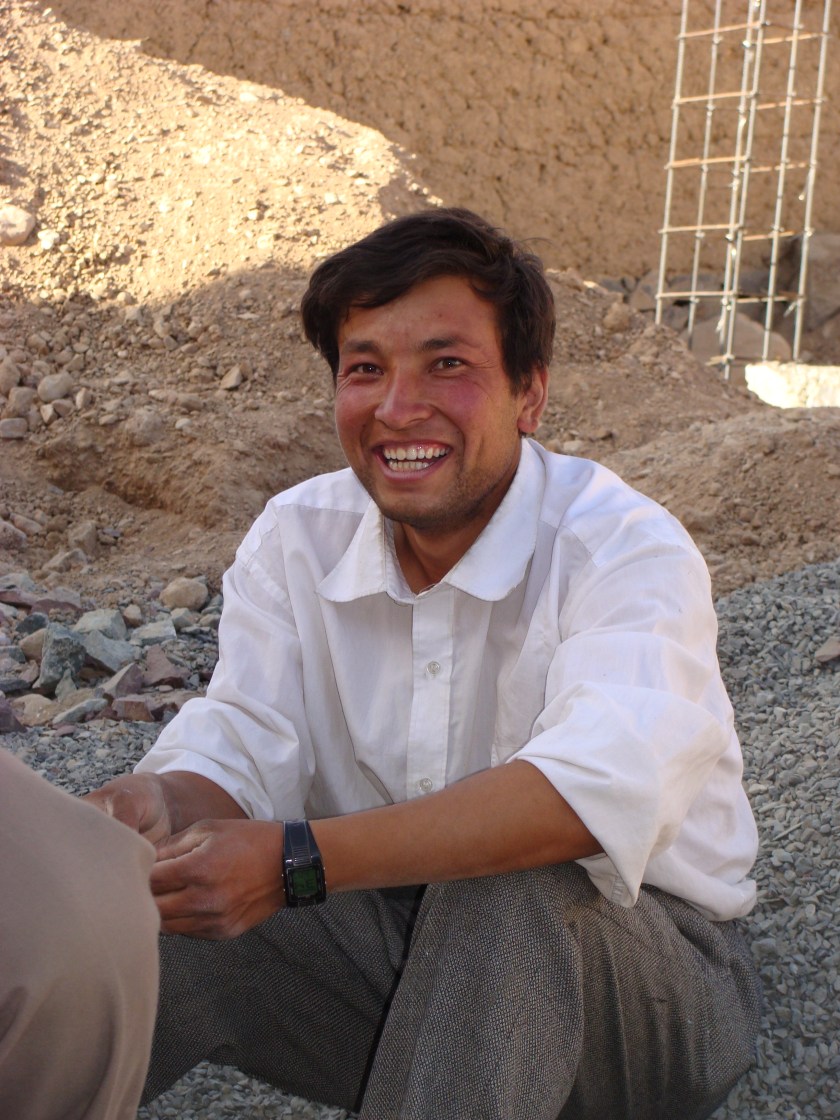
Khamad Jan at a construction site in Bamiyan, Afghanistan

Kabul– Khamad Jan, age 22, remembers that, as a youngster, he was a good student who enjoyed studying.  “Now, I can’t seem to think,” he said sadly, looking at the ground.  There was a long pause. “War does this to your mind.”

He and his family fled their village when Taliban forces began to attack the area. Bamiyan Province is home to a great number of Hazara families, and Khamad Jan’s is one of them. Traditionally, other Afghan ethnic groups have discriminated against Hazaras, regarding them as descendants of Mongolian tribes and therefore inferior.

During the Taliban attacks, Khamad Jan’s father was captured and killed.  As the eldest, Khamad Jan bore responsibility to help provide for his mother, two brothers and two sisters. But he struggled with debilitating depression, so much so that villagers, anxious to help, talked of exorcism. One day, he said he felt ready to give up on life.  Fortunately, community members and his friends in a local youth group, the “Afghan Youth Peace Volunteers,” have helped him come to terms with the pain he feels, assuring him that he can find a meaningful future.

Khamad Jan’s village is a particularly hard place in which to build houses, roads or farms. He and his family own a small plot of land which produces potatoes and wheat. The family works hard, but they only grow enough to feed themselves for seven months of the year. For a few months of every year, they must depend heavily on bread and potatoes, a carbo-diet which leads to malnutrition.  Like other women in the village, Khamad Jan’s mother and sisters are chronically anemic, suffering from headaches and leg cramps.

Continue reading ““War does this to your mind””

Bamiyan Diaries – Day Two

by David Smith-Ferri

Editor’s Note: American peace activists Kathy Kelly, Jerica Arents and David Smith-Ferri are part of a 3 person delegation currently travelling in Afghanistan. Read Smith-Ferri’s first piece on their experiences here.

Building Bamiyan Peace Park

The city of Bamiyan, with a population of roughly 60,000, has only one paved street, a wide, two-kilometer road without lanes that is a site of constant activity from 5 a.m. to curfew, at 10 p.m., and is referred to as the “Bazaar” because it is lined on both sides with shops.

In our short time here, we’ve been struck by how hard people, both in town and in the outlying villages, have to work to make a meager living. Children clearly work hard, too, seeming to participate fully in the livelihood of the family. At almost anytime of the day they can be seen at all manner of enterprise – helping set up the family street stall early in the morning, riding a donkey to fetch water in five-gallon plastic jugs, helping harvest potatoes, herding sheep or goats, collecting leaves for fuel, washing clothes in a creek, caring for younger siblings; and of course, they also attend school. Their work is as much a part of the landscape as the cottonwood trees and the red-rock cliffs which stand above the rivers.

Having had a chance to talk with members of the Afghan Youth Peace Volunteers (AYPV) and learn something about their significant commitments to home, family, and school, it was with delight and astonishment that we visited Bamiyan Peace Park today with nine proud members of the group and learned about their role in its development and use.

Continue reading “Bamiyan Diaries – Day Two”