Amnesty International: Do the Media Aid Israel?

The following series of talks, on media coverage of Israel, was hosted by Amnesty International, who came under pressure to cancel the event. It was surprising to see reports that the Jewish division of the EDL had shown up at the meeting as I thought they’d been ejected from that noxious organisation for being too extreme. Perhaps they’ll set up there own Israeli Defence League instead: which would probably be more honest, and would cause less confusion about what to call them now.

The concerted Zionist campaign to smear the Middle East Monitor (MEMO) and the Palestine Solidarity Campaign (PSC) failed dismally last night as the two groups co-hosted one of their most successful public events to date. The topic up for discussion was “Complicity in Oppression – Does the Media Aid Israel?” The panellists consisted of Prof. Greg Philo who discussed his new book “More Bad News from Israel” (an excellent academic analysis of the media’s skewed coverage of news coming out of Palestine-Israel); Tim Llewellyn, former BBC Middle East correspondent, and Abdel Barri Atwan, expert Palestinian commentator on the Middle East. The discussion was chaired by Victoria Brittain, former associate foreign editor of the Guardian.

Prof. Greg Philo, co-author of Bad News from Israel and More Bad News from Israel

Continue reading “Amnesty International: Do the Media Aid Israel?”

Why I disrupted Benjamin Netanyahu


Rae Abileah in her own words (crossposted from Mondoweiss).

Do you know that our Congress gave 29 standing ovations to Israeli Prime Minister Benjamin Netanyahu when he spoke in the Capital on Tuesday, May 24? I couldn’t watch this hero’s welcome for a man who supports the continued building of illegal settlements, won’t lift the siege of Gaza and refuses to negotiate with the new Palestinian unity government. During the talk, when Netanyahu was praising young people rising up for democracy in the Middle East, and I took my cue to stand up from my seat in the Capital Gallery, unfurl a banner, and shout, “No More Occupation! Stop Israeli War Crimes! Equal Rights for Palestinians!”

Continue reading “Why I disrupted Benjamin Netanyahu”

Mr Netanyahu goes to Washington…and Washington quails

Former Ambassador Chas Freeman on AIPAC’s campaign against Barack Obama, despite the latter’s extraordinary efforts to appease the lobby group.

John Mearsheimer thinks that Obama is doomed to disappoint.

Barack Obama gave a major speech on the Middle East on Thursday, May 19, and it is clear from the subsequent commentary that he impressed few people. The main reason for this is that he did not say much new or indicate that there would be any serious changes in US policy in the region. It was essentially more of the same with some tweaking here and there. Nevertheless, he did manage to anger some people. For example, Israel’s hard-line supporters were outraged that he said: “Palestine should be based on the 1967 lines with mutually agreed swaps.” For them, the 1967 borders are “Auschwitz borders” and thus can never serve as a basis for negotiations.

Continue reading “Mr Netanyahu goes to Washington…and Washington quails”

Here comes your non-violent resistance

While in the US even CNN’s liberal icon Anderson Cooper is busy portraying Palestinian Nakba protests as a Syrian conspiracy (with able assistance from neoconservative house-Arab Fouad Ajami), the Economist shows how with all their constitutional protections, the docile American media can’t match the standards of an even staid and conservative British magazine. Check out this gem from from the Economist’s M.S.
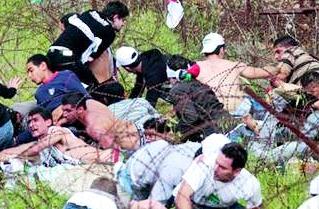
FOR many years now, we’ve heard American commentators bemoan the violence of the Palestinian national movement. If only Palestinians had learned the lessons of Gandhi and Martin Luther King, we hear, they’d have had their state long ago. Surely no Israeli government would have violently suppressed a non-violent Palestinian movement of national liberation seeking only the universally recognised right of self-determination.

Palestinian commentators and organisers, including Fadi Elsalameen and Moustafa Barghouthi, have spent the last couple of years pointing out that these complaints resolutely ignore the actual and growing Palestinian non-violent resistance movement. For that matter, they elide the fact that the first intifada, which broke out in 1987, was initially as close to non-violent as could be reasonably expected. For the most part, it consisted of general strikes and protest marches. In addition, there was a fair amount of kids throwing rocks, as well as the continuing threat of low-level terrorism, mainly from organisations based abroad; the Israelis conflated the autochthonous protest movement with the terrorism and responded brutally, and the intifada quickly lost its non-violent character. That’s not that different from what has happened over the past couple of months in Libya; it shows that it’s very hard to keep a non-violent movement non-violent when the government you’re demonstrating against subjects you to gunfire for a sustained period of time.

Continue reading “Here comes your non-violent resistance”

Protesters shot dead for shouting: Nakba Remembrance Day 2011

by Brenda Heard

The 15th of May is a day of remembrance. Around the world, we remember the systematic displacement and massacre of the Palestinian people. In their honour, we take note of the necessity of safeguarding the sliver of impoverished land that has been left to the survivors. We pay tribute to those who have refused to be stomped into oblivion.

Yet the Israeli newspaper Haaretz bemoans self-righteously the ‘Palestinian protests for the annual Nakba Day, which mourns the creation of the State of Israel’. At this phraseology we can only shake our heads and say, ‘no, it is not about you; it is about the injustice done to the Palestinian people; it is this injustice that is the catastrophe’.

Continue reading “Protesters shot dead for shouting: Nakba Remembrance Day 2011”

Palestine Whistleblower Speaks

Ziyad Clot writes for the Guardian on why he leaked PA documents to al-Jazeera.

In Palestine, the time has come for national reconciliation. On the eve of the 63rd commemoration of the Nakba – the uprooting of Palestinians that accompanied the creation of Israel in 1948 – this is a long-awaited and hopeful moment. Earlier this year the release by al-Jazeera and the Guardian of 1,600 documents related to the so-called peace process caused deep consternation among Palestinians and in the Arab world. Covering more than 10 years of talks (from 1999 to 2010) between Israel and the PLO, the Palestine papers illustrated the tragic consequences of an inequitable and destructive political process which had been based on the assumption that the Palestinians could in effect negotiate their rights and achieve self-determination while enduring the hardship of the Israeli occupation.

My name has been circulated as one of the possible sources of these leaks. I would like to clarify here the extent of my involvement in these revelations and explain my motives. I have always acted in the best interest of the Palestinian people, in its entirety, and to the full extent of my capacity.

Continue reading “Palestine Whistleblower Speaks”

Egyptians to mark Nakba with a march to Palestine

This article first appeared on Gaza TV:

On 15 May, the annual commemoration of the creation of the state of Israel and the expulsion of Palestinians, known as Nakba, Egyptians plan to march to Palestine under the slogan “Cairo’s liberation will not be complete without the liberation of Al-Quds [Jerusalem].”

Following Egypt’s January 25 Revolution, Egyptians are pushing for some of the country’s foreign relations policies to change, especially those related to Israel and Palestine. Aid or protest convoys to Gaza were frequently stopped or arrested during the Mubarak era by the ousted president’s regime, and now for the first time since the revolution thousands of activists are planning to march to the Rafah border town.

Continue reading “Egyptians to mark Nakba with a march to Palestine”

Gaza Strip

James Longley, the acclaimed director of the Oscar-nominated Iraq in Fragments (an award the film should have won, but for political reasons was instead handed to Al Gore), has generously made available his acclaimed 2002 film Gaza Strip for online viewing. (via Joseph Dana at +972)

In early 2001 I spent three months in Gaza filming material for this documentary, GAZA STRIP, working with local fixer and translator, Mohammed Mohanna. The second Palestinian uprising against Israeli military occupation had begun in September, 2000, and there had already been large numbers of deaths in Gaza when I started this project.

Though the period this documentary covers includes the election of Ariel Sharon as Israeli Prime Minister and large incursions by the Israeli Defense Forces into Gaza, in retrospect the time depicted here is one of relative quiet. More recent Israeli attacks against Gaza have been far more destructive and deadly than what falls into the scope of this film.

Continue reading “Gaza Strip”

The Goldstone Report: The Legacy of the Landmark Investigation of the Gaza Conflict

Adam Horowitz and Philip Weiss

Our dear friends Phil Weiss and Adam Horowitz of Mondoweiss at an event organized by Middle East Children’s Alliance (MECA) to launch of their new book The Goldstone Report: The Legacy of the Landmark Investigation of the Gaza Conflict, an edited version of Judge Goldstone’s U.N. report documenting war crimes during Israel’s Operation Cast Lead in Gaza. It includes essays by Raji Sourani, Leila El-Haddad, Ali Abunimah, Rashid Khalidi, Letty Cottin Pogrebin, Brian Baird, with a forward by Desmond Tutu and an introduction by Naomi Klein.

The event was chaired by Penny Rosenwasser of MECA. Also speaking at the event were Prof. George Bisharat of UC Hastings Law School and Barbara Lubin of MECA.

Continue reading “The Goldstone Report: The Legacy of the Landmark Investigation of the Gaza Conflict”