The London Review of Books on Syria

An improvised weapon in Aleppo

Robin Yassin-Kassab

I wrote to the editor of the London Review of Books concerning their Syria (and Libya) coverage. There’s been no reply, so I’m posting the letter here.

Dear….

…….(introduction)…..

Watching the representation of the tragedy in the media has been almost as depressing as watching Syria burn. As someone with strong leftist and anti-imperialist leanings, it’s been particularly galling to find that ‘leftist’ commentary on Syria has often been the worst of all. Large sections of the left have wholeheartedly embraced the very discourse that they resisted during the War on Terror years – that of ‘terrorists’ and al-Qa’ida conspiracies explaining all. Leftist journalists have paid little or no attention to the regime’s blatant and deliberate instrumentalisation of sectarian hatreds, but have focussed on, and exaggerated, the backlash. Robert Fisk has gone so far as to embed himself with the regime army, and to (grotesquely) interview survivors of the Darayya massacre in the presence of the perpetrators of the massacre. Many leftists have convinced themselves, against all the evidence, that the American-led empire has been conspiring against the Syrian regime since the start of the revolution, that this is a re-run of Iraq. Tariq Ali even appeared on Russia Today (near the start) to explain that America was trying to take over Syria but Russia was protecting the country. Russia – the imperialist power which is arming and funding the regime as it commits genocide.

I subscribe to the London Review of Books because it’s by far the best written, most incisive, most reflective, and bravest British publication. Publishing Walt and Mearsheimer was a great move. On the middle east, Adam Shatz is always excellent, well-informed, interested in teasing out a complex truth. Much of the coverage of the revolutions has been eurocentric and orientalist, however. I agreed with novelist Hisham Matar when he called ‘shame’ on Hugh Roberts’s very long Libyan piece which at no point attempted to see things from a Libyan perspective. Rather, it cast the Libyans as passive agents, pawns in the hands of the devilishly clever white man. And on Syria, commentary has been statist-leftist, as if this were an amusing chess game between regional and super powers rather than a struggle for freedom and a genocide, with only one side receiving sustained imperialist aid. I wrote in brief about Patrick Cockburn’s orientalism here.
Saving Syria’s Children

In a special edition, Panorama travels with British doctors inside Syria to exclusively reveal the devastating impact of the war on children caught in the conflict. The doctors witness the aftermath of the bombing of a school by a suspected napalm-like incendiary device and medical facilities constantly under attack – both war crimes under international law. Filmed in the north of the country after the chemical weapons attack in Damascus which inflamed world opinion and brought America, Russia and the UN to the table, the film shows how the conventional war is intensifying with children bearing the brunt of this humanitarian catastrophe.

Syria’s Grassroots Civil Opposition

Leila Shrooms writes this excellent survey of Syrian civil activists for Tahrir-ICN.

The discourse on Syria has been dominated by discussions of militarization, Islamization, sectarianism and geopolitical concerns. Conversely there has been relatively little focus on Syria’s grass roots civil opposition. This has led to a lack of knowledge outside of Syria for activists who want to stand in solidarity with Syria’s revolutionaries but don’t know where to start. This article attempts to provide an introduction to some of the many civil resistance initiatives taking place on the ground and efforts at revolutionary self-organization. It is by no means a comprehensive overview. It focuses on initiatives that are non-party political  or religiously aligned.[1] It must be remembered that prior to March 2011 there was not a functioning civil society in Syria as rights to free expression, assembly and association were highly restricted with severe consequences for those who failed to comply.[2]

Who are the grass roots civil opposition?
The core of the grassroots civil opposition is the youth, mainly from the working and middle-classes, in which women and diverse religious and ethnic groups play active roles. Many of these activists remain non-affiliated to traditional political ideologies but are motivated by concerns for freedom, dignity, social justice and basic human rights.

Local committees and local councils
The main form of revolutionary organization in Syria has been at the local level, through the work of local committees and local councils. These were influenced by the work of Syrian anarchist Omar Aziz. He argued that it was inconsistent for revolutionaries to participate in protests by day and then return to living within the hierarchical and authoritarian structures imposed by the state. Aziz believed that revolutionary activity should permeate all aspects of life and advocated for radical changes to social relationships and organization. He called for autonomous, non-hierarchical organization and self-governance, based of principles of cooperation, solidarity and mutual aid.[3] Together with comrades he founded the first local committee in Barzeh, Damascus.

Today hundreds of local committees/coordinations have been established in neighborhoods and towns throughout the country.[4]  In the local committees revolutionary activists engage in multiple activities, from documenting and reporting on violations carried out by the regime (and increasingly elements of the opposition) to organizing protests and civil disobedience campaigns (such as strikes and refusing to pay utility bills) and collecting and providing aid and humanitarian supplies to areas under bombardment or siege. They operate as horizontally organized, leaderless groups, made up of all segments of the society. Whilst organizing on the local level, they have built up networks of solidarity and mutual aid across the country.

At the city and district levels local councils have been established. There are 128 throughout Syria.[5] They are often the primary civil administrative structure in areas liberated from the state, as well as some areas that remain under state control.[6] These ensure the provision of basic services, coordinate with the local committees, coordinate with armed resistance groups and maintain security. They mainly follow some form of representative democratic model and free local elections have occurred in areas where they have been established, something that has not happened in Syria under four decades of Baath rule. Some councils change their elected representatives every three months and their is no leader amongst them. As the humanitarian situation has deteriorated they have taken on an increasingly vital role but they face many challenges. The scarcity of resources has meant that some have had to suspend work, such as happened in Aleppo. In an appeal for support to local councils, human rights activist Razan Zaitouneh says “We cannot continue to demand local councils to play their role without support and employment plans that assist them to do the simplest actions helping civilians to survive under siege and shelling. These plans include providing potable water, collecting garbage from residential areas, and supporting projects that provide food from inside the besieged area exposed to hunger.”[7] She also highlights that lack of resources make local councils susceptible to influence by armed groups and that help is needed for them “to be independent from supporting parties that try to arm the region to establish their authority on the ground, rather than enable [them] to have neutrality- as much as possible- and make independent decisions.” [8] At least one Local Council in Manbej, Aleppo, suspended work in protest against the excess of the militant Jihadi group ISIS in the town.[9] Some local councils have been more successful and inclusive than others which have been plagued by infighting or found themselves unable to displace the bureaucratic structures of the old regime.

Continue reading “Syria’s Grassroots Civil Opposition”

Actually Existing Intervention

Now that the glorious revolutionary alliance of the Stop the War Coalition, Sarah Palin’s Tea Party, UKIP, the BNP, Tory back-benchers and the (Iraq-invading) Labour Party has won its historical victory over the forces of imperialism, the western faux-left can go back to sleep while Bashaar al-Assad can continue and escalate his genocide of the Syrian people. Here’s a short film showing Iranian occupation forces in Syria. At one point one of them says, “There are no human beings here – only Arabs.”

Aziz’s Story

aziz cellThis was published at NOW

The Syrian city of Selemiyyeh lies to the east of Hama, where the fertile crescent becomes barren. The ruins of Shmemis castle, dating to the late Hellenistic period, cling to the cone of an extinct volcano nearby. The major historical site in the city itself is a shrine containing the tombs of Imam Taki Muhammed and Radi Abdallah. Some believe that Imam Ismail, the foundational figure of the Ismaili sect, is buried here too.

Although it’s an ancient city, with ancient links to the Ismaili faith, the ancestors of its present population were 19th and 20th Century migrants from Ismaili hill towns to the west, places such as Qadmous and Misyaf. The town, which also houses significant populations of Sunnis, Twelver Shia and Alawis, has long been a model of sectarian co-existence. Its secularism has been real – a genuine popular tolerance for difference, not the debased, propagandistic ‘secularism’ of the regime.

Along with Homs, Darayya, Dera‘a and Kafranbel (each one for different reasons), Selemiyyeh has become one of the capitals of the Syrian revolution. As a predominantly non-Sunni community which has since the start stood solidly for freedom and against the regime, its example proves both the mendacity of Assad’s sectarian narrative and the oversimplified western media discourse which portrays the fight as one between Sunni extremists and minority-secularists.

As part of its divide-and-rule strategy, the regime has spared Selemiyyeh the aerial bombardment and rocket attacks it has visited on majority-Sunni areas, but the city has suffered as much as anywhere from detentions and disappearances. Its revolutionaries, like all revolutionaries in regime-controlled areas, live underground.

Selemiyyeh has also bled (in January and February) from bomb attacks, probably organised by Jabhat an-Nusra, which targetted the regime’s shabeeha militia but also killed many innocent civilians. Despite such provocations, Selemiyyeh’s revolutionaries have cooperated with the Salafists of Ahrar ash-Sham, who have brought food aid to the city. And the community has done a great deal to house and feed its brothers and sisters of all sects fleeing violence in Homs and Hama. Pioneers of the early non-violent protests, many of Selemiyyeh’s residents are now engaged in the armed struggle.

When I met Aziz Asaad, an activist from Selemiyyeh, across the Turkish border in Antakya, I asked him why the community was so revolutionary, why it hadn’t been scared into fencesitting or even grudging support for Assad by the Islamist element of the opposition. His answer: “We read a lot. We’ve always read books.”

Continue reading “Aziz’s Story”

Al-Bayda: Anatomy of a War Crime

An excellent report from Channel 4 on the al-Bayda massacre, one of hundreds of massacres in Assad’s Russian-backed genocide.

Top Five Worst Arguments Against US Airstrikes in Syria

By Malik Little

People like Robin Yassin-Kassab make good arguments against U.S. airstrikes on the regime of Bashar al-Assad in Syria; the problem is that hardly anyone else is making them. Instead, we usually hear some variation of the following five.

5. Hypocrisy.

The U.S. crossed President Obama’s “red line” in the 1980s by aiding and abetting Saddam Hussein’s use of chemical weapons in the 1980s, first against Iran during the Iran-Iraq war and then against Iraq’s restive Kurdish population. The U.S. crossed Obama’s “red line” again during its invasion and occupation of Iraq by using white phosphorus during an assault on rebel-held Fallujah. Before that, the U.S. used Agent Orange, napalm, and white phosphorus in Viet Nam. Based on this extremely brief history of U.S. chemical weapons usage, the U.S. is in no position morally to punish the Syrian regime for crossing a “red line” although it is in this position militarily.

Anti-interventionists who build their case on U.S. hypocrisy operate under the illusion that non-hypocritical military powers exist or that wars are exercises in morality. They don’t and they aren’t.

Waiting for a militarily powerful state founded and led by Santa Claus or a modern-day Gandhi to arise is not an acceptable course of action in the face of the clear and present danger of continued chemical weapons use by the Assad regime.

4. Non-violent alternatives, non-military options.

MSNBC’s Rachel Maddow talked up sanctions, negotiations, arms embargos, war crimes tribunals, stepped up humanitarian aid to refugees, and all manner of embarrassingly ineffectual schemes given that the Syrian people exhausted non-military options over two years ago. For those that don’t know, their peaceful protests were met with gunfire, the torture and mutilation of children, rape on a mass scale, shelling, airstrikes, Scud missiles, and sarin gas attacks by the Assad regime that have killed over 100,000 people, forced two million to flee to neighboring countries, displaced five million internally, and led seven million to need humanitarian assistance – all in a country of a little more than 20 million.

There simply is no non-violent way to stop such a heinously violent regime.

Continue reading “Top Five Worst Arguments Against US Airstrikes in Syria”

Not Anymore – A Story of Revolution

The award-winning documentary film about Syria, Not Anymore: A Story of Revolution, directed by Matthew VanDyke. This film has won more than a dozen awards and is an official selection in more than 60 film festivals around the world. For more see The Syrian Revolution Film.

The End of the World?

I make some brief contributions to this Channel 4 News film on the apocalyptic resonances for both Muslims and Christians (some at least) of watching Damascus burn. I wish there’d been time to make the more important point: religion and myth add resonance to fighting and dying, but as in Northern Ireland or Palestine-Israel, the religious vocabulary is only a glittering sideshow to the real power dynamic. Al-Qa’ida franchises would be in Syria whether or not the Messiah were due to descend on a minaret of the Umawi mosque: because they turn up wherever there’s an opportunity, and Syria’s geographical and political centrality to the Arab-Muslim world is enough. In any case, such militias compose less than twenty percent of anti-Assad forces. Their influence has been vastly overblown, both by the right and by a left which embraces the very War on Terror discourse (terrorists, al-Qa’ida conspiracies) it resisted so loudly when used by Blair and Bush. The West doesn’t see a genocide, still less a living, breathing revolution, but only an even-matched war between Alawi-secularists and radical Salafists. It seems too late to change this fantastic illusion. The story seems set in the western mind. Just as Assad wants it.

This film was great fun to make, and it provides an interesting look at an interesting subject. But I worry about its context in the news bulletin. It necessarily highlighted the mad jihadist aspect, and it was followed by an interview with a neo-conservative on the dangers of radical Islamism. The problem as framed by the broadcast was clear: apocalyptic-minded Muslims were the problem. But the clear and present danger in Syria is the regime, the regime which is generating the trauma and  extremism, the regime which is committing genocide. Once again that was lost. And we in general are lost, paddling about in superstructure, paying no attention to the base.

A Cry for Help

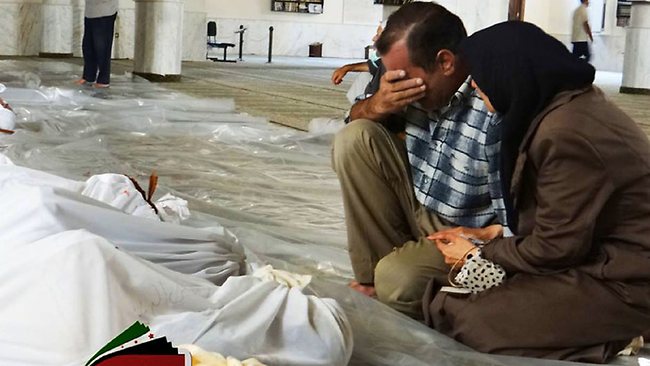
shroudYassin al-Haj Saleh, from the suburbs of the eastern Ghouta, writes this plea at the New York Times.

THE story is simple. Here in Syria, there is a regime that has been killing its subjects with impunity for the last 30 months. The notion that there is a mysterious civil war that is inextricably linked to the nature of the Middle East and its complicated sectarian divisions is far from the truth.

The primary perpetrator of violence is the government of Bashar al-Assad, which controls public resources, the media, the army and the intelligence services. The civilians who rose up against that regime, first peacefully and then through armed resistance, constitute a broad spectrum of Syrian society.

When a government murders its own citizens and they resist, this can hardly be called a civil war. It is a barbaric campaign of the first degree.

During the revolution’s first year, Syrians demanded international protection. First we asked for no-flight zones or humanitarian corridors, and later for weapons and military aid for the Free Syrian Army, but to no avail.

Not a month went by without some American or NATO official expressing little appetite for intervention. Realizing that this attitude was not about to change, the regime escalated the violence. It attacked the rebels with everything it had: first with rifles, then with tanks, helicopters, jet fighters, missiles and toxic gases.

Meanwhile, Western powers masked their diplomatic inertia with empty rhetoric about a “political solution.” Yet they have failed to coax the regime — which has not once indicated that it is ready to abandon its “military solution” — to the negotiating table.

Inaction has been catastrophic. While the world has dithered, Syrians have experienced unprecedented violence. Around 5,000 Syrians were killed in 2011. About the same number are now being killed each month. The regime has targeted lines outside bakeries; it has used Russian cruise missiles to bomb densely populated areas; and local activists say they have documented 31 occasions when it has used chemical weapons (United States officials have confirmed only some of these attacks).

Countless Syrians, among them women and children, have been subjected to arbitrary detention, rape and torture. A staggering seven million people — one-third of Syria’s population — are now displaced, either internally or externally.

Continue reading “A Cry for Help”