Negotiations?

We Will Not Die We Will Remain Here by Wissam al-Jazairy

This was published at The National.

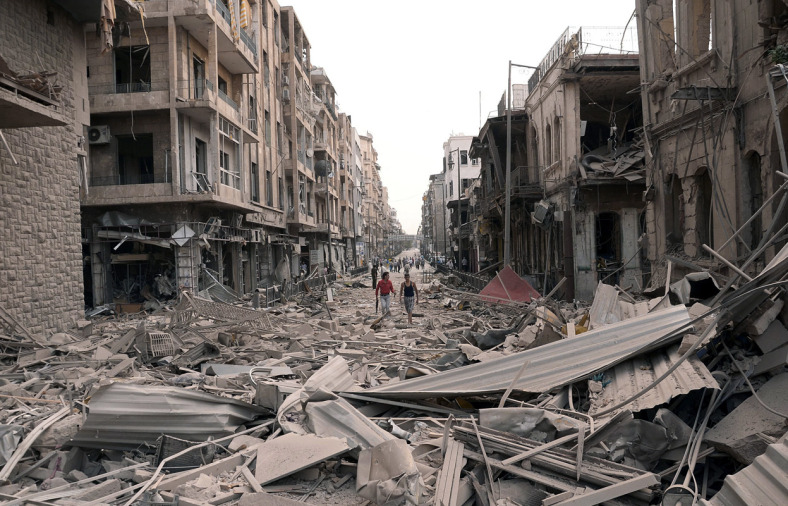
On January19th  Syrian foreign minister Walid al-Moallem gave an apparently conciliatory interview to state TV. “I tell the young men who carried arms to change and reform, take part in the dialogue for a new Syria and you will be a partner in building it. Why carry arms?” In the southern and eastern suburbs of Damascus his voice was drowned out by the continuing roar of the regime’s rocket, artillery and air strikes.

The UN and parts of the media have also called for negotiations. Until late January this year, however, the Syrian National Coalition – the widely-recognised opposition umbrella group – opposed the notion absolutely. But then SNC leader Moaz al-Khatib announced that he would talk directly to regime representatives (not Bashaar al-Assad himself) on condition that the regime releases 160, 000 detainees and renews the expired passports of exiled Syrians.

In the context of Moallem’s media offensive (and in the absence of concerted international financial or military support for either the SNC or the revolutionary militias) al-Khatib’s announcement calls the regime’s bluff. It doesn’t, of course, mean that negotiations are about to be launched. For a start, the regime only intends to negotiate with, as it puts it, those “who have not betrayed Syria”. Like successive Israeli regimes, it will only talk with the ‘opposition’ it chooses to recognise. This includes, as well as pro-regime people posing as oppositionists, Haytham Manaa’s National Coordination Committee for Democratic Change, a group which has no influence whatsoever on the revolutionary fighters setting the agenda. The SNC – which does have some influence on the ground, and would have far more if it were sufficiently funded – is definitely not invited.

Continue reading “Negotiations?”

World Service Twice

Golan drinks, Lyse looks on, Nihad eyes me suspiciously

Last night I was at London’s Purcell Room, honoured to be in the presence of novelist and screenwriter Nihad Sirees and poet Golan Hajji. The event was chaired by the BBC’s Lyse Doucet. We were talking about writing in the context of the Syrian revolution. Then I participated in the morning edition of the BBC World Service’s World Have Your Say, discussing Syria, and I joined the WHYS in the evening too, discussing Syria and Mali (on which I’m no expert) at greater length.

Here is the morning edition.

And here is the longer evening programme.

What I saw in the war

Reporter Janine di Giovanni has been to the worst places on Earth to bring back stories from Bosnia, Sierra Leone and most recently Syria. She tells stories of human moments within large conflicts — and explores that shocking transition when a familiar city street becomes a bombed-out battleground.

The Revolution Armed Itself

regime policy in aleppoThis piece, a rebuttal to Marc Lynch, was published at Foreign Policy under the title Fund Syria’s Moderates.

In response to non-violent protests calling for reform, the Baathist regime in Damascus has brought Syria bloodshed, chaos, and created the conditions in which jihadism thrives. The now partially armed revolution is doing its best to roll back the bloodshed and to eliminate the regime that perpetrates it.

Yet Foreign Policy’s Marc Lynch, one of the more perceptive analysts of the Middle East, argues that after more than 60,000 lives have been lost, “the last year should be a lesson to those who called for arming the rebels.” In a previous article, Lynch noted, “Syrian armed groups are now awash with weapons.”

Anyone laboring under the delusion that pro-revolution foreign powers have flooded Syria with hi-tech weaponry should scroll through the blog of New York Times correspondent C.J. Chivers or peruse the web pages displaying improvised catapult bombs and PlayStation-controlled armored cars. These are hardly the tools of a fighting force that has been armed to the teeth.

While it’s true that some armed groups — particularly the al Qaeda-linked Jabhat al-Nusra — have sometimes found themselves in possession of plenty of weaponry, the resistance remains overwhelmingly dependent on the weapons it can buy, steal, or seize from captured checkpoints and bases.

Simply put, the assumptions of those who called for arming the rebels have not been tested because the rebels have not been armed — except in irrelevant, sporadic and, in Lynch’s words, “poorly coordinated” ways. For instance, an ammunition shortage slowed the original rebel advance in Aleppo to a destructive halt.

Continue reading “The Revolution Armed Itself”

Iran Shoots Itself in the Foot

iransyriahizbThis was written for the excellent Lobelog.

In August 2012 Egyptian President Muhammad Morsi attended a meeting of the Non-Aligned Movement (NAM) in Tehran. His presence at the conference was something of a diplomatic victory for the Iranian leadership, whose relations with Egypt, the pivotal Arab state, had been at the lowest of ebbs since the 1979 revolution.

Egypt’s President Sadat laid on a state funeral for the exiled Iranian shah. A Tehran street was later named after Khalid Islambouli, one of Sadat’s assassins. Like every Arab country except Syria, Egypt backed Iraq against Iran in the First Gulf War. Later, Hosni Mubarak opposed Iranian influence in Iraq, Syria, Lebanon and Palestine, worked with the US and Saudi Arabia against Iran’s nuclear program, and was one of the Arab dictators (alongside the Abdullahs of Jordan and Saudi Arabia) to warn darkly of a rising “Shi’ite cresent”. Not surprisingly, Iran was so overjoyed by the 2011 revolution in Egypt that it portrayed it as a replay of its own Islamic Revolution.

Iran also rhetorically supported the revolutions in Tunisia and Libya, the uprising in Yemen, and, most fervently, the uprising in Shia-majority Bahrain.

In Syria, however, Iran supported the Assad tyranny against a popular revolution even as Assad escalated repression from gunfire and torture to aerial bombardment and missile strikes. Iran provided Assad with a propaganda smokescreen, injections of money to keep regime militias afloat, arms and ammunition, military training, and tactical advice, particularly on neutralising cyber opponents. Many Syrians believe Iranian officers are also fighting on the ground.

Continue reading “Iran Shoots Itself in the Foot”

Discussing Assad’s Speech at the Opera House

“It was operatic in its otherworldly fantasy, unrelated to realities outside the building,” wrote Rami Khouri of Bashaar al-Assad’s latest speech, delivered as the bombs fell on southern Damascus. I was a guest on the BBC World Service to discuss the speech alongside Patrick Seale (Hafez al-Assad’s biographer), Syria Comment’s Joshua Landis, Faisal Yafai of the National, and Dr Yazan Abdullah. You can listen to the conversation here. (I fear it may not be accessible beyond the UK).

Woman in the Crossfire

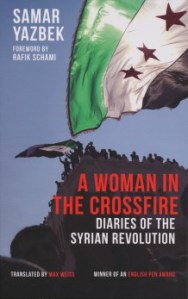
womaninthecrossfire_72A Woman in the Crossfire: Diaries of the Syrian Revolution’ by novelist Samar Yazbek is part journalism, part personal memoir, and all literature. It’s literature of the instantaneous sort, a staggered snapshot of the first four months of the revolution, a public history of  “a country succumbing to the forces of death,” and an interior history too. Yazbek tells us about her headaches, her insomnia and Xanax addiction, her crying fits, her fears for her daughter and herself, her constant panic. How sometimes in the speeded-up context the rush of information precedes all feeling: “The daily news of killing,” she writes, “was more present inside of me than any emotion.”

Samar Yazbek has always been problematic. Having consecrated herself “to the promise of a mysterious freedom in life,” she left home (in Jableh, on the coast) at sixteen, later divorced her husband and lived in Damascus, a single mother, working in journalism and writing sexually controversial novels. When Syria rose up against the Asad regime she publically supported the victims and their cries for freedom. And she’s an Alawi, a member of the president’s largely loyalist sect, of a well-known family. As an unveiled and obviously independent woman, a secularist and daughter of a minority community, her support for the revolution proved the lie of regime propaganda, which characterised the uprising as Salafist from the start.

So leaflets slandering her were distributed in the mountains. She was called a traitor, made  recipient of death threats, publically disowned by family and hometown. Naturally she was visited by the mukhabarat and made to experience, vicariously at least, the domestic wing of regime propaganda – for the theatre of blood is as important inside Syria as the projection of civilised moderation used to be abroad – by being walked through a display of meat-hooked and flayed torturees.

Continue reading “Woman in the Crossfire”

On Both Sides of the Golan

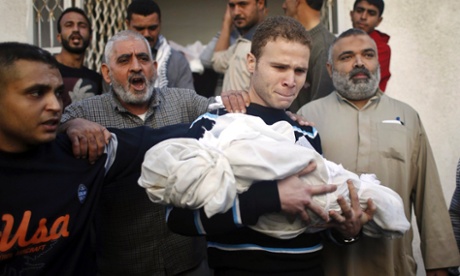
The picture on the left is doing the rounds on the internet labelled as a Palestinian child  victim of US-backed Zionist bombing in Gaza. In fact, it seems that it depicts a Syrian child injured by Russian and Iranian-backed Asadist barbarism. No matter – the two are interchangeable today. Both are fighting hyper-violent tyrannies rooted in the Sykes-Picot carve-up of bilad ash-Shaam. And while Zionism bombs Palestinian refugees in Gaza, Asad’s forces continue to bomb Palestinian refugees in the Yarmouk camp, Damascus. The film below shows some of the aftermath of this bombing. Below that we reprint an article by novelist Ahdaf Soueif, in which she describes the changed Arab environment meeting the latest aggression on Gaza, and points out that Israel’s action is in part aimed to take “the heat off Bashar al-Assad’s murderous activities in Syria.”

Continue reading “On Both Sides of the Golan”

Hypocrisy, As Usual

Omar al-Masharawi, son of a BBC cameraman in Gaza, murdered by Zionist bombs.

Israel has launched yet another attack against the Gaza Strip, striking the densely-populated and besieged territory from the air and the sea, and as usual the United States, Canada and Britain have lined up in support of Zionist terrorism.

Speaking from a system poisoned by the Israel lobby, State Department spokesman Mark Toner says: “There is no justification for the violence that Hamas and other terrorist organizations are employing against the people of Israel. We call on those responsible to stop these cowardly acts immediately. We support Israel’s right to defend itself.” Confusing Zionist settlers for ‘the Jewish people’, confusing perpetrator with victim, and then parroting outmoded ‘war on terror’ propaganda, Canadian foreign minister John Baird vomits the following: “Far too often, the Jewish people find themselves on the front lines in the struggle against terrorism, the great struggle of our generation.” Then Britain’s foreign minister William Hague makes the following immoral and illogical comment: “I utterly condemn rocket attacks from Gaza into southern Israel by Hamas and other armed groups. This creates an intolerable situation for Israeli civilians in southern Israel, who have the right to live without fear of attack from Gaza.”

Two things must be said. First, this round of escalation, like the 2008/2009 slaughter, was started by Israel. It is totally mendacious to pretend otherwise. The Hamas government in Gaza refrained from stopping other groups from firing missiles as a result of Israel’s murder of a disabled man and of a twelve-year-old boy in Gaza. Here is a timeline of events. Second, the settlers of southern Israel do not have the right to live without fear of attack while the original inhabitants of ‘southern Israel’ are herded into refugee camps. Eighty percent of people in Gaza are descendants of refugees ethnically cleansed from their villages and towns by Zionist militias in 1947 and 1948.

Continue reading “Hypocrisy, As Usual”

Moaz al-Khatib’s speech translated

Rabi Tawil of the excellent Levantine Dreamhouse blog translates Syrian National Coalition head Shaikh Moaz al-Khatib’s important speech of 11/11/2012, in which he addresses issues of violence, sectarianism, revenge and independence in the Syrian revolution.

The Syrian people are the product of 10,000 years of civilization.  The great people of Syria are facing daily, a programmed war of extermination and savage destruction.  It can be safely said that there is not a citizen that has not been harmed by this regime.  Many parties have exerted effort to pull this regime out of its primitiveness, its savagery and its stupidity but have been put off by its stubbornness and its arrogance.  The regime has destroyed all aspects of normal life and turned Syria into ruins; it has worked for fifty years to negate the will of the people and to play on its contradictions using them to tear apart our people.

After a long struggle, numerous patriotic groups have now united as one to stop the massacre to which our people are being subjected daily as the rest of world passively listens and watches.  Our primary task is to provide emergent humanitarian relief to our people and to stop the torrent of blood that runs day and night, as we unite our ranks to remove this tyrannical regime with all its symbols and build a righteous society based on justice and the dignity that is bestowed by God on every human being.

I would like to alert you to certain issues, even if I deviate a little from the norms of diplomatic protocol.  The first issue is that our revolution is a peaceful revolution from its beginning to its end and it is the regime alone that bears the moral and legal responsibility; for it is the regime that forced our people to resort to armed resistance to defend themselves, their families, their property and their religion.  In dozens of cities flowers were carried during demonstrations by thousands of young men and women. They carried flowers and cold water to give to members of the security forces to ask for their right, to simply express themselves. This monstrous regime responded with arrests, jail and torture and then proceeded to destroy the physical, social and economic structure of the country after destroying its intellectual and moral fabric for the past fifty years.

Continue reading “Moaz al-Khatib’s speech translated”