For more films on Syria see Homs: Journey into Hell; Inside the Secret Revolution; and Syria’s Torture Machine.
Category: Syria
Arm the Guerrillas
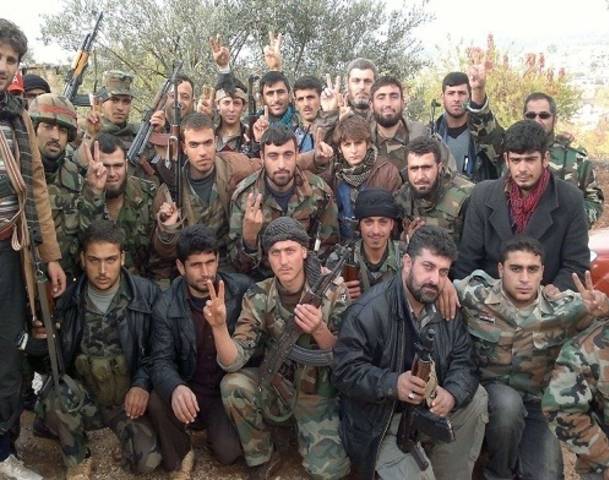 This was published at Foreign Policy.
There are some, perhaps many, Syrians who detest their government and are entirely aware of its treasonous nature — yet wish for the demonstrations and the guerrilla actions of the Free Syrian Army (FSA) to stop and for President Bashar al-Assad’s regime to regain control as soon as possible. They take this position out of a profound pessimism: They believe it is impossible to uproot the surveillance-and-torture state and its deep sectarian substructure, that more people will die the longer the unrest continues, that the economy will collapse further, and that nothing will alter the end — Assad’s inevitable victory. Some Syrians go so far as to say that the regime itself, or a branch of it, is surreptitiously encouraging demonstrations so as to have an “excuse” to teach the new generation an unforgettable lesson.
I can’t agree with this defeatist perspective on principle — the principle being my refusal to give in to despair, and my faith in the ability of human beings to change their circumstances. I understand it, however, and I understand that I might share it if I were living in the heart of the horror instead of in Scotland. But apart from principle, I think the assumption underlying the defeatist perspective is mistaken. Yes, the regime is still able to kill, and will continue or even intensify its killing. However, it has lost control of the country and won’t be able to reestablish it.
The much-maligned United Nations observers have confirmed what news reports had already suggested: Large areas of the Syrian countryside and provincial cities are either under FSA control or nobody’s. Regime forces are able to infiltrate and punish areas under the revolutionaries’ sway, but they dare not linger. Sometimes, they are not even able to move in. When the Assad regime recently attempted to retake the eastern city of Rastan, the FSA destroyed a number of armored vehicles and killed 23 soldiers, forcing the military to retreat.
Not Writing About Syria
I haven’t been writing about Syria at my previous pace. The time is not right.
This is a time for Syrian internet activists, those still surviving, to send us their videos. It’s a time for gathering evidence – although no more evidence is needed.
It’s a time for reporters to write, for committed foreign journalists to smuggle themselves inside and tell the tale. (You could call the murdered journalists martyrs, because they chose to go to a place where they knew they might die, and they did so for the sake of the truth.)
People who have specific human stories to tell should tell them. I hear the occasional story, and I might relay some of them; but I am not there. I am observing from Scotland.
This time is the beginning of a long process of creative mulling for those who will eventually produce novels and films concerned with the tragedy.
Most of all it’s a time in which people scream and suffer and die, a time to wait for the next explosion, or the next kick at the door, or for the return of the rapists, or for the next shriek of pain and humiliation from the neighbouring cell. It’s a time for burying children at night, hastily, in silence. And the suffering continues with glacial inevitability. Fate doesn’t seem to plan an end to it, not yet.
Ali Ferzat: Breaking the barrier of fear
Al Jazeera’s Listening Post interviews the great Syrian cartoonist Ali Ferzat whose work we have featured here often.
Sectarianism and Honesty
This was published in the excellent Ceasefire magazine.
Ba‘athism began as a conscious attempt to supercede the sectarian and regional divisions which plague the Arab world. That’s why many of its early ideologues were Christians or members of other minority groups. The Ba‘athist slogan umma arabiya wahida zat risala khalida – One Arab Nation Bearing an Eternal Message – employing the word for ‘nation’ which previously designated the international Muslim community, and the word for ‘message’ previously associated with the Prophet Muhammad’s divine message – suggests that this variety of Arabism actually intended to supercede religion itself, or to become a new religion.
In Iraq it all went wrong very quickly. Saddamist Ba‘athism in effect designated ethnic Arabs of the Sunni sect as true Arabs, the Shia majority as quasi-Persian infiltrators, and the Kurds as an enemy nation. Saddam even wrote a characteristic pamphlet called ‘Three Things God Should Not Have Invented – Persians, Jews and Flies’, and so demonstrated the slip from nationalism to fascism.
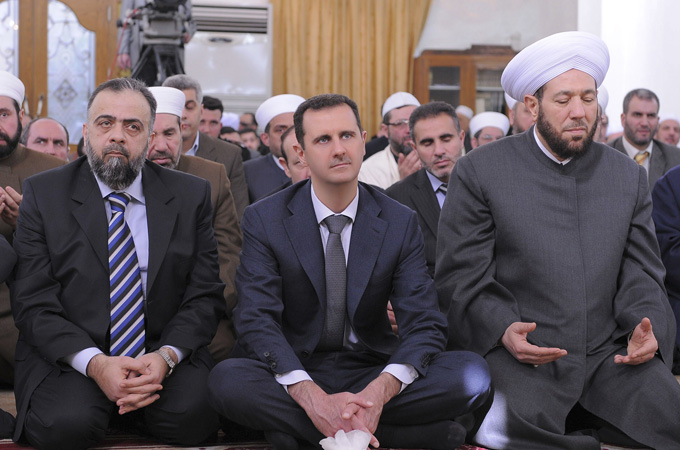
Syria was somewhat different, somewhat more sophisticated. Despite the fact that the president and his top spies and generals were Alawis from the Lattakkia region, only Sunni Islam and Christianity were taught in the state’s religious education system (to the chagrin of traditional Alawi shaikhs). When the president prayed in public he prayed in the manner of the majority, Sunni-style. In the last couple of decades the regime sought to broaden its base by coopting Sunni businessmen as well as soldiers from the minority groups. And the majority’s rituals and religious festivals were never banned as they were in Iraq.
Syria on the brink
A year ago, Syrians took to the streets in peaceful protest demanding democratic change but the regime ruthlessly crushed the uprising. Empire discusses if the world powers can do anything to stop the escalation of force.
Syria: Songs of Defiance
This is typically excellent and courageous. The journalist is supposed to be anonymous but they haven’t disguised his voice very well.
An Al Jazeera journalist who was forced to remain anonymous for security reasons offers an unusual but compelling first-person account of a country in turmoil and a revolution in progress in this intriguing episode of People and Power.
Panorama – Homs: Journey into Hell
In a follow up to Panorama’s Syria: Inside the Secret Revolution they have produced Homs: Journey into Hell.
Paul Wood charts the rise and brutal suppression of the uprising in the Syrian city of Homs. What started with hope of revolution now sees refugees fleeing to escape retribution.
Journalists and activists killed in Homs shelling
Two foreign journalists have been killed in Homs, activists say, as shelling of a district of the Syrian city continued amid warnings of an escalating humanitarian crisis.
Omar Shakir, an activist in the city, told Al Jazeera that the deaths of Marie Colvin, a US reporter working for the UK’s Sunday Times newspaper, and French photographer Remi Ochlik occurred as a building used by activists as a media centre was shelled on Wednesday.
Syrian People’s Army
Some members of the Syrian army are beginning to do what their service oath mandates: to protect the Syrian people.
One of the soldiers, Fayez al-Abdullah, spoke to Al Jazeera earlier:
 P U L S E