by Ahmed Habib
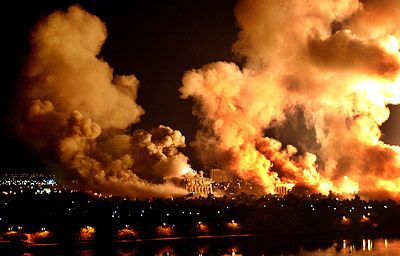 On March 20, 2003, at approximately 5:30 in the early hours of the morning, just at that time where the sun settles into its daytime position over the skies of Baghdad, American jet fighters unleashed indiscriminate firepower over the beautiful city.
Amidst a house filled with resilient spirits, Laila cowered for cover with her neighbours and family. As a twenty year old university student, the Baghdad native had already been through two wars, and a genocidal sanctions regime that limited her childhood to an existence of deprivation and fear.
“This time, it was different, the explosions were so big, we all thought we were going to die,” Laila, a pseudonym used out of fear for her safety, says over a tired phone connection seven years later.
Tens of thousands of kilometres away, activists huddled around a television set, with their heads in their hands, and watched a glorified play by play of death narrated by indifferent talking heads.
“Those are people dying under those bombs, and we couldn’t do anything to stop them,” said Firas from a Toronto apartment, to the backdrop of free flowing tears.
In the lead up to that day, millions of people took to the streets to oppose the impending war, to no avail. Since then, over a million Iraqis have lost their lives, more than five million have been displaced, and countless lives have been destroyed.
When the Data Falls Short
For those concerned with numeric representations of loss, the figures describing the magnitude of destruction in Iraq are staggering. However, statistical bureaus will never be able to measure the fear, despair, and dehumanization experienced by Iraqis under the feet of armed militia and private security firms.
From murder campaigns carried out by the Badr Brigades to Al Qaeda, the American led occupation has been characterized by a systematic campaign of terror waged against Iraqis. The complete ethnic cleansing of cities and, more obsessively, neighbourhoods according to sectarian divisions was carried out under the watchful eye of the Iraqi government.
Families who have called certain areas of Baghdad home for decades were forced to move to other sections of the city, or make shift camp grounds after being threatened by machine gun wielding thugs coming to their door.
“We have lived near Al Rabie street for most of my life, and when we fled Baghdad, I couldn’t even say goodbye to my neighbours,” said Ahmed, another pseudonym, from the United Arab Emirates, where he currently lives.
Numbers cannot account for the horror that parents experienced when sending out their children to school, resorting to isolated upbringings instead. Kidnappings and murders decorated the paths to decrepit schools, and the future of Iraqis was held hostage by makeshift checkpoints and drive by shootings.
There are no pie charts that depict the amount of missed opportunities for Iraqi children to live functional lives, nor are there graphs that shed light on broken love stories, tragically ended by separation, or death.
Systematic Theft and the Myth of Reconstruction
There are, however, several tangible indicators that point to the dismantling of Iraq’s infrastructure. The destruction of Iraq began long before the occupation. America’s interventions in Iraq have dated back to the CIA backed imposition of Saddam Hussein onto the political scene in Iraq. As early as 1959, Hussein was part of an American squad assembled to assassinate then Iraqi Prime Minister Abdul Karim Kassim, ushering in the Baathist regime.
Subsequently, under the reign of Hussein, America’s man spent the majority of the country’s resources on armed forces to fight a proxy war against Iran. An eight year conflict that cost the lives of hundreds of thousands, including attacks using chemical weaponry against Iraqi Kurds in Halabja. America knew of the atrocities, and the complex costs of the war, and ignored them.
A sanctions regime imposed on Iraq after their invasion of Kuwait in 1990, unpopular with the oil tycoons of the Bush administration, dealt the fatal blow to Iraq’s social fabric, and set the stage for the American onslaught in 2003.
For over thirteen years, more than 500,000 Iraqi children under the age of 5 and over a million Iraqis perished at the mercy of an embargo that banned the import of everything from basic medical supplies to sewage treatment equipment.
When American forces, bolstered by an army of war profiteers, assumed control of Iraq, the conditions were ripe for the looting of the country. Within days of the fall of Baghdad on April 9, Paul Bremer, America’s emperor in Iraq, put in motion 100 orders, that configured Iraq’s economic and legal structures forever.
Examples include order 39 which allowed, amongst several debilitating regulations, for the complete privatization of all of Iraq’s state-owned ventures, as well as the full foreign ownership of Iraqi businesses. At a time when Iraqis were struggling with the total absence of adequate healthcare, electric power, clean water, and other basic means of sustenance, such a law would allow multinationals such as Bechtel unlimited access to billions of dollars in projected profits.
A more symbolic blow against Iraqi sovereignty was order 81, which forbid Iraqi farmers from using locally cultivated seeds in agriculture. For a country that is the birthplace of irrigation and farming, telling Iraqi farmers, who have cultivated the land between the Tigris and Euphrates rivers for thousands of years how to farm, was reflective of American intentions to destroy Iraq. More disturbing was the fact that Iraqi farmers would have to use terminator seeds owned by American corporations instead.
Iraq quickly became a cesspool of corrupt business dealings. Fire trucks ordered would mysteriously burn along the way, while the vendor would still get paid. A police college built by the American construction firm Parsons leaking from the roof with sewage, for the prepaid price of millions of dollars, would be one of many monuments to theft. Malfunctioning metal detectors sold to Iraqi police by a British firm, and the list goes on.
In 2007, the American government admitted that more than $9 billion could not be accounted for by internal audits. What was present, however, was the emergence of a strengthened reactionary elite, well fed at the expense of impoverished Iraqis.
Democracy on Television
Many members of this business class went on to get feature roles in the theatrics of so-called democracy in Iraq. Either financial strength or allegiance to America, or Iran, Iraq’s shadow occupier, determined one’s eligibility to be part of the A-list in Iraq’s political scene.
“Many of these people spent their entire lives living as rich businessmen in the West before jumping on the backs of invading tanks to come and govern Iraq,” says Basman, an injured veteran, who works several jobs to help his family survive.
Slumlords and war criminals found themselves at the top of the governance structure in an occupied Iraq. A sectarian constitution ensured that political parties would be built around ethnicities and religious divisions as opposed to national visions and ideologies.
In Iraqi Kurdistan, political power was divided between two opposing parties, their corrupt leadership, and the inner circles that surrounded them. The remainder of the country was cut along manufactured divides, pitting sects against each other in an effort to gain glorified grounds.
The ballots are still being counted from the latest Iraqi elections. Millions of Iraqis took to polling booths out of desperation, evading rocket propelled grenades and car bombs, and cast their vote. As is customary with voting under occupation, the international community celebrated the “bravery” of the people, to make the elections an “overwhelming success.”
Many of the same men that held Baghdad’s head down while she was being assaulted returned for the ballot box bonanza, some in different colours, some with different teams, but all with the same sterile approach to governance in Iraq.
The Future
There are little signs of hope in a country that still imports oil, despite being one of the largest producers of the natural resource in the world. Tattered hospitals, starving schools, and broken homes bestow the cities of Iraq with their presence.
The invisibility of a unified political project that puts the occupation in crosshairs and places the people’s welfare as a priority leaves the political discourse susceptible to the promotion of destructive interests.
A status of forces agreement (SOFA) signed between the United States and the Iraqi government will see the building of permanent American bases, and will relinquish control of Iraqi airspace and military mobility to America forever.
Iraq, at the end of the day, is not a country that exists within a moulding vacuum, as many of its beaten down inhabitants would see it. It is a well resourced country that exists within the realm of a region aggressively pursued by America’s greedy aspirations.
Without the dismantling of Israeli Apartheid, the restoration of democracy in Egypt, the reconciliation of Iran and the Gulf, and the thwarting of the project for a new American century, Iraq will always be hindered in its ability to gain genuine sovereignty.
At the same time, the spirit of resistance embedded in the women and children of Iraq will determine the flow of power in a region that has lived under the boots of colonialism for too long.
Everyday, Iraqi students and workers put their lives on the line to defend their communities. At the same time, people living in the affluent West must confront their governments’ complicity in the destruction.
Without a concerted global effort to change the dominant structure of racism and exploitation, Iraqis like Laila, Ahmed, and Basman will surely mark many more anniversaries under American occupation.
Ahmed Habib is a Toronto based writer and activist who misses his home in Baghdad.
 P U L S E
THOSE WHO PERPETRATED THIS WAR OR WHO PROMOTED IT SHOULD BE PROSECUTED FOR MASS MURDER. THEY ARE DESPERATE CRIMINALS WHO MUST BE TRIED & HELD ACCOUNTABLE.