by Sam Charles Hamad and Oz Katerji
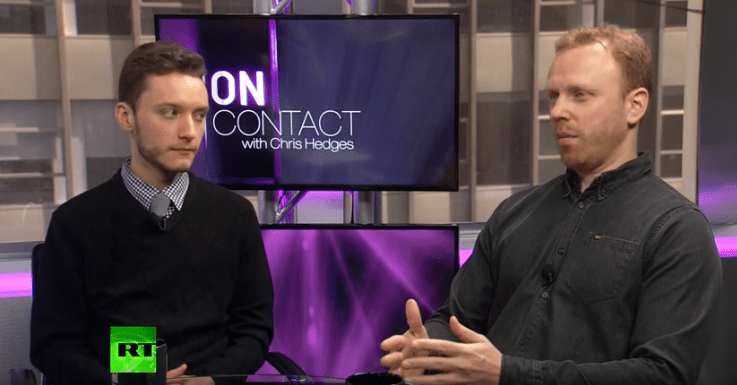
Last March, a live performance in support of Syrian first responders by a flashmob orchestra at New York’s Grand Central Station was physically disrupted by a group of six protesters. Within hours, the video of the disruption was uploaded to social media and promoted by an RT employee. Max Blumenthal, a blogger at Alternet, soon released documents that suggested the performance was organized by a pro-Syrian campaign group. In characteristic inversion of reality, RT billed the disruption as a triumph for “anti-war” direct action.
Three participants in the protest have so far been identified: all have links to RT, the Russian state-funded propaganda network now under investigation by the U.S. government for its alleged interference in the last presidential election. Alexander Rubinstein, the man who filmed the protest, is an RT employee, and Taryn Fivek and Sara Flounders, the two protesters, are RT contributors. Blumenthal, who amplified the story, is also a regular on RT.
Fivek was an officer with the International Organization for Migration until she was found to have used the pseudonym Emma Quangel on Twitter to cheer Russia’s actions in Syria and mock civilian suffering. Flounders, a steering committee member of the pro-Assad Syria Solidarity Movement, has graduated from denying Serb atrocities in Bosnia to denying Assad regime atrocities in Syria. Both have limited influence. It is Blumenthal who with Alternet has created an effective beachhead in the US for Kremlin propaganda.
Things were not always thus. In 2012, Blumenthal had publicly resigned as a columnist from the pro-Assad Lebanese daily Al Akhbar, citing as his reason the paper’s publishing of cheerleaders who blamed Assad’s victims and maligned critical journalists. He likened their behavior to that of Israel’s apologists. Blumenthal has now dramatically resurrected himself as an apologist for Assad, a scourge of critical journalists, and a mirror image—by his own logic—of Israel’s apologists.
What happened in between to occasion this dramatic reversal? Continue reading “Did a Kremlin Pilgrimage cause Alternet blogger’s Damascene conversion?”
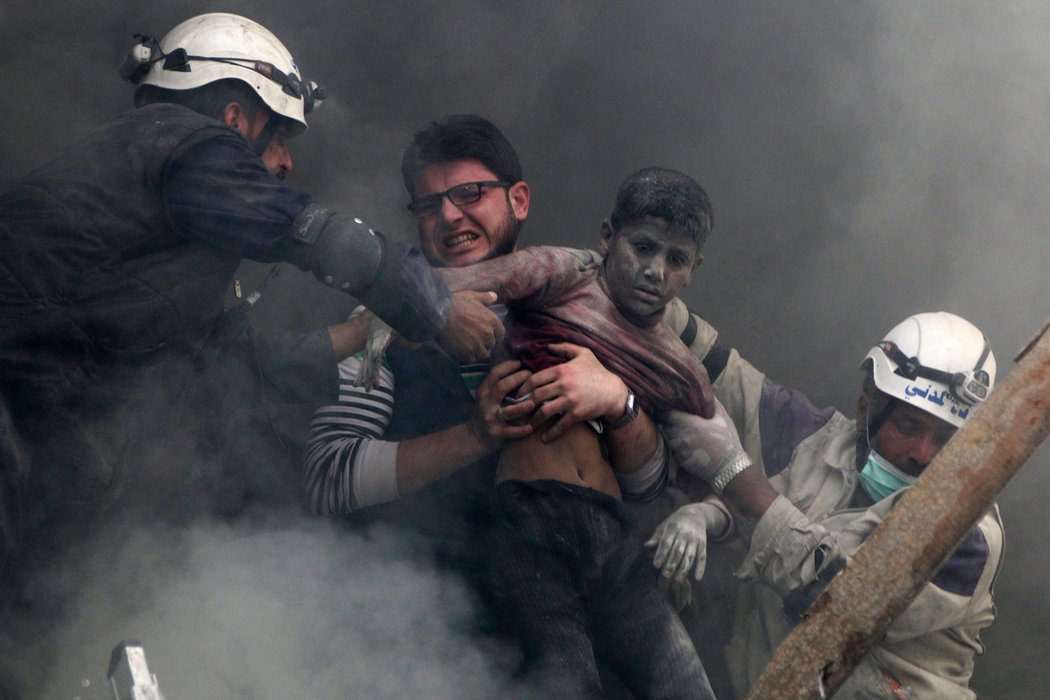
 You would know none of this if your only window into the Syrian conflict is the western media or, worse, its Kremlin counterpart. Syria, for all one can tell from their coverage, is about ISIS atrocities, Al Qaeda gains, Coalition bombings, regime advances, Russian resurgence and CIA manoeuvres. It is a geopolitical chessboard in which Syrians are mere pawns, denied agency, except in violence; denied humanity, except in victimhood. When earlier this week the UN war crimes prosecutor Carla del Ponte resigned over the Security Council’s inaction, she saw fit to add: “everyone in Syria is bad now”. She said this at a time the news of the execution of media activist Bassel Khartabil was becoming public, Idlib University was holding free elections, Saraqib and Eastern Ghouta were electing local councils and volunteers from the Syrian Civil Defence were risking lives to rescue victims of the regime’s relentless bombings. For del Ponte and her ilk, these people might as well not exist.
 P U L S E