From Guantanamo to Honduras: Psychological Wars Then and Now

embajada
Honduran military surrounds Brazilian embassy in Tegucigalpa. (Photo: AFP)

By Joseph Shansky

Recently, musicians such as Rage Against the Machine, Steve Earle and Pearl Jam joined the newly-formed National Campaign to Close Guantanamo Bay.  It’s a public effort to protest the past misuse of recordings during “enhanced interrogation techniques” at Guantanamo prison.  An exaggerated volume and incessant repetition of loud music are just a few auditory torture techniques famously used by the American government overseas to disorient prisoners. 

However, the issue of psychological warfare should not only be seen in a past context.  Since these revelations, the question of its continued use in other parts of the world deserves exposure.

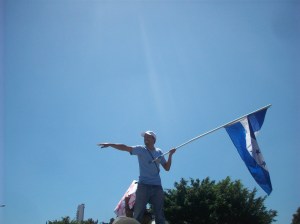
One timely example is Honduras.  In June of this year, President Manuel Zelaya was violently removed from power in a military coup d’état and replaced with a non-elected government, led by former National Congress leader Roberto Micheletti.  Since his return to Honduras September 21, President Zelaya has been residing with supporters in the Brazilian embassy in Tegucigalpa, with Honduran armed forces stationed outside.

Following orders by coup government officials, the army has been frequently directing harsh noises at the embassy occupants.  The most recent example took place early in the morning of October 21, when the broadcast included military anthems, rock music, and animal noises (pig grunts, in an apparent attempt to add insult to injury) at an excessive volume, and on a constant loop from around 1:30 am to 7 am. 

Continue reading “From Guantanamo to Honduras: Psychological Wars Then and Now”

Challenging the Dahiyeh Doctrine: the Samouni Family and the Goldstone Report

The Samouni family of Palestine lost 29 members of its extended family in Israel’s December massacre against the defenceless population in Gaza. Brenda Heard, founder of Friends of Lebanon, reveals how the goodwill of the Samouni family and assumption of continued cordiality with Israelis was repaid: in their family’s blood. The Samouni’s naive neighbourliness in the service of self-preservation was repaid with most of their extended family mercilessly wiped out by the occupying apartheid regime. This was not collaboration but a misguided attempt to co-exist under conditions of occupation and siege. The genocidal contempt towards genuine peace and all Palestinians is on display in a microcosm here as the UNHRC passes the Goldstone Report.

Continue reading “Challenging the Dahiyeh Doctrine: the Samouni Family and the Goldstone Report”

Khalil Bendib interviews Shlomo Sand

(Download Mp3)

Sand Invention-of-the-Jewish-smallFollowing an interview earlier this year, Khalil Bendib once again speaks with Tel Aviv University historian Dr. Shlomo Sand about his brand-new book, The Invention of the Jewish People. The book has become a best seller both in Israel and in France: Did the world’s Jewry truly originate in Palestine, and if not, why does that myth persist to this day?

Sand is currently touring the US: see also an interesting review of Shlomo Sand’s recent NYU lecture by Philip Weiss here.

Continue reading “Khalil Bendib interviews Shlomo Sand”

Smashing the Silence: Community Defiance in Honduras

Demonstration in front of Clarion Hotel, Tegucigalpa. (Photo: Joseph Shansky)

By Joseph Shansky

Since the few days of renewed excitement around the “secret” return to Honduras of democratically-elected President Manuel “Mel” Zelaya, there has been a disturbing omission of the Honduran political crisis in the international news.  It would be reasonable to think that with each passing day an exiled president was camped in a foreign embassy (as Zelaya has been in the Brazilian embassy since September 21st), tensions would rise and all eyes of the world would be on that lone building.  Instead the opposite has occurred and it appears as though the international press had lost interest without action to follow.  The subsequent collapse and renewal (and collapse again, etc.) of ongoing “negotiations” with Roberto Micheletti’s coup government did little to breathe life into this story.

Here in Tegucigalpa, life continues under subtle siege for ordinary citizens.  The city gets dark faster at night now and the people seem more frightened in general.  The curfew remains.  Small groups huddle together and glance around anxiously, couples hug closer, young girls grasp hands tighter and walk faster.  Militia is everywhere of course, made up of young, mostly uneducated kids who twirl their guns with abandon, dig their batons into the dirt and wait for a notice for action.  It can come at a whistle’s call here, and sometimes it feels as though the entire country is poised, frozen in battle.

Continue reading “Smashing the Silence: Community Defiance in Honduras”

Nobel Prize for Public Speaking

Robert Fisk, Richard Murphy and Azzam Tamimi discuss the Nobel Peace Prize to Barack Obama. Does he deserve the prize? And what has he achieved? Or was the award granted in the hope he would succeed in the future?

On Palestinian Civil Disobedience — Neve Gordon

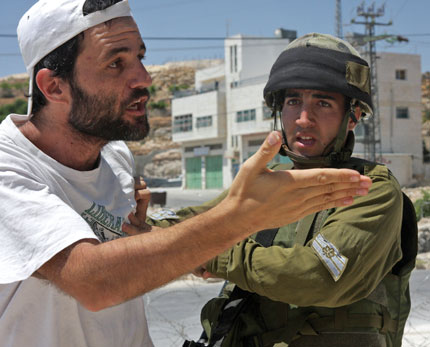
Kobi Snitz: "Even ten Israelis at a demonstration can make a real difference. We know from the army's own declarations that their open fire regulations change as soon as they think there are Israelis around."

A simple google search with the words “Palestinian violence” yields over 86,000 pages, while a search with the words “Palestinian civil disobedience” generates only  47 pages.
 
Sometime in 1846, Henry David Thoreau spent a night in jail because he refused to pay his taxes. This was his way of opposing the Mexican-American War as well as the institution of slavery. A few years later he published the essay Civil Disobedience, which has since been read by millions of people, including many Israelis and Palestinians.
 
Kobi Snitz read the book. He is an Israeli anarchist who is currently serving a 20 day sentence for refusing to pay a 2,000 shekel fine.
 
Thirty-eight year-old Snitz was arrested with other activists in the small Palestinian village of Kharbatha back in 2004 while trying to prevent the demolition of the home of a prominent member of the local popular committee. The demolition, so it seems, was carried out both to intimidate and punish the local leader who had, just a couple of weeks earlier, began organizing weekly demonstrations against the annexation wall. Both the demonstrations and the attempt to stop the demolition were acts of civil disobedience.

Continue reading “On Palestinian Civil Disobedience — Neve Gordon”

Sabra And Shatila: On massacres, atrocities and holocausts

In honour of the victims of the Sabra Shatila massacre, we are republishing this piece by Sonja Karkar from 2007. May we never forget this Israeli-enabled Phalangist crime. Warning: the following article depicts the horror of a massacre and should be read by mature readers — details of the atrocity appear over the fold.

candleSabra And Shatila
On massacres, atrocities and holocausts

by Sonja Karkar, Women for Palestine and Australians for Palestine

The Massacre

It happened twenty-five years ago – 16 September 1982. A massacre so awful that people who know about it cannot forget it. The photos are gruesome reminders – charred, decapitated, indecently violated corpses, the smell of rotting flesh, still as foul to those who remember it as when they were recoiling from all those years ago. For the victims and the handful of survivors, it was a 36-hour holocaust without mercy. It was deliberate, it was planned and it was overseen. But to this day, the killers have gone unpunished.

Sabra and Shatila – two Palestinian refugee camps in Lebanon – were the theatres for this staged slaughter. The former is no longer there and the other is a ghostly and ghastly reminder of man’s inhumanity to men, women and children – more specifically, Israel’s inhumanity, the inhumanity of the people who did Israel’s bidding and the world’s inhumanity for pretending it was of no consequence. There were international witnesses – doctors, nurses, journalists – who saw the macabre scenes and have tried to tell the world in vain ever since.

Continue reading “Sabra And Shatila: On massacres, atrocities and holocausts”

Looking For Eric, Melbourne Festival, and the Cultural Boycott

Rebecca O'Brien, Paul Laverty, Ken Loach, Kierston Wareing, Juliet Ellis and Leslaw Zurek at the Venice Film Festival 2007

In response to an earlier attack by Richard Moore of the Melbourne International Film Festival, The Guardian published an edited version of a response (Boycotts don’t equal censorship) by Ken Loach, Paul Laverty and Rebecca O’Brien. Here is the original.

When we decided to pull our film Looking for Eric from the Melbourne film festival following our discovery that the festival was in part sponsored by the Israeli state we wrote to the Director Richard Moore with our detailed reasons. Continually he has dishonestly misrepresented us and does so again (Comment is Free 27th Aug ‘09) by stating that “to allow the personal politics of one film maker to proscribe a festival position…..goes against the grain of what festivals stand for.” Later “Loach’s demands were beyond the pale”. Once again Mr Moore, this decision was taken by three film makers, (director, producer, writer) not in some private abstract bubble, but after long discussion between us and in response to a call for a cultural boycott, including film festivals, from a wide spectrum of Palestinian civil society, including writers, film makers, cultural workers, human rights groups, journalists, trade unions, women’s groups, student organizations and many more besides. As Moore should know by now “The Palestine Campaign for the Academic and Cultural Boycott of Israel” (PACBI) was launched in Ramallah in April 2004, and its aims, reasons, and constituent parts are widely available on the net. This in turn is part of a much wider international movement for “Boycott, Divestment, and Sanction” (B. D. S.) against the Israeli State.

Continue reading “Looking For Eric, Melbourne Festival, and the Cultural Boycott”

Surfing on Islamophobia

On Sunday, our good friend Phil Weiss posted a sympathetic piece by Scott McConnell, editor of The American Conservative, on Christopher Caldwell’s new book about Islam in Europe. Here is the response by PULSE editors Muhammad Idrees Ahmad and Robin Yassin-Kassab which was published on MondoWeiss today:
There are two sets of population statistics about Europe, writes Eliot Weinberger in a post on the London Review Blog: ‘those of the Islamophobes and those of everyone else.’ Weinberger is commenting on the recent of flurry of books trading in the ‘Islamic threat’, among them one by neoconservative writer Christopher Caldwell. In his encomium to Caldwell, Scott McConnell couldn’t possibly have been referring to the statistics of ‘everyone else’. It would be hard otherwise to elevate a minority of 3.6 percent into a civilizational threat. So presumably he accepts the numbers of the Islamophobes. But he does more; he also echoes their assumptions. Small wonder then that he should consider ‘nuanced’ a book that describes Muslims as ‘conquering Europe’s cities, street by street’.

But before we get to Caldwell lets address McConnell’s own assumptions.

McConnell splits ‘the West’ and ‘the Muslims’ into opposing camps, and understands their relationship only in terms of harm. ‘Had I to weigh the extent to which the Islamic world is more victim or victimizer of America and the West’, he opines, ‘the scales would tilt decisively towards America as the more guilty party’. American crimes include the Iraq war and support for Israeli conquest of ‘the Arab sections’ of Jerusalem and the West Bank. Support for dictators, the proponderance of military bases, the exploitation of resources, Somalia, Lebanon, Afghanistan, and support for the Israeli conquest of the ‘Arab sections’ of Tel Abib and Yaffa, clearly do not factor in McConnell’s narrow vision. But it’s fair enough in itself. Where logic fails McConnell entirely, or rather where he fails logic and turns to racism instead, is where he places Muslim immigration into Europe ‘on the other side of the ledger’.

Continue reading “Surfing on Islamophobia”

Scenes of Resistance: Notes from Tegucigalpa

marchBy Joseph Shansky

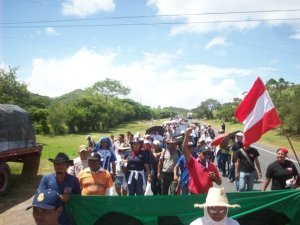
I came to Honduras as part of a delegation of concerned activists who went to witness and accompany the daily protests, monitor human rights violations, and report back to the international community on conditions since the June 28th military coup. On that day, democratically-elected President Manuel Zelaya was forcibly removed from office by the Honduran military and expelled from the country.  In the aftermath there has been an immediate popular uprising in his support, with many instances of severe police and military repression which continue today.  The following is a reflection on time spent in and around Tegucigalpa during two critical weeks in August.

Last night as I was packing my bags to go to Honduras, I heard that the military repression was getting worse.  One hundred and fifty arrested, many wounded.  I sit in the airport waiting room and scan CNN.  Not a mention on the world news.

Continue reading “Scenes of Resistance: Notes from Tegucigalpa”