Zelaya’s Return: Neither Reconciliation nor Democracy in Honduras

Credit: FNRP

by Adrienne Pine

This article was first published in NACLA.

Over the past few weeks U.S. Secretary of State Hillary Clinton and latter-day media “experts” have hailed Manuel Zelaya’s return to Honduras and the pending reintegration of the country into the OAS as a restoration of democracy. Here in Honduras, it is clear that such claims could not be further from the truth. Despite the triumphal language of Venezuelan president Hugo Chávez, Colombian president Juan Manuel Santos, Honduran president Porfirio Lobo, and even Zelaya himself following their signing of the Cartagena Accords, Honduras today is no closer to reconciliation than it was in the months following the June 28, 2009 military coup.

As Dana Frank points out in The Progressive on May 27, the Cartagena Accords ensure the reinstatement of Honduras into the OAS in return for only one “concession” that is not already ostensibly guaranteed: that the trumped-up charges, leveled against Zelaya by the same court that legitimated his unconstitutional expulsion from the country, be dropped. That this should be sufficient for Honduras’s return is perplexing, given that the country was expelled under Article 21 of the OAS Democratic Charter, which reads in part:

When the special session of the General Assembly determines that there has been an unconstitutional interruption of the democratic order of a member state, and that diplomatic initiatives have failed, the special session shall take the decision to suspend said member state from the exercise of its right to participate in the OAS by an affirmative vote of two thirds of the member states in accordance with the Charter of the OAS.

Continue reading “Zelaya’s Return: Neither Reconciliation nor Democracy in Honduras”
Pakistan: A Hard Country

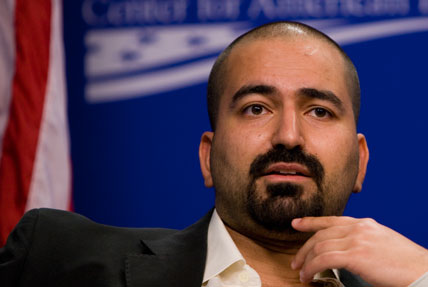
Anatol Lieven discusses his new book Pakistan: A hard country, which I shall review here shortly.

The people want…

Part of Al Jazeera’s The Arab Awakening series.

“The people want the fall of the regime” is the shared slogan of the Arab uprisings. In this episode an array of characters from across the region explain what they want and what they expect for the future.

Absolute Power

Part of Al Jazeera’s The Arab Awakening series.

As revolution shakes the Arab world, a series of films explore the roots of the uprisings and ask ‘what next’? Those in a position to know reveal the ‘tricks of the trade’ of Arab dictatorship.

Why I disrupted Benjamin Netanyahu


Rae Abileah in her own words (crossposted from Mondoweiss).

Do you know that our Congress gave 29 standing ovations to Israeli Prime Minister Benjamin Netanyahu when he spoke in the Capital on Tuesday, May 24? I couldn’t watch this hero’s welcome for a man who supports the continued building of illegal settlements, won’t lift the siege of Gaza and refuses to negotiate with the new Palestinian unity government. During the talk, when Netanyahu was praising young people rising up for democracy in the Middle East, and I took my cue to stand up from my seat in the Capital Gallery, unfurl a banner, and shout, “No More Occupation! Stop Israeli War Crimes! Equal Rights for Palestinians!”

Continue reading “Why I disrupted Benjamin Netanyahu”

Ellsberg: I’m not a traitor… nor is Manning

Daniel Ellsberg, former U.S. military analyst who famously leaked the Pentagon Papers in 1971 weighs in on if he thinks this has been a good or bad year for journalism.

Mr Netanyahu goes to Washington…and Washington quails

Former Ambassador Chas Freeman on AIPAC’s campaign against Barack Obama, despite the latter’s extraordinary efforts to appease the lobby group.

John Mearsheimer thinks that Obama is doomed to disappoint.

Barack Obama gave a major speech on the Middle East on Thursday, May 19, and it is clear from the subsequent commentary that he impressed few people. The main reason for this is that he did not say much new or indicate that there would be any serious changes in US policy in the region. It was essentially more of the same with some tweaking here and there. Nevertheless, he did manage to anger some people. For example, Israel’s hard-line supporters were outraged that he said: “Palestine should be based on the 1967 lines with mutually agreed swaps.” For them, the 1967 borders are “Auschwitz borders” and thus can never serve as a basis for negotiations.

Continue reading “Mr Netanyahu goes to Washington…and Washington quails”

Nir Rosen on Western media fraud in the Middle East

Journalist and author Nir Rosen writes the following in an article for Al Jazeera about the myriad obstacles to the dissemination of truth in Western reporting on the Middle East:

Relying on a translator means you can only talk to one person at a time and you miss all the background noise. It means you have to depend on somebody from a certain social class, or sect, or political position, to filter and mediate the country for you. Maybe they are Sunni and have limited contacts outside their community. Maybe they are a Christian from east Beirut and know little about the Shia of south Lebanon or the Sunnis of the north. Maybe they’re urban and disdainful of those who are rural. In Iraq, maybe they are a middle class Shia from Baghdad or a former doctor or engineer who looks down upon the poor urban class who make up the Sadrists. And so in May 2003, when I was the first American journalist to interview Muqtada Sadr, my bureau chief at Time magazine was angry at me for wasting my time and sending it on to the editors in New York without asking him, because Muqtada was unimportant, lacking credentials. But in Iraq, social movements, street movements, militias, those with power on the ground, have been much more important than those in the establishment or politicians in the green zone, and it is events in the red zone which have shaped things.

Continue reading “Nir Rosen on Western media fraud in the Middle East”

Here comes your non-violent resistance

While in the US even CNN’s liberal icon Anderson Cooper is busy portraying Palestinian Nakba protests as a Syrian conspiracy (with able assistance from neoconservative house-Arab Fouad Ajami), the Economist shows how with all their constitutional protections, the docile American media can’t match the standards of an even staid and conservative British magazine. Check out this gem from from the Economist’s M.S.

FOR many years now, we’ve heard American commentators bemoan the violence of the Palestinian national movement. If only Palestinians had learned the lessons of Gandhi and Martin Luther King, we hear, they’d have had their state long ago. Surely no Israeli government would have violently suppressed a non-violent Palestinian movement of national liberation seeking only the universally recognised right of self-determination.

Palestinian commentators and organisers, including Fadi Elsalameen and Moustafa Barghouthi, have spent the last couple of years pointing out that these complaints resolutely ignore the actual and growing Palestinian non-violent resistance movement. For that matter, they elide the fact that the first intifada, which broke out in 1987, was initially as close to non-violent as could be reasonably expected. For the most part, it consisted of general strikes and protest marches. In addition, there was a fair amount of kids throwing rocks, as well as the continuing threat of low-level terrorism, mainly from organisations based abroad; the Israelis conflated the autochthonous protest movement with the terrorism and responded brutally, and the intifada quickly lost its non-violent character. That’s not that different from what has happened over the past couple of months in Libya; it shows that it’s very hard to keep a non-violent movement non-violent when the government you’re demonstrating against subjects you to gunfire for a sustained period of time.

Continue reading “Here comes your non-violent resistance”