Revolution In The Head And The Art Of Protest

A documentary about Rage Against The Machine by See of Sound.

Arguably the most provocative band of the last 20 years, Rage Against The Machine have since their explosive debut, been the group most associated with the American protest movement. This film dissects the work and career of RATM and looks at their place in this always fascinating lineage of artists and performers who have spoken out on behalf of, and drawn attention to, the world’s marginalised, downtrodden and oppressed. Picking up the flame from a linear musical tradition going back to the War Of Independence, with the best known protagonists coming up during the 1950s and 60s civil rights movement via artists such as Pete Segar and the young Bob Dylan, the anger remained as brutal as ever during the final decade of the 20th Century in Rage and contemporaries like Public Enemy. FEATURING: Brand new interviews with; renowned Rage producer and engineer, Garth Richardson; RATM Biographer, Colin Devenish; the band’s live sound engineer, Dave ‘Rat’ Levine and the man who signed them Michael Goldstone. With further contributions from folk-protest singer and author Jerry Silverman, ex-‘Rolling Stone’ editor Joe Levy, and Professor of American Studies and English at Washington State University, T.V. Reed.
Egyptian unrest and US media bias

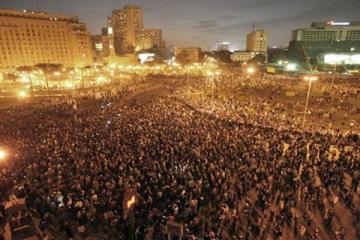
The coverage of Egyptian uprising in the TV Channels across US have been criticised for being both pessimistic and superficial. Since the pro-democracy protests began, the mainstream American media has focused sharply on what it all means for the U.S. and its allies in the region.

Zizek and Ramadan on future of Egypt

Zizek is in fine form on the Riz Khan Show. In a recent op-ed he noted that

the most shameful and dangerously opportunistic reaction was that of Tony Blair as reported on CNN: change is necessary, but it should be a stable change. Stable change in Egypt today can mean only a compromise with the Mubarak forces by way of slightly enlarging the ruling circle. This is why to talk about peaceful transition now is an obscenity: by squashing the opposition, Mubarak himself made this impossible. After Mubarak sent the army against the protesters, the choice became clear: either a cosmetic change in which something changes so that everything stays the same, or a true break.

The revolutionary chants on the streets of Egypt have resonated around the world, but with a popular uprising without a clear direction and an unpopular leader refusing to concede, Egypt’s future hangs in the balance. Riz Khan talks to Muslim scholar Tariq Ramadan and Slovenian philosopher Slavoj Zizek about the power of popular dissent, the limits of peaceful protest and the future of Egyptian politics.

Egyptian Riot Grrls: Finding the Feminine Face of Fury

by Beenish Ahmed

(AP Photo/Ben Curtis)

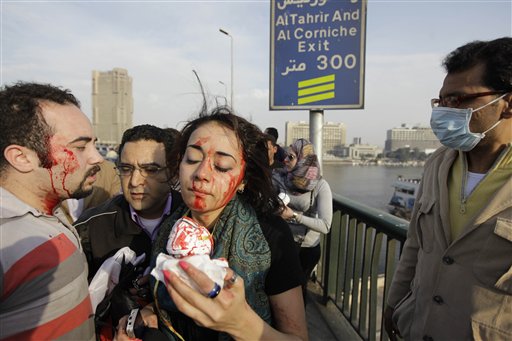
Much has been aflutter on twitter about the very visible presence of women among the protests that have taken Egypt by storm over the last few weeks, but images of them have remained sparse amid the digital slideshows strung together by major media outlets, portraying mainly dense crowds of the manly.

What falls within these frames does not necessarily paint a full picture, since as Egyptian Organization for Human Rights activist Ghada Shahbandar claims, the crowd in downtown Cairo is up to 20 percent female. Others have put the number much higher, at 50 percent.

Although they are less prevalent, some efforts have been made to depict the role of women this popular uprising. The Global Post put together a slideshow on the Women of Egypt among the March of Millions in Tahrir Square, and a compilation of photographs from various sources can be found on sawt al niswa, a self-described “feminist webspace.”

A quick look through the reels of these images reveals the feminine side of fury and eliminates any remaining shred of doubt that the issues of unemployment and corruption that are widely cited as the primary causes for this unrest effect only men.

Continue reading “Egyptian Riot Grrls: Finding the Feminine Face of Fury”

Freedom lies behind a door closed shut, to be knocked down with a bleeding Arab fist …

by Tariq Ali

“Freedom lies behind a door closed shut,” the great Egyptian poet Ahmed Shawqi wrote in the last century. “It can only be knocked down with a bleeding fist.” More than that is bleeding in the Arab world at the moment.

The uprisings we are witnessing in Egypt have been a rude awakening for all those who imagined that the despots of the Arab world could be kept in place provided they continued to serve the needs of the West and their harsh methods weren’t aired on CNN and BBC World. But while Western establishments lull themselves to sleep with fairy tales, ordinary citizens, who are defeated and demoralized, mull their revenge.

The French government seriously considered sending its paratroopers to save former President Zine El Abidine Ben Ali in Tunisia. Israeli Prime Minister Benjamin Netanyahu is pleading with officials in Washington to delay Hosni Mubarak’s departure from Egypt so that Israel has time to prepare for the likely outcome. Former U.K. Prime Minister Tony Blair is even describing the Egyptian dictator as a “force for good.”

The almost 200 pro-democracy citizens who have been killed don’t bother him too much. That’s small beer compared with the tens of thousands dead in Iraq. And a desperate Palestine Liberation Organization is backing Mubarak and repressing solidarity demonstrations in Ramallah on the West Bank.

Continue reading “Freedom lies behind a door closed shut, to be knocked down with a bleeding Arab fist …”

An Arab 1848: Despots Totter and Fall

by Tariq Ali

He can’t stay any longer because the military has declared that they will not shoot their own people. This excludes a Tiananmen Square option. Were the Generals (who have so far sustained this regime) to go back on their word it would divide the army, opening up a vista of civil war. Nobody wants that at the moment, not even the Israelis who would like their American friends to keep their point man in Cairo for as long as possible. But this, too, is impossible.

So, will Mubarak go this weekend or the next? Washington wants an ‘orderly transition’, but the hands of Suleiman the Spook (or Sheikh Al-Torture as some of his victims refer to him), the Vice-President they have forced Mubarak to accept, are also stained with blood. To replace one corrupt torturer with another is no longer acceptable. The Egyptian masses want a total regime change, not a Pakistan-style operation where a civilian crook replaces a uniformed dictator and nothing changes.

The Tunis infection has spread much more rapidly than anyone imagined. After a long sleep induced by defeats—military, political moral—the Arab nation is reawakening. Tunis impacted immediately on neighboring Algeria and the mood then crossed over to Jordan and reached Cairo a week later. What we are witnessing are a wave of national-democratic uprisings, reminiscent more of the 1848 upheavals —  against Tsar and Emperor and those who collaborated with them — that swept Europe and were the harbingers of subsequent turbulence. This is the Arab 1848. The Tsar-Emperor today is the President in the White House. That is what differentiates these proto-revolutions from the 1989 business: That and the fact that with few exceptions, the masses did not mobilize themselves to the same degree. The Eastern Europeans lay down before the West, seeing in it a happy future and singing ‘Take Us, Take Us. We’re Yours Now.’

Continue reading “An Arab 1848: Despots Totter and Fall”

Mubarak’s goons charge protesters on horses and camels

Anderson Cooper, who earlier in the day was assaulted by Mubarak’s goons, describes scenes from the day.

Obama 2.0

Marwan Bishara brings another episode of Empire with Ralph Nader, As’ad Abukhalil, Roger Hodge, and Stefan Halper.

Two years after an historic victory that saw the first African-American elected president of the US, Barack Obama has come under pressure. Empire discusses the failures and successes of Barack Obama’s presidency.

Mubarak to Georgetown: Hire me like you hired Uribe

Humorous video suggests Mubarak prolong his shelf life by following in the footsteps of former Colombian President Alvaro Uribe: