“All That We Share” isn’t enough

by Robert Jensen

A review of All That We Share: A Field Guide to the Commons/How to Save the Economy, the Environment, the Internet, Democracy, Our Communities, and Everything Else That Belongs to All of Us by Jay Walljasper and On the Commons

The New Press, 2010, 288 pages, $18.95
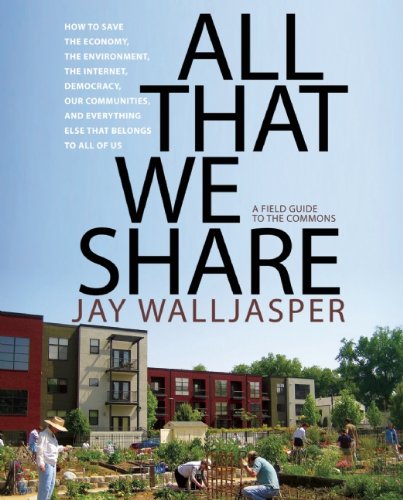
All That We Share is an exciting and exasperating book. The excitement comes from the many voices arguing to place “the commons” at the center of planning for a viable future. The exasperation comes from the volume’s failure to critique the political and economic systems that we must transcend if there is to be a future for the commons.

In the preface, the book’s editor and primary writer, Jay Walljasper, describes how he came to understand the commons as a “unifying theme” that helped him see the world differently and led him to believe that “as more people become aware of it, the commons will spark countless initiatives that make a difference for the future of our communities and the planet.”

Defining the commons as “what we share” physically and culturally — from the air and water to the internet and open-source software — the contributors recognize that a society that defines success by individuals’ accumulation of stuff will erode our humanity and destroy the planet’s ecosystems. Walljasper calls for a “complete retooling” and “a paradigm shift that revises the core principles that guide our culture top to bottom.” No argument there. Unfortunately the book avoids addressing the specific paradigms we must confront. Is commons-based transformation possible within a capitalist economy based on predatory principles and an industrial production model built on easy access to cheap concentrated energy?

Continue reading ““All That We Share” isn’t enough”

Street-fighting, still

Our good friend Tariq Ali, who was the inspiration for the Rolling Stones classic Street Fighting Man, continues to inspire. Here he speaks to students activists at the SOAS occupation.

On a wing and a prayer

Flying is one of the safest modes of travel — i.e., unless you are flying a Boeing 737 NG. As the following investigation by Tim Tate reveals, the FAA and Boeing have been covering up serious structural flaws with this most widely used model. Next time you are on a 737, just hope that the manufacturers have read Arthur Miller’s All My Sons.

Air travel is a question of trust, but a People & Power investigation asks what happens when that trust is shaken.

We Want You Out

An open letter from the Afghan Youth Peace Volunteers and Afghans for Peace

As the Obama administration releases its December review of the U.S. war effort in Afghanistan, the Afghan Youth Peace Volunteers, along with Afghans for Peace, have issued a review of their experiences.  To express support for their letter, click here.

To all the leaders of our world, the leaders of the US-led coalition, the Afghan government, the ‘Taliban/Al-Qaeda’ and regional countries,

We are intolerably angry.

All our senses are hurting.

Our women, our men and yes shame on you, our children are grieving.

Your Afghan civilian-military strategy is a murderous stench we smell, see, hear and breathe.

President Obama, and all the elite players and people of the world, why?

America’s 250-million-dollar annual communications budget just to scream propaganda on this war of perceptions, with its nauseating rhetoric mimicked by Osama and other warlords, is powerless before the silent wailing of every anaemic mother.

We will no longer be passive prey to your disrespectful systems of oligarchic, plutocratic war against the people.

Your systems feed the rich and powerful. They are glaringly un-equal, they do not listen, do not think and worst, they do not care.

Continue reading “We Want You Out”

Ostrich America?

by Chase Madar

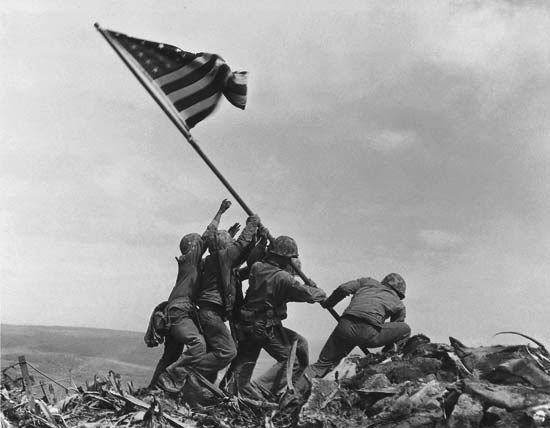
Famous photograph of the US isolating itself in Iwo Jima. (Photo: Joe Rosenthal, 1945)

Of all the received ideas that clog America’s foreign-policy discourse, none is more at variance with reality than the threat of isolationism. We have never been more engaged with every corner of the world, yet we have never been lectured more often about the consequences of “retreating within our borders.” The more countries we attack—Pakistan, Somalia, Yemen—the more dire warnings we get about national introversion. The specter of isolationism has never looked healthier.

A case in point was George W. Bush’s 2006 State of the Union address, a venue he used to tell a spine-chilling tale. With his foreign policy exploding all around him, Bush warned against an even more disastrous alternative: there were those who would “tie our hands” and have us “retreat within our borders.” From the tenor of his talk, he seemed to think that Americans were about to burn down both the Pentagon and Department of State, beat defense intellectuals into postal workers, and force every house in the land to set up a little steel foundry in the back yard—just like in the Great Leap Forward—while learning to live on grubs and wild mountain honey.

Of course, this is absurd: as many pointed out in response to this scaremongering, there are no isolationists in America—not in either political party, not in the media, and not in the academy. (The i-word is often used as a synonym for unilateralism. Here I am assigning only its most common meaning: a tendency to ignore security threats beyond territorial borders and disengage diplomatically, politically, and economically from the rest of the world.) Nevertheless, the menace of a return to geopolitical autarky is carted out whenever our sclerotically narrow foreign-policy consensus gets an unwelcome jolt. This habit of mind did not end with the exit of George W. Bush.

Continue reading “Ostrich America?”

Neocons holding up START treaty

The neoconservatives represent the Likud wing of the Israel lobby. In the 1970s, when the United States was reeling from the defeat in Vietnam, and reconsidering its imperial stance, the neocons joined the military-industrial complex and unreconstructed Cold Warriors to derail the Strategic Arms Limitation Treaty (SALT) and Nixon’s detente. The Cold War is over, but the neocons still have an interest in maintaining a state of conflict. Once again, therefore, they are derailing a worthy arms control initiative. Here are some wise words from Ivan Eland as to why the neocons are so afraid of New START.

The START treaty, which would reduce the United States and Russia’s nuclear arsenals by 30%, has been held up in Congress for months by neoconservatives. Will the treaty gain any traction before more conservatives join Congress in January? RT’s Dina Gusovsky is joined by Jacob Hornberger from The Future of Freedom Foundation and Ivan Eland from the Independent Institute to discuss the START treaty.

Careless Words and Callous Deeds

by David Bromwich

It has lately become usual for right-wing columnists, bloggers, and jingo lawmakers to call for the assassination of people abroad whom we don’t like, or people who carry out functions that we don’t want to see performed. There was nothing like this in our popular commentary before 2003; but the callousness has grown more marked in the past year, and especially in the past six months. Why? A major factor was President Obama’s order of the assassination of an American citizen living in Yemen, the terrorist suspect Anwar al-Awlaki. This gave legal permission to a gangster shortcut Americans historically had been taught to shun. The cult of Predator-drone warfare generally has also played a part. But how did such remote-control killings pick up glamor and legitimacy? Here again, the president did some of the work. On May 1, at the White House Correspondents dinner, he made an unexpected joke: “Jonas Brothers are here tonight. Sasha and Malia are huge fans. But boys, don’t get any ideas. Two words: predator drones. You will never see it coming.” The line caught a laugh but it should have caused an intake of breath. A joke (it has been said) is an epigram on the death of a feeling. By turning the killings he orders into an occasion for stand-up comedy, the new president marked the death of a feeling that had seemed to differentiate him from George W. Bush. A change in the mood of a people may occur like a slip of the tongue. A word becomes a phrase, the phrase a sentence, and when enough speakers fall into the barbarous dialect, we forget that we ever talked differently.

Continue reading “Careless Words and Callous Deeds”

‘We don’t need no occupation … Hey, AIPAC, leave Palestine alone!’

Great marshalling of Pink Floyd’s ‘Another Brick in the Wall’ by a CodePink flashmob yesterday.

On Monday, December 13, when the American Israel Public Affairs Committee held its annual dinner in Oakland, a group of activists performed a flashmob inside the Marriott hotel to the tune of Pink Floyd’s ‘Another Brick in the Wall’ addressing Israel’s illegal occupation of Palestine. Six activists and one writer were arrested. The flashmob was coordinated by activists representing CODEPINK Women for Peace, American Friends Service Committee, US Boat to Gaza, Students for Justice in Palestine, Queers Undoing Israeli Terror and Don’t Buy Into Apartheid.

Death Squads versus Democracy

by Prof. Michael Keefer

Right-wing Canadian pundit Tom Flanagan contemplating Julian Assange's assassination.

Tom Flanagan, University of Calgary political science professor, right-wing pundit, and mentor and former senior adviser to Prime Minister Harper, has earned himself more international media attention during the past week than even he may have an appetite for.

On November 30th, Flanagan spoke as one of the regular panelists on CBC Television’s national political analysis program, Power and Politics with Evan Solomon. Staring into the camera, while across the bottom of the television screen there appeared a banner reading “WIKILEAKS LATEST: New document mentions PM Stephen Harper,” Flanagan had this to say about Julian Assange, the founder and editor of Wikileaks:

Well, I think Assange should be assassinated, actually. I think Obama should put out a contract and maybe use a drone or something.

Continue reading “Death Squads versus Democracy”

Jody McIntyre exposes the BBC’s disabilities

This is what passes for journalism on the BBC.  Here is Jody McIntyre, a disabled youth, a wonderful human being, who was assaulted by the police at a student protest. And what does the BBC do? It spends over eight minutes fearlessly interrogating the wheelchair-bound youth with cerebral palsy, prodding him to explain how he invited the attack by ‘provoking’ the police. McIntyre demonstrates that he may be physically impaired, but he is a moral giant. The BBC on the other hand is disabled both morally and ethically.

The disgusting sack of shit conducting the interview is called Ben Brown. Please make sure to register your displeasure: http://www.bbc.co.uk/complaints/ and please share widely, lest anyone still harbour the belief that the BBC is anything but a state propaganda organ.

UPDATE: Reader Squall has this useful suggestion:

Don’t complain to the BBC. They’re already rejecting complaints about this, and they never agree that they’ve failed to be impartial anyway.

Complain to Ofcom. State that the BBC has broken section 5.1 (Due Impartiality and Due Accuracy in News) of the Broadcasting Code.
https://stakeholders.ofcom.org.uk/tell-us/specific-programme-epg