Julian Assange on Larry King Live, telling it like it is.
Julian Assange on Larry King Live, telling it like it is.
In a special investigative report for Al Jazeera journalist and author Dahr Jamail presents evidence that BP’s dispersants are not only ‘causing sickness’ in the defenseless wildlife in and around the area, but in humans too.
by Tariq Ali

Arundhati Roy is both loathed and feared by the Indian elite. Loathed because she speaks her mind. Feared because her voice reaches the world outside India and damages the myths perpetrated by New Delhi regardless of which party holds power. She often annoys the official Indian Left because she writes and speaks of events for which they are either responsible or of which they dare not speak. Roy will not allow her life to be subjugated by lies. She never affects a courage or contempt she does not feel. Her campaigns against injustice are undertaken with no view to either fame or profit. Hence the respect awarded her by the poor, ordinary citizens, who know the truth but are not allowed a voice in the public sphere. The authorities can’t buy her silence. One of the few voices in India who has spoken loudly against the continuing Indian atrocities in Kashmir, she is now being threatened. If she doesn’t shut up they’ll charge her with sedition, aping their colonial masters of yesteryear. Her response to those who would charge and imprison her is a model of clarity, conviction and refusal to compromise.
Editor’s note: Also see Democracy Now’s interview with Arundhati Roy. This post first appeared on the London Review Blog.
by Jerica Arents
Editor’s Note: American peace activists Kathy Kelly, Jerica Arents and David Smith-Ferri are part of a 3 person delegation currently travelling in Afghanistan. Find more entries from their travelogues on PULSE.
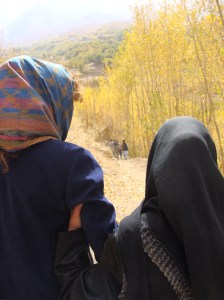
Kabul, Afghanistan – After a week visiting Bamiyan, a rural Afghan Province, one thing has been made abundantly clear to me: the experience of being a woman in this country is much different than being a woman in the United States. Here, the inescapable and indelible fact of gender colors social interactions, far more so than back home. But being a woman has also created safe spaces of inclusion within the village’s maternal system, from which I would have otherwise been kept at a distance.
Time and time again, after meeting with the men in the family, I was led into a separate room to visit with the women, who had gathered there and were waiting eagerly for us with their children. Immediately, an exchange began, a series of greetings, smiles, thanksgivings, and comments about the style of my clothes, quality of my hands, or strangeness of my backpack. Daughters and granddaughters would join us, children at their feet, each little face more beautiful than the last.
When we met with women and men together, the men tended to be the focal point, dominating the conversation. In the absence of their male counterparts, the women, adorned in vibrant cloths, filled the sparsely furnished rooms with stories and laughter. In this conservative Afghan village, one woman shared with us the heartbreaking experience of having her husband kidnapped and killed by the Taliban – and raising her kids, now teenagers, without the breadwinner of the house. She looked down at her wrinkled hands and paused before telling us of her struggles with depression. “We age so quickly here” she reflected, looking up at me, circles under her eyes. Her skin was weathered and worn, bearing the years of harsh living conditions and inadequate nutrition. I would have guessed she was in her late 50s – she is in fact only 38.
John Mearsheimer debates the WikiLeaks war logs with Patrick Mansoor, a former Petraeus aide.
JOHN MEARSHEIMER, University of Chicago:
[I]t does make it very clear how horrible the violence has been in Iraq since we invaded in 2003. And it also is quite clear from the documents that the United States has played an important role in making that violence happen.Not only do the documents show that American soldiers and airmen have killed large numbers of civilians. It’s also clear that we didn’t do much at all to stop the Iraqis from torturing and murdering prisoners. This was a huge mistake on our part. […]
Pity the nation that has to silence its writers for speaking their minds. Pity the nation that needs to jail those who ask for justice.

Kashmir, Oct. 26—I write this from Srinagar, Kashmir. This morning’s papers say that I may be arrested on charges of sedition for what I have said at recent public meetings on Kashmir. I said what millions of people here say every day. I said what I, as well as other commentators have written and said for years. Anybody who cares to read the transcripts of my speeches will see that they were fundamentally a call for justice. I spoke about justice for the people of Kashmir who live under one of the most brutal military occupations in the world; for Kashmiri Pandits who live out the tragedy of having been driven out of their homeland; for Dalit soldiers killed in Kashmir whose graves I visited on garbage heaps in their villages in Cuddalore; for the Indian poor who pay the price of this occupation in material ways and who are now learning to live in the terror of what is becoming a police state.
Yesterday I traveled to Shopian, the apple-town in South Kashmir which had remained closed for 47 days last year in protest against the brutal rape and murder of Asiya and Nilofer, the young women whose bodies were found in a shallow stream near their homes and whose murderers have still not been brought to justice. I met Shakeel, who is Nilofer’s husband and Asiya’s brother. We sat in a circle of people crazed with grief and anger who had lost hope that they would ever get insaf-justice-from India, and now believed that Azadi-freedom-was their only hope. I met young stone pelters who had been shot through their eyes. I traveled with a young man who told me how three of his friends, teenagers in Anantnag district, had been taken into custody and had their finger-nails pulled out as punishment for throwing stones.
Continue reading “Arundhati Roy Responds to Threat of Arrest for Sedition”
UPDATE: See part II of Al Jazeera’s Secret Iraq Files below. Also see Part 1 and Part 2 of Democracy Now‘s interview with Julian Assange, and Daniel Ellsberg on why he supports Wikileaks.
The Wikileaks war logs present irrefutable evidence of the murder, torture and rape which has been occuring for the past seven years in Iraq. However, it is not clear why it has chosen to collaborate with the dubious Iraq Body Count which for years has been providing a convenient underestimate of Iraqi casualties to war supporters.
by David Smith-Ferri
Editor’s Note: American peace activists Kathy Kelly, Jerica Arents and David Smith-Ferri are part of a 3 person delegation currently travelling in Afghanistan. Find more entries from their travelogues on PULSE.
 Again and again in this isolated Afghan province, when visiting Afghan people in their homes or when talking with members of the Afghan Youth Peace Volunteers (AYPV), we have heard this message: “We want to know the people of the world, and we want the world to know that we are human beings, not animals.”
On our first night in Bamiyan, we joined the AYPV at a restaurant on the main street in town. The restaurant, unlike those I am accustomed to visiting, served groups of customers in separate, rooms. So we walked down an alley, around the back of the restaurant, up a steep flight of metal stairs to a narrow landing which opened onto several small, windowless rooms. Inside one of them we arranged ourselves as comfortably as possible on the floor and along the walls, eleven Afghan youth and three Americans.
At the outset of the conversation, fourteen-year-old Ali asked us, “How do Americans know we are bad?” The question burst out of him, without preamble, as though he’d been carrying it for years, waiting for this opportunity. He followed it with a statement: “We want Americans to know we are not animals.” Later, while he held my arm and walked me home in the dark, I asked Ali about this belief regarding American perceptions of Afghan people. “Why else would they bomb us?” he said. There wasn’t anything more to say.
Today, two days later, we again gathered for a shared meal, this time in twenty-year-old Moh’d (short for Mohammad) Jan’s home, in a village outside Bamiyan. We piled into a van, and drove out over rocky, pitted, unpaved mountain roads, following the fickle course of a narrow river. High, red-rock cliffs loomed above us, and wherever there was flat land, it was cultivated. “Would you like to leave the car here and walk to my home along the river?” Moh’d Jan asked. We readily agreed.
Stenciled on nearby rocks in the Dari language were words warning people that the hills above are laced with landmines. We left the road and followed a creek lined with willow and cottonwood trees, along the edge of cultivated plots – apple orchards, potato fields being harvested, swaths of thickly-sown, bright green pea plants – the autumn sun pouring into the valley with sweet abundance, as though time had stopped and it would always be like this.
Continue reading ““Tell them to come to Afghanistan and make friends””
by Jerica Arents
Editor’s Note: American peace activists Kathy Kelly, Jerica Arents and David Smith-Ferri are part of a 3 person delegation currently travelling in Afghanistan. Find more entries from their travelogues on PULSE.
 Kabul, Afghanistan – After an exhausting day trekking through the dirt roads of the city of Bamiyan and outlying settlements, three Americans were guided by a dozen Afghan boys to a tent packed with overstuffed pillows and comforters. After the boys served them a delicious meal cooked over a small outdoor stove, they affixed their flashlights to the spine of the tent and invited the Americans to enter. Unlike the forts I made in my parents’ living room when I was little, this tent had a pressing message: a group of youngsters in a central province of Afghanistan want peace, not war.
The Afghan Youth Peace Volunteers, a group of ethnically diverse young men from a city one hundred miles northwest of Kabul, have been actively speaking out against the U.S- and NATO occupation for the last four years. The boys have endured grave opposition and community ridicule. However, through the help of networking sites and YouTube, this group of young men want to ask the world, “Why not love?”
“Our life is a life of the poor”, reflected the mother of one of the boys as we sat in her simple village home. With Afghanistan now being the worst country a child can be born into, alongside the challenges of building life in a country that has been fraught with thirty years of war, the very existence of this group of gentle spirits is miraculous. Many of these boys have lost one or both of their parents to infectious disease or conflict. Their city of 60,000 has no running water, little internet access, and a few hours of generated electricity a night. A barrage of cars, bicycles, donkeys, motorcycles and vans share the single-lane paved road that bisects the city – and over and over again we experienced the striking hospitality of this tense land.
 P U L S E