Pachamama and Progress: Conflicting Visions for Latin America’s Future

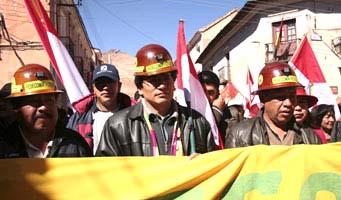
Miners march in Potosí, Bolivia (Photo: Telesur)

by Benjamin Dangl

Miners in Potosí, Bolivia set off sticks of dynamite as cold winter winds zipped through the city, passing street barricades, protests, hunger strikers and an occupied electrical plant. These actions took place place from late July to mid-August against the perceived neglect of the Evo Morales administration toward the impoverished Potosí region.

This showdown in Bolivia is similar to conflicts across Latin America between the promises of left-leaning governments, the needs of the people and the finite resources of Pachamama (Mother Earth).

Diverse social organizations, miners, unions, students, local residents, and even the city’s soccer team, united in the protest in late July. The mobilizations shut down the city and many mining operations. Residents criticized what they saw as the government’s lack of attention, funding and development projects for Potosí, the poorest department in the country.

Continue reading “Pachamama and Progress: Conflicting Visions for Latin America’s Future”

Naomi Klein, Hernando de Soto and Joseph Stiglitz on Economic Power

Naomi Klein, Hernando de Soto and Joseph Stiglitz speaking on economic power at the Graduate Centre, CUNY, moderated by David Harvey. See speaker biographies over the fold. From the fora.tv series ‘Is capitalism dead‘? Run time is 62 minutes, with a ten minute preview.

Vodpod videos no longer available.

Continue reading “Naomi Klein, Hernando de Soto and Joseph Stiglitz on Economic Power”

The ‘real agenda’ of the BBC’s Jane Corbin, who calls herself a ‘Journalist’

Pro-Palestinian activists from Turkey, wearing life jackets, hold a news conference on board the Turkish ship Mavi Marmara as they sail in the international waters of the Mediterranean Sea. (Reuters)

by Abbas Al Lawati

On August 19, the Israeli consulate in New York tweeted: #BBC “Panorama” presents arguably the most complete & thorough account of the #Flotilla.

The documentary has not received much endorsement elsewhere. Instead there have been loud protests of bias, especially among those aboard the Mavi Marmara, the largest vessel in the Gaza-bound aid flotilla that Israeli commandos raided on May 31, killing nine activists.

Recently aired, the Panorama documentary, entitled Death in the Med, was produced by the BBC’s veteran documentary maker Jane Corbin. It claims to investigate the “real agenda” of “those who call themselves peace activists”.

A close analysis of the documentary reveals a troubling lack of objectivity in trying to paint the activists, headed by the Turkish relief organisation IHH, as radical Islamists bent on waging violent jihad.

Continue reading “The ‘real agenda’ of the BBC’s Jane Corbin, who calls herself a ‘Journalist’”

Gideon Levy on Middle East peace

Riz Khan speaks to the great Gideon Levy of Ha’aretz about the ‘peace talks’ that are set to resume between Israelis and Palestinians in Washington.

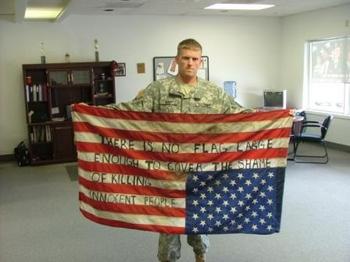
There are no heroes in illegal and immoral wars

by Robert Jensen

"There is no flag large enough to cover the shame of killing innocent people."

When the 4th Stryker Brigade, 2nd Infantry Division rolled out of Iraq last week, the colonel commanding the brigade told a reporter that his soldiers were “leaving as heroes.”

While we can understand the pride of professional soldiers and the emotion behind that statement, it’s time for Americans — military and civilian — to face a difficult reality: In seven years of the deceptively named “Operation Iraqi Freedom” and nine years of “Operation Enduring Freedom” in Afghanistan, no member of the U.S. has been a hero.

This is not an attack on soldiers, sailors, and Marines. Military personnel may act heroically in specific situations, showing courage and compassion, but for them to be heroes in the truest sense they must be engaged in a legal and morally justifiable conflict. That is not the case with the U.S. invasions and occupations of Iraq or Afghanistan, and the social pressure on us to use the language of heroism — or risk being labeled callous or traitors — undermines our ability to evaluate the politics and ethics of wars in a historical framework.

Continue reading “There are no heroes in illegal and immoral wars”

US diverts floodwater on town to protect airbase in Pakistan, refuses use for relief operations

by The Asian Human Rights Commission

PAKISTAN: Minister tasked with saving US airbase at the cost of the displacement of thousands

The presence of Pakistan army personnel speaks to the fact that the breach of Jamali bypass was intentional and ordered from above.

It has been reported earlier that the US Air Force has denied the relief agencies use of the Shahbaz airbase for the distribution of aid and assistance. Soldiers of the Pakistan army, a federal minister and the administration of Sindh province are blamed for the incident involving Shahbaz Airbase at Jacobabad district in Sindh province in which it has been reported that flood waters were diverted in order to save the airbase. The diversion of the floodwaters is blamed for inundating hundreds of houses and the displacement of 800,000 people. According to the media reports, the Federal Minister of Sports along with soldiers from the army and a contingent of officials from the Sindh provincial government breached the Jamali Bypass in Jafferabad district of Balochistan province during the night between August 13 and 14 to divert the water entering the airbase which has remained in US Air Force hands since the war on terror started in 2001.

Continue reading “US diverts floodwater on town to protect airbase in Pakistan, refuses use for relief operations”

George Will’s Irrepressible Conflict With Facts

by Max Blumenthal

George Will had a horrible run in Israel. Luckily for him, the Washington Post does not correct errors if they advance Israeli hasbara

Conservative columnist George Will was recently in Israel. His trip resulted in a series of laughably error-laden columns revealing not only a crude view of the Israel-Palestine conflict and obsequious admiration for Bibi Netanyahu, but a lack of knowledge about major historical events in his own country.

In his third column, Will begins his mutilation of history in a passage about the Peel Commission. He wrote:

In 1936, when the British administered Palestine, the Peel Commission concluded that there was “an irrepressible conflict” — a phrase coined by an American historian to describe the U.S. Civil War — “between two national communities within the narrow bounds of one small country.” And: “Neither of the two national ideals permits” a combination “in the service of a single state.” The commission recommended “a surgical operation” — partition. What followed was the Arab Revolt of 1936 to 1939.

Asad Abukhalil has already nailed Will for getting the date of the Peel Commission report wrong. It was 1937, not 1936. And the Arab Revolt broke out in Palestine before the Peel Commission introduced its findings. I would also add that David Ben Gurion privately accepted the Peel Commission’s recommendations because he saw them as the basis for a later partition that would gift the Zionist settler minority with major port cities like Jaffa and Haifa and throw the Palestinian Arabs back to the hinterlands. Moshe Sharett, a future prime minister of Israel, remarked about the Peel Commission, “the [Palestinian] Arab reaction would be negative because they would lose everything and gain almost nothing ….”

Continue reading “George Will’s Irrepressible Conflict With Facts”

The Assault on Wikileaks

You’ll be seeing plenty more of this in the days and months ahead. Wikileaks has been the target of black propaganda and dirty tricks since the day it released the Baghdad massacre video. Recently even Amnesty International (which brought you the Gulf War of 1991 with false claims about Iraqi soldiers throwing Kuwaiti babies out incubators) and Reporters without Borders (which was mighty outraged when Venezuela closes down a broadcaster invovled in an attempted coup, but seemed remarkably understanding when France shut down a Palestinian television channel) joined the Pentagon in the attempts to discredit Wikileaks, blaming it for endagering the lives of Afghan collaborators. It now emerges that the latest attempt to defame Julian Assange was another lie. The powers that be seem not to realize that as each propaganda sally misses the mark, Wikileaks’s stature grows further.

Julian Assange, the founder of the whistle-blower website Wikileaks, has categorically denied Swedish sexual abuse charges launched against him.

The country’s prosecution authority has dropped an arrest warrant for a rape charge, but a separate molestation accusation is still under investigation.

WikiLeaks has been criticised for leaking Afghan war documents.And despite warnings from the Pentagon, the website is preparing to release a fresh batch of classified documents.

In an exlusive interview with Al Jazeera, Assange said that the accusations are part of a “smear campaign” against him.

First they came for the Muslims; then they came for the Roma…

One would have thought it was too soon for France to forget its Vichy past.

After destroying their homes and giving them $383, France is flying 700 Roma people to Romania and Bulgaria. The government has been dismantling Roma settlements, saying they were havens for illegal trafficking, child exploitation, begging and prostitution. But Romania’s foreign minister says he’s worried France’s action is creating xenophobia. Al Jazeera’s Estelle Youssouffa looks at the man leading the French drive for security and public order.

Continue reading “First they came for the Muslims; then they came for the Roma…”

Why Pakistan isn’t getting the aid it needs

by Beenish Ahmed

United Nations General Secretary Ban Ki Moon has called the recent floods in Pakistan the worst humanitarian disaster he has ever witnessed. With over 20 percent of the country under water, contagious diseases run rampant while the delivery of vital goods and services are all but halted by gushing water and broken roads.

While the 1500 projected dead in Pakistan is a minuscule sum compared to the 100,000 lives lost in the earthquake that ravaged Haiti at the onset of this year, or the 250,000 killed by the South East Asian Tsunami of 2004, exponentially more people are adversely affected by the flood. As cruel as the reality seems, the amount of aid needed cannot be measured in terms of death toll, but in terms of those who continue to live amidst the rubble of their former lives.

The plights of those who survive when all around them falls to a state of ruin is especially heart-wrenching, and tuning in to such atrocity has not come without a response of great empathy. An outpouring of donations to relief work came from all corners of the world as it watched the aftermath of hurricanes, tsunamis, earthquakes, and now a catastrophic flood. Still, with such widespread devastation hitting the globe with frightening regularity, the amount that sympathetic souls can give, especially those who are themselves hard-pressed by a recession of epic proportions is seemingly on the decline.

Continue reading “Why Pakistan isn’t getting the aid it needs”