From Andy Singer.
Author: alannahpriestley

Drones and Democracy
by Kathy Kelly and Josh Brollier
Islamabad: On May 12th, the day after a U.S. drone strike killed 24 people in Pakistan’s North Waziristan, two men from the area agreed to tell us their perspective as eyewitnesses of previous drone strikes.
One is a journalist, Safdar Dawar, General Secretary of the Tribal Union of Journalists. Journalists are operating under very difficult circumstances in the area, pressured by both militant groups and the Pakistani government. Six of his colleagues have been killed while reporting in North and South Waziristan. The other man, who asked us not to disclose his name, is from Miranshah city, the epicenter of North Waziristan. He works with the locally based Waziristan Relief Agency, a group of people committed to helping the victims of drone attacks and military actions. “If people need blood or medicine or have to go to Peshawar or some other hospital,” said the social worker, “I’m known for helping them. I also try to arrange funds and contributions.”
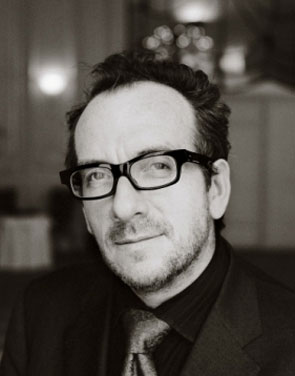
Bravo Elvis Costello! ‘Sometimes silence in music is better than adding to the static…’
Elvis Costello, we salute you, for heeding the BDS call and acting upon your conscience to cancel concerts in Israel. Here’s his statement:
It is after considerable contemplation that I have lately arrived at the decision that I must withdraw from the two performances scheduled in Israel on the 30th of June and the 1st of July.
One lives in hope that music is more than mere noise, filling up idle time, whether intending to elate or lament.
Then there are occasions when merely having your name added to a concert schedule may be interpreted as a political act that resonates more than anything that might be sung and it may be assumed that one has no mind for the suffering of the innocent.
I must believe that the audience for the coming concerts would have contained many people who question the policies of their government on settlement and deplore conditions that visit intimidation, humiliation or much worse on Palestinian civilians in the name of national security.
Elaine Hagopian Reviews Israeli Exceptionalism
Israeli Exceptionalism: The Destabilizing Logic of Zionism (Palgrave Macmillan, November 10, 2009). Publisher’s link.
by Elaine Hagopian
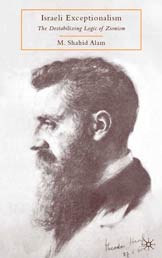 For those unfamiliar with the extraordinary evolution of Israeli exceptionalism emanating from its Zionist narrative and assuring Israel’s incredible success as a colonial settler state, M. Shahid Alam’s book is the one to read. He has recorded a compelling, uniquely comprehensive and enlightening historical analysis of the inherently destabilizing dynamic of Zionism. Of particular note are his detailed Chapters Nine and Thirteen.
In Chapter Nine, he documents the constellation of Jewish factors that came together in the 19th century which assured Zionist success: the spread of Jewish intellectuals and professionals across major cities in Europe; Jewish population growth to 16.7 million in 1939 which could root a nationalist movement; business acumen and ownership of major banks and a strong media presence; growth of interchange with other Jewish leaders contributing to a sense of community – important considering that Jews had not previously formed a sense of nation according to Alam; and as European nationalism grew, Jews were affected by the idea though they had no majority presence in any one state which could be claimed by them. Historical anti-Semitism prodded the Jewish elites toward formulation of the Zionist project even as Jews were moving out of the ghettos of a liberalized Europe. Given their distribution throughout Europe and without a territorial base of their own, the Zionist sought and captured the needed “mother” country to implement their colonial settler state in Palestine. This they found in the U.K initially and then in the U.S. with periodic support by other countries such as France.
Continue reading “Elaine Hagopian Reviews Israeli Exceptionalism”
From Prayer to Paralysis
by Joshua Brollier
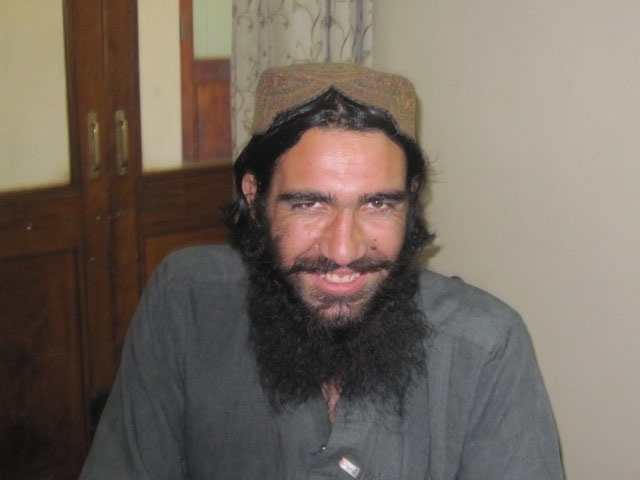
May 17, 2010, Islamabad — Through the Soviet invasion and occupation, the Afghan civil war and now the United States war and occupation, a young man named Zainullah, around 25 years of age, has seen war his whole life. But you’d never know it by his engaging smile and his relaxed countenance. Zainullah currently lives at a paraplegic center in Hayatabad, Pakistan, a suburb of Peshawar, the capital city of the North-West Frontier Province. He is originally from the Helmand province of Afghanistan, which has been one of the most intense battlegrounds during the “war on terror” launched by the United States in 2001.
Zainullah was paralyzed about nine months ago after being struck with shrapnel from a U.S. cruise missile. On the day of the attack, Zainullah was getting ready to start his prayers. He heard a bomb blast, and before he had a chance to realize that he was the target, Zainullah was laying prostrate on the ground with a piece of metal lodged in his spinal cord. Two men from his village carried him to the nearest clinic. There he was given an injection and then taken to the International Commission of the Red Cross (ICRC) facility in Helmand. Now paralyzed from the waist down, Zainullah spent one month at the ICRC , and then decided to seek more extensive rehabilitation treatment in Pakistan.
Margaret Atwood Cashes In
By Jennifer Matsui

Novelist Margaret Atwood’s decision to travel to Tel Aviv to share a literary prize worth a million dollars has ignited a controversy in which the septuagenarian author and vice-president of the literary human rights organization PEN International has come under fire by Palestinian rights activists. Ms Atwood’s acceptance of the Dan David Prize, whose previous laureates include Al Gore and Tony Blair, is viewed by Ms Atwood’s critics as a betrayal to the ideals she supposedly represents, and an unwitting endorsement of Israel’s race exclusive policies.
The Canadian author’s insistence that refusing the blood-spattered trophy would be tantamount to “censorship” rings as false as her commitments to justice as an anti-apartheid activist, and as a writer who has made tyranny and oppression recurring themes in her novels, elevating her from fiction writer to public intellectual. “False” because “justice for some” is hardly an ethical stance with any merit, and certainly not one that will maintain her status as an “oppositional intellectual”. Sadly, this “intellectual” has made no effort to research the subject of Israel’s illegal occupation of Palestinian land and its unyielding, systematic oppression of the Palestinian people (as many Jewish and Israeli scholars and activists themselves have bravely condemned). Otherwise, she would use the occasion of the invitation to denounce an increasingly murderous regime and call upon its people to support sanctions, boycotts and divestments until their government accepted the rule of International law and reversed its policy of displacement and expulsion of Arab people from their ancestral lands. Instead the once outspoken author has chosen to put monetary interests ahead of the principled moral stances she has taken in the past, in order to lay claim to a tainted prize given each year to fame-hungry “artists” looking to boost sagging sales of their product while making all the appropriate noises to the press about free speech.
Nakba day – يوم النكبة Yawm al-Nakba 2010
By Mazin Qumsiyeh
 Today is the day we actually commemorate Nakba Day, 14 May 1948, the date the state of Israel was declared. However, it is not the beginning of our Nakba (catastrophe) nor its end. Over 200 villages were ethnically cleansed in the six months before 14 May 1948. This simple fact illustrate that it is not the founding of the militarized state of Israel that began the Nakba but that it was a pivotal moment in it. After that date, the wave of ethnic cleansing was being done in a name of a nation-state established by and for Jews from Europe and not just the terrorist underground Jewish militias. The ethnic cleansing accompanying the foundation of this apartheid Jewish state and its maintenance meant the destruction of 530 villages and towns and meant that in the past 9 years alone over 10,000 homes were destroyed in the West Bank (including occupied Jerusalem), Gaza, and the Negev.
Today 7 million of the 11 million Palestinians around the world are refugees or displaced people. The Israeli population according to the Israeli central bureau of statistics is 7,510,000 of which 5,984,500 are “Jews and others” (presumably the others are Druze, Russian non-Jews, and similar categories) and 1,525,500 Palestinian Arabs (1). The population of Palestinians in the West Bank and Gaza is 4 million allowed to live on areas A & B, small parts of the 22% of Palestine occupied since 1967 (2). The total area allowed for Palestinian use is 2.5% of the area of pre-1967 Israel (3) plus areas A & B of the West Bank . In total this comes to 2.5% of 78% and 29% of the 22% that is the West Bank and Gaza (4). The total geographic access to all remaining Palestinians (5.525 million) is thus 1.95%+6.38%=8.33% while the Jewish and other population (Zionist preferred) consists of 5.5 million with access to the remaining lands comprising 91.67% of historic Palestine.
Continue reading “Nakba day – يوم النكبة Yawm al-Nakba 2010”
Pressured from all sides in Pakistan’s Swat Valley
by Kathy Kelly and Joshua Brollier
May 14th, 2010

In May of 2009, under tremendous pressure from the United States, the Pakistani military began a large-scale military operation in the Swat District of Pakistan to confront militants in the region. The UNHCR said the operation led to one of the largest and fastest displacements it had ever seen. Within ten days, more than two million people fled their homes.
Now, a year later, our small delegation visited the Swat District. After a breathtaking ride through the Hindu Kush mountains, traveling in a pick-up truck from Shah Mansour in the Swabi district, we arrived in Swat’s capital, Saidu Sharif.
Saidu Sharif is a small town, ringed by mountains. The Swat River, a few hundred yards in width, runs through it. It’s easy to imagine a former time when tourists would flock to visit this scenic treasure. While we were there, the town seemed tranquil. Stores were open and the streets were bustling. Merchants, children, shoppers, bicyclists, goats, cars, donkey carts, rickshaws, and tractors jostled for space in the narrow roadways. But, we also saw dozens of uniformed men, carrying weapons, suggesting that tensions still prevail in Swat.
Continue reading “Pressured from all sides in Pakistan’s Swat Valley”
Elena Kagan and the Supreme Court: A Barnyard Smell in Chicago, Harvard and Washington
By James Petras
 President Obama has nominated Elena Kagan for Justice of the United States Supreme Court on the basis of an academic publication record which might give her a fighting chance for tenure at a first rate correspondence law school in the Texas Panhandle.
A review of her published scholarship after almost two decades in and out of academia turns up four law review articles, two brief pieces and several book reviews and in memoriam. There is nothing even remotely resembling a major legal text or research publication.
Her lack-luster academic publication record is only surpassed by her total lack of any practical experience as a judge: zero years in adjudication, unless one accepts the line of her exuberant advocates, who point to Kagan’s superb ability in adjudicating among the squabbling faculty at Harvard Law School when she served as Dean. No doubt Kagan had been very busy as the greatest fundraising Law School Dean in Harvard’s history ($400 million), which may account for the fact that she never found time to write a single academic article during her nine year tenure (2001-2009).
Stephen Zunes and the Zionist Tinderbox
By Michael Barker

“[A]nti Zionism may be a ‘fool’s anti-imperialism,’ where Jewish nationalism itself is erroneously seen as the problem rather than the alliance its leaders have made with exploitative Western interests.”
—Stephen Zunes, 2006.1
Who is Stephen Zunes? Well according to his web-site, he is a Professor of Politics and International Studies at the University of San Francisco, who in 2002 won recognition from the Peace and Justice Studies Association as Peace Scholar of the Year. Although Zunes describes himself as a committed peace loving, anti-imperialist activist, by reviewing just one of his books this article will demonstrate that in actual fact his scholarly actions belie such intent. The book in question is Tinderbox: U.S. Middle East Policy and the Roots of Terrorism (Zed Books, 2003), a popular text that received glowing accolades from Noam Chomsky, Howard Zinn, Richard Falk, and Saul Landau (amongst others). This essay will illustrate how Zunes’ proclivity for defending Zionism ultimately leads hims to promote a “fool’s anti-imperialism.”
That is not to say that Zunes is uncritical of U.S. foreign policy, far from it, just that his work serves as a smokescreen for understanding the real drivers of U.S. foreign policy vis-a-vis the Middle East.
 P U L S E