Pacified

by Kathy Kelly

If the U.S. public looked long and hard into a mirror reflecting the civilian atrocities that have occurred in Afghanistan, over the past ten months, we would see ourselves as people who have collaborated with and paid for war crimes committed against innocent civilians who meant us no harm.

Two reporters, Jerome Starkey (the Times UK), and David Lindorff, (Counterpunch), have persistently drawn attention to U.S. war crimes committed in Afghanistan. Makers of the film “Rethinking Afghanistan” have steadily provided updates about the suffering endured by Afghan civilians. Here is a short list of atrocities that have occurred in the months since General McChrystal assumed his post in Afghanistan.

December 26th, 2009: US-led forces, (whether soldiers or “security contractors” (mercenaries) is still uncertain), raided a home in Kunar Province and pulled eight young men out of their beds, handcuffed them, and gunned them down execution-style. The Pentagon initially reported that the victims had been running a bomb factory, although distraught villagers were willing to swear that the victims, youngsters, aged 11 – 18, were just seven normal schoolboys and one shepherd boy. Following courageous reporting by Jerome Starkey, the U.S. military carried out its own investigation and on February 24th, 2010, issued an apology, attesting to the boys’ innocence.

Continue reading “Pacified”

The End of the American Empire

Chalmers Johnson on Media Matters with Bob McChesney.

Chalmers Johnson is president of the Japan Policy Research Institute, a non-profit research and public affairs organization devoted to public education concerning Japan and international relations in the Pacific. He was chairman of the academic advisory committee for the PBS television series “The Pacific Century,” and he played a prominent role in the PBS “Frontline” documentary “Losing the War with Japan.” Both won Emmy awards. His most recent books are Blowback: The Costs and Consequences of American Empire (New York: Metropolitan Books, 2000); The Sorrows of Empire: Militarism, Secrecy, and the End of the Republic (New York: Metropolitan Books, 2004); and Nemesis: The Last Days of the American Republic (New York: Metropolitan Books, 2007).

The Collapse of Journalism/ The Journalism of Collapse

by Robert Jensen

A version of this essay The Collapse of Journalism/The Journalism of Collapse: New Storytelling and a New Story was delivered as the Lawrence Dana Pinkham Memorial Lecture, Asian College of Journalism, Chennai, India, March 18, 2010.

There is considerable attention paid in the United States to the collapse of journalism — both in terms of the demise of the business model for corporate commercial news media, and the evermore superficial, shallow, and senseless content that is inadequate for citizens concerned with self-governance. This collapse is part of larger crises in the political and economic spheres, crises rooted in the incompatibility of democracy and capitalism. New journalistic vehicles for storytelling are desperately needed.

There has been far less discussion of the need for a journalism of collapse — the challenge to tell the story of a world facing multiple crises in the realms of social justice and sustainability. This collapse of the basic political and economic systems of the modern world, with dramatic consequences on the human and ecological fronts, demands not only new storytelling vehicles but a new story.

Continue reading “The Collapse of Journalism/ The Journalism of Collapse”

Ghazal for Iranians Who Don’t Hate Arabs

To Rom, and Parichehr

Today I met Iranians who don’t hate Arabs.
They smiled and said “hey, selam,” even knowing I was Arab.

They didn’t have green eyes, yet they seemed to bear up
pretty well without them, and they don’t fault Arabs,

not all of us, at least, for Nahavand, and the bloody flare-up
at Karbala; after all, remember, Imam Husayn was Arab.

I was a little scared at first, but soon I scraped my chair up
closer and acknowledged half our poetry and science isn’t Arab.

Half? Two thirds! Three quarters! All Persian! I went clear up
to The Arabian Nights, to Ibn Sina; who says he was Arab?

Continue reading “Ghazal for Iranians Who Don’t Hate Arabs”

Colombian Elections Show Little Change Other Than Names

Party of National Integration still not as popular as the null vote.

By Ken Kelley

Candidates from three right-wing parties allied with Colombian President Alvaro Uribe won a clear majority in both the Senate and lower house in elections held on March 14.  The results are considered to be a sign of how Colombians will vote on May 30 when they choose a successor to Uribe, who was recently barred from seeking a third term.

Perhaps the biggest surprise was the emergence of the rightist Party of National Integration (PIN), which won 8 out of the 102 Senate seats, displacing the leftist Alternative Democratic Pole as the country’s fourth largest political party.  The victorious PIN candidates were mostly relatives of ex-lawmakers now in jail or under investigation for ties to right-wing paramilitary groups.  In a scandal that tarnished the previous Congress, 12 pro-Uribe legislators were jailed while another 80 are still under investigation.

Continue reading “Colombian Elections Show Little Change Other Than Names”

Seven Years in Iraq and Counting

by Ahmed Habib

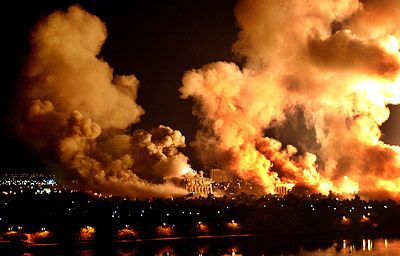
On March 20, 2003, at approximately 5:30 in the early hours of the morning, just at that time where the sun settles into its daytime position over the skies of Baghdad, American jet fighters unleashed indiscriminate firepower over the beautiful city.

Amidst a house filled with resilient spirits, Laila cowered for cover with her neighbours and family. As a twenty year old university student, the Baghdad native had already been through two wars, and a genocidal sanctions regime that limited her childhood to an existence of deprivation and fear.

“This time, it was different, the explosions were so big, we all thought we were going to die,” Laila, a pseudonym used out of fear for her safety, says over a tired phone connection seven years later.

Tens of thousands of kilometres away, activists huddled around a television set, with their heads in their hands, and watched a glorified play by play of death narrated by indifferent talking heads.

“Those are people dying under those bombs, and we couldn’t do anything to stop them,” said Firas from a Toronto apartment, to the backdrop of free flowing tears.

In the lead up to that day, millions of people took to the streets to oppose the impending war, to no avail. Since then, over a million Iraqis have lost their lives, more than five million have been displaced, and countless lives have been destroyed.

Continue reading “Seven Years in Iraq and Counting”

The Undue Influence of the Israel Lobby

by Jeffrey Blankfort

Despite the repeated humiliations suffered during his recent visit to Israel, US Vice President Joe Biden continued to grovel publicly to his Israeli hosts. Yet, according to Yediot Ahronoth, Israel’s most widely read newspaper, Biden had privately complained to the Israeli Prime Minister Benjamin Netanyahu that Israel’s behavior was “starting to get dangerous for us.” “What you’re doing here,” he reportedly said, “undermines the security of our troops who are fighting in Iraq, Afghanistan and Pakistan. That endangers us, and it endangers regional peace.” That Biden made such a statement has been denied by the White House, but it follows closely an earlier memorandum sent by General Petraeus to the Joint Chiefs of Staff and his testimony before a US Senate Armed Services Committee on Tuesday.

In his prepared statement, Petraeus depicted the Israeli-Arab conflict as the first “cross cutting challenge to security and stability” in the CENTCOM area of responsibility [AOR]. “The enduring hostilities between Israel and some of its neighbors present distinct challenges to our ability to advance our interests in the AOR.”

Treading in an area where few members of the US military have dared to go before, Petraeus observed that “The conflict foments anti-American sentiment, due to a perception of U.S. favoritism for Israel. Arab anger over the Palestinian question limits the strength and depth of U.S. partnerships with governments and peoples in the AOR and weakens the legitimacy of moderate regimes in the Arab world.” It should be noted that neither the New York Times’s Elizabeth Bumiller nor the Washington Post’s Anne Flaherty included any reference to these comments by Petraeus in their coverage of his testimony.

Continue reading “The Undue Influence of the Israel Lobby”

Taxpayer-funded ‘anti-Terror’ unit involved in propaganda effort over Gaza

by Scotland Against Criminalising Communities

The Annual Report of the Intelligence and Security Committee (ISC), laid before Parliament last Thursday, confirms that a Government propaganda unit set up to tackle terrorism intervened to influence British public opinion during the Israeli attack on Gaza last year. The report also outlines a number of other steps taken by the Research, Information and Communications Unit (RICU), including the creation of a network of community organisations. RICU is linked to the UK Government’s Prevent programme for preventing “violent extremism.”

Activities of this sort distort democracy in the UK. They aim to mobilise public and voluntary sector workers and ordinary people as propagandists for controversial Government policies. They poison public debate by linking opposition to the Government’s foreign policy to support for “extremism.” And they do all this within a framework of Government initiatives already notorious for the massive intelligence-gathering that they involve.

Continue reading “Taxpayer-funded ‘anti-Terror’ unit involved in propaganda effort over Gaza”

Taking Sides: Israel and the lobby against the US

by John Mearsheimer

In the wake of Vice President Joe Biden’s ill-fated trip to Israel last week, many people would agree with the Israeli ambassador Michael Oren’s remark that ‘Israel’s ties with the United States are in their worst crisis since 1975… a crisis of historic proportions.’ Like all crises, this one will eventually go away. However, this bitter fight has disturbing implications for Israelis and their American supporters.

First, the events of the past week make it clear in ways that we have not seen in the past that Israel is a strategic liability for the United States, not the strategic asset that the Israel lobby has long claimed it was. Specifically, the Obama administration has unambiguously declared that Israel’s expansionist policies in the Occupied Territories, including East Jerusalem, are doing serious damage to US interests in the region. Indeed, Biden reportedly told the Israeli prime minister, Binyahim Netanyahu, in private:

This is starting to get dangerous for us. What you’re doing here undermines the security of our troops who are fighting in Iraq, Afghanistan and Pakistan. That endangers us, and it endangers regional peace.

If that message begins to resonate with the American public, unconditional support for the Jewish state is likely to evaporate.

Continue reading “Taking Sides: Israel and the lobby against the US”

Inside the Lawfare Project

Netanyahu’s Attack on Human Rights NGO’s Hits the States

by Max Blumenthal

As the anti-Goldstone, human rights-bashing Lawfare Project’s opening event on March 11 wrapped up, I asked its chairman, Columbia University Law School Dean David Schizer, for an interview. Schizer, who had just attacked the Goldstone Report from the podium, pointedly refused to speak to me and looked for the exit. As Schizer was leaving, he was politely confronted by Columbia Law School Professor Katherine Franke, who heads the school’s Program in Gender and Sexuality Law.

“Why didn’t you invite any speakers with an alternative perspective?” Franke asked Schizer.

His reply was curt. “We invited one or two but they couldn’t make it,” Schizer claimed before hurrying away.

Schizer was understandably nervous about his exposure. After all, he had just presided over a day-long conference during which Israeli human rights workers were labeled as traitors while Judge Richard Goldstone and human rights groups were compared to “anti-Semitic street gangs.” After several speakers had harshly condemned legal efforts against the construction of Israeli settlements in East Jerusalem and the West Bank, Schizer appeared beside them to lend his credibility to their views.

Continue reading “Inside the Lawfare Project”