America’s Quaking Racial Divide

Martin Luther King Jr

On Martin Luther King Jr. Day, Andrew Oxford reflects on America’s extant racial divide and the lingering threat of white nationalism.

In the preface to his monumental study of the contemporary American white supremacist movement (1), Leonard Zeskind points to the Sarajevo Haggadah for a pertinent lesson on race and society. A Hebrew text of stories, songs, and prayers written by Spanish Jews around 1314, it arrived in the Yugo peninsula with Sephardic Jews fleeing the Inquisition. In the nineteenth century, it was entered into the Sarajevo Museum and saved from invading Germans during World War II by the Croation curator. For the duration of the war, it was guarded by Muslim clerics and it currently resides in the vaults of the Serbian National Bank while it is revered as a cultural icon of all peoples of the region. Reflecting upon the curious history of this relic, Zeskind writes:

It is useful to remember that at one time a hodgepodge of religious and ethnic groups lived together in relative harmony. Places like Sarajevo were cosmopolitan centers of learning and culture for centuries. But in a matter of a few historical seconds, the whole place went up in flames, like a refugee hostel attacked by arsonists…

The United States, unlike the former Yugoslavia, has well cemented the foundations of its federal order in the 150 years since our own Civil War, and the election of a black man, Barack Obama, has broken the white monopoly on the presidency. Nevertheless, collective identities based on race and religion have remained just under the skin of American life. As such, we will continue to be vulnerable to the machinations of … white nationalists … particularly as population demographics shift in the next few decades. For those of us who hope to protect and extend our multiracial democracy, and the cosmopolitanism of the type that preserved the Sarajevo Haggadah, we ignore this white nationalist movement at our own peril.
Continue reading “America’s Quaking Racial Divide”

The GFM, Palestinian Non-Violence and International Solidarity

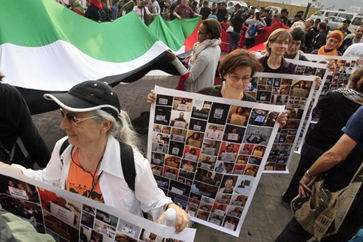
Writer, graduate student and organizer Max Ajl was in Cairo earlier this month along with 1,300 other activists who had gathered from all over the world to protest the illegal blockade of Gaza.  The following is an article written by Ajl which includes his reflections on the Gaza Freedom March (he was a principal organizer) and the concept of international solidarity and non-violence in the Palestinian context.

I’m going to discuss the utility of non-violent resistance as it applies to resolving the Israel-Palestine conflict and, specifically, the occupation and blockade of the Gaza strip.  Even more specifically, I’m going to discuss the Gaza Freedom March (GFM), of which I’m one of the organizers.  But before discussing Palestinian non-violence, several things must be clarified.  One is that no one — least of all me, a Jewish kid from Brooklyn — has the slightest right to dictate to the Palestinians how to end the blockade or resist the occupation.  Another is the need to avoid the nearly inevitable antiseptic air to talk by Westerners discussing Palestinian non-violence.  Antiseptic, because it is cleansed of the complicating grit of the occupation within which non-violence must take place.  There’s also usually a tacit subtext, usually a four-word question: Where Is Their Gandhi?  That question could not be more in error.  I hope to show why.

Continue reading “The GFM, Palestinian Non-Violence and International Solidarity”

A People’s History of Gaza in Cartoons

by Paul de Rooij

The launch of a new book by Joe Sacco is a major event, and with considerable expectation a crowd recently gathered in London to hear the great Maltese-American cartoonist and author discuss his latest book: Footnotes in Gaza. [1] Sacco spent seven years researching and drawing about two sordid events that took place in November 1956 when Israeli forces invaded Gaza as part of the joint British-French attack against Egypt. The Israeli army conducted two massacres where hundreds of Palestinians were murdered, and Sacco set out to collate the oral histories of the Palestinians who witnessed or were the victims of the events. Sacco engaged in a detailed investigative work finding the witnesses who could credibly recollect what happened, sifted through the accounts to eliminate the factual inconsistencies due to the deteriorated memories, and then spent four years bringing these histories to life in his inimitable style. The book doesn’t only focus on the past, but the present is also very much part of his account; in present day Gaza giant armoured bulldozers flatten houses in Rafah and where the ongoing siege affects everybody’s lives. Sacco says: “… the past and the present cannot be so easily disentangled; they are part of a remorseless continuum…”

Contemporary history is usually written by academics with access to the main protagonists, usually politicians or military commanders, inert archives, and press accounts. This history is usually antiseptic – there are no piles of corpses to embarrass the generals. It is also imbued with certainty – historians usually don’t question the politician’s say-so. It is rare for mainstream historians to listen to victims; their accounts are seldom incorporated into the victor’s history. What sets Joe Sacco apart is that not only is he a great artist, but also a peoples’ historian who is willing to listen to the victims; his historiography is imbued with sympathy and respect for the these victims; their history is worthwhile recording. Sacco also focused on a usually-ignored slice of history. In 2001, he travelled in Gaza with Chris Hedges, the American journalist, to research an article about the 1956 massacres for an article for Harper’s magazine. When the article finally appeared, the history of the massacres had been editorially expunged; not all histories are treated equally. Perhaps it was this incident that piqued his interest to write about the neglected massacres.

Continue reading “A People’s History of Gaza in Cartoons”

On Mads Gilbert’s North American Tour

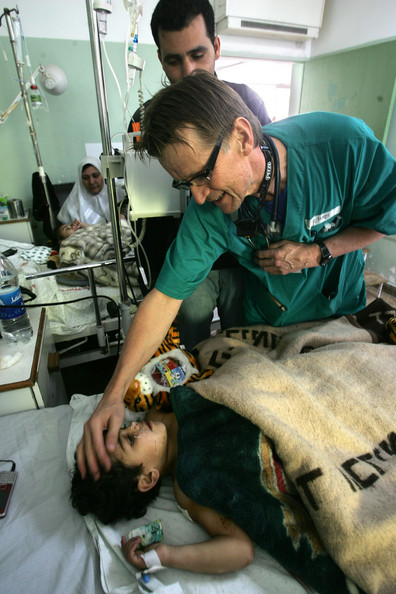
Dr. Mads Gilbert treating a wounded Palestinian child during Israel's December 2008 assault on Gaza.

During Israel’s assault on Gaza in December 2008, two doctors working from the frontline attempted to bring attention to the imbalance of power that exists at the heart of this conflict — an imbalance which weighs heavily towards the Israeli side.  While Israeli media spokespeople used airtime to argue that Israel was only targeting Hamas militants, Dr. Mads Gilbert and Dr. Erik Fosse of the Norwegian Aid Committee attempted to bring attention to just how many women and children were being wheeled in to be treated for shrapnel and bullet wounds, and how many families they were treating all at once.  They have since written a book about the event and Gilbert will be touring North America to spread their message. 

The following was written by Fatemah Meghji, the national co-ordinator of Solidarity for Palestinian Human Rights and a university student who has been organizing a nation-wide tour for Gilbert.  Below her piece you will find a listing of tour dates and locations — be sure to attend an event if you can, I know I will. 

by Fatemah Meghji

From Dr. Mads Gilbert & Dr. Erik Fosse’s Eyes in Gaza:

The boy with the destroyed brain did not need anaesthetic; he could no longer feel anything. The other lay in an artificial coma with intravenous anaesthetic agents to soften the pain and allow the ventilator to work without resistance from the boy’s own breathing. A large bandage covered both his eyes. He could not see anyway. He was already blind. 

Where could I cry out the despair and rage I felt for all this terrible fate we saw at such close quarters? Would the heavens hear? Will the world hear? They know that this is happening, after all. The numbers tick into the West every single afternoon, to the news agencies, to the intelligence services and to the diplomatic missions of the world’s most powerful nations, who do not even make an attempt to pull in the reins and control the wildness of the Israeli war machine.

Continue reading “On Mads Gilbert’s North American Tour”

Israeli Exceptionalism: A Grim Prognosis

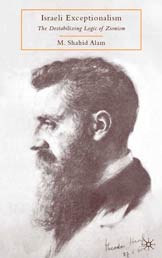
Cover Image GIFIn the coming weeks we’ll be publishing reviews and responses to M. Shahid Alam’s new book Israeli Exceptionalism: The Destabilizing Logic of Zionism (New York: Palgrave Macmillan, 2009). Following is the first from political scientist Ahrar Ahmad.

Dr. Shahid Alam is primarily an economist and an educator.  But, he is also a public intellectual, and often a lively polemicist, who writes with insight and conviction on issues dealing with culture, identity, religion, globalization, imperialism, and terrorism.  But nothing stirs his passions as intensely as the issue of the Palestinians – their dispossession, marginalization, despair.  His feelings are ardent, his language combative, his intellectual engagement prickly and zealous.  It is largely this pre-occupation that has earned him a place in David Horowitz’s book on the Hundred Most Dangerous Academics in the US (an ignominy that he probably wears as a badge of honor).  His latest book distills, clarifies and deepens much of his previous thinking on Zionism, the creation of the state of Israel, and the injustices inflicted on the Palestinians.

The trope along which this book is organized is the concept of “Exceptionalism” that is often claimed by the state of Israel, and sometimes by Jews themselves.  To Alam this is nothing other than a rhetorical device, and a moral posture, to ensure the West’s indulgence and support, to protect Israelis from any criticism, and exempt them from standards and behavioral norms that apply to other peoples.  This “exceptionalism” is derived from their Biblical covenants and the belief in their inherent “chosen-ness”, their wrenching history of suffering and persecution, their considerable achievements in science, philosophy and philanthropy, and their current status as a people allegedly besieged by Islamic fundamentalists, anti-Semitic bigots, and the barbaric and self-destructive Arabs.  To question anything about Israel is tantamount to denigrating every aspect of its special status.

Continue reading “Israeli Exceptionalism: A Grim Prognosis”

Speaking Truth to Power

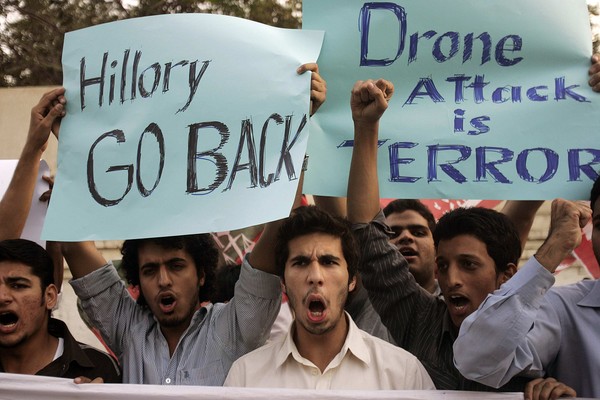
Students in Lahore, Pakistan, protest against the visit of U.S. Secretary of State Hillary Clinton. (K.M. Chaudary/AP Photo/October 29, 2009)

by Kathy Kelly

There’s a phrase originating with the peace activism of the American Quaker movement: “Speak Truth to Power.”  One can hardly speak more directly to power than addressing the Presidential Administration of the United States. This past October, students at Islamabad’s Islamic International University had a message for Secretary of State Hillary Clinton.  One student summed up many of her colleagues’ frustration. “We don’t need America,” she said. “Things were better before they came here.”

The students were mourning loss of life at their University where, a week earlier, two suicide bombers walked onto the campus wearing explosive devices and left seven students dead and dozens of others seriously injured. Since the spring of 2009, under pressure from U.S. leaders to “do more” to dislodge militant Taliban groups, the Pakistani government has been waging military offensives throughout the northwest of the country.  These bombing attacks have displaced millions and the Pakistani government has apparently given open permission for similar attacks by unmanned U.S. aerial drones.   Every week, Pakistani militant groups have launched a new retaliatory atrocity in Pakistan, killing hundreds more civilians in markets, schools, government buildings, mosques and sports facilities.  Who can blame the student who believed that her family and friends were better off before the U.S. began insisting that Pakistan cooperate with U.S. military goals in the region?

Continue reading “Speaking Truth to Power”

Eyeless in Tehran

Press TV should be ashamed of running such crude and embarrassing propaganda. The channel couldn’t have found a better way to insult its audience. Neda Agha Soltan’s killing was an outrage; to try to cover it up in such a shoddy manner merely adds insult to the injury. Press TV has provided excellent coverage in Gaza and elsewhere. If it is to remain credible, it will have to assert its independence and put a distance between itself and its sponsors.

Viva Palestina breaks Gaza siege

The Viva Palestina aid convoy has broken the siege of Gaza despite Egyptian attempts to violently disrupt their progress.

Continue reading “Viva Palestina breaks Gaza siege”

Moshe Halbertal and the Goldstone Report

Jerome Slater refutes Moshe Halbertal’s attack on the Goldstone Report published in The New Republic, an Israel Lobby mouthpiece.

Judge Goldstone in Gaza

As an academic of nearly fifty years, I take seriously that the core principle and highest calling of our profession is to seek and tell the truth, as best as one can. For those who know the full historical facts about the Israeli-Palestinian conflict, one of the most shocking and depressing phenomena is the extent to which many leading Israeli and American Jewish intellectuals and academicians ignore, conceal, or willfully deny them.

I am not speaking here of ordinary citizens, who might simply be unaware that many of the most cherished Israeli mythologies are historically unsustainable; rather I refer only to the media commentators, political scientists, historians, and even moral philosophers who regularly write about the conflict and whose distortions or outright falsifications cannot be explained away by ignorance.

What, then, does explain this situation? For some, their ideology is simply so impenetrable that the facts can’t get through. For others, I assume that they knowingly, or at least semi-knowingly, conceal the truth because they fear that revealing it will harm Israel. If so, they are also wrong about the consequences — over sixty years of Israeli repression of the Palestinians has done incalculable harm to Israel’s own best interests. In any case, no matter what their motives, the academics who seek to defend Israel against the most reasonable criticisms betray their calling.

Continue reading “Moshe Halbertal and the Goldstone Report”

Viva Palestina faced with 2,000 riot police in the port of Al-Arish

2,000 Egyptian riot police have reportedly besieged the Viva Palestina convoy. Here is a report and and appeal from convoy leader Kevin Ovenden.

UPDATE: Congratulations to Viva Palestina for breaking the siege despite Egypt’s attempt to violently thwart their efforts.

URGENT: Viva Palestina faced with 2,000 riot police in the port of Al-Arish!

To all friends of Palestine,

Our situation is now at a crisis point! Riot has broken out in the port of Al- Arish.

Continue reading “Viva Palestina faced with 2,000 riot police in the port of Al-Arish”