Now that the glorious revolutionary alliance of the Stop the War Coalition, Sarah Palin’s Tea Party, UKIP, the BNP, Tory back-benchers and the (Iraq-invading) Labour Party has won its historical victory over the forces of imperialism, the western faux-left can go back to sleep while Bashaar al-Assad can continue and escalate his genocide of the Syrian people. Here’s a short film showing Iranian occupation forces in Syria. At one point one of them says, “There are no human beings here – only Arabs.”
Author: Robin Yassin-Kassab
Aziz’s Story
 This was published at NOW
The Syrian city of Selemiyyeh lies to the east of Hama, where the fertile crescent becomes barren. The ruins of Shmemis castle, dating to the late Hellenistic period, cling to the cone of an extinct volcano nearby. The major historical site in the city itself is a shrine containing the tombs of Imam Taki Muhammed and Radi Abdallah. Some believe that Imam Ismail, the foundational figure of the Ismaili sect, is buried here too.
Although it’s an ancient city, with ancient links to the Ismaili faith, the ancestors of its present population were 19th and 20th Century migrants from Ismaili hill towns to the west, places such as Qadmous and Misyaf. The town, which also houses significant populations of Sunnis, Twelver Shia and Alawis, has long been a model of sectarian co-existence. Its secularism has been real – a genuine popular tolerance for difference, not the debased, propagandistic ‘secularism’ of the regime.
Along with Homs, Darayya, Dera‘a and Kafranbel (each one for different reasons), Selemiyyeh has become one of the capitals of the Syrian revolution. As a predominantly non-Sunni community which has since the start stood solidly for freedom and against the regime, its example proves both the mendacity of Assad’s sectarian narrative and the oversimplified western media discourse which portrays the fight as one between Sunni extremists and minority-secularists.
As part of its divide-and-rule strategy, the regime has spared Selemiyyeh the aerial bombardment and rocket attacks it has visited on majority-Sunni areas, but the city has suffered as much as anywhere from detentions and disappearances. Its revolutionaries, like all revolutionaries in regime-controlled areas, live underground.
Selemiyyeh has also bled (in January and February) from bomb attacks, probably organised by Jabhat an-Nusra, which targetted the regime’s shabeeha militia but also killed many innocent civilians. Despite such provocations, Selemiyyeh’s revolutionaries have cooperated with the Salafists of Ahrar ash-Sham, who have brought food aid to the city. And the community has done a great deal to house and feed its brothers and sisters of all sects fleeing violence in Homs and Hama. Pioneers of the early non-violent protests, many of Selemiyyeh’s residents are now engaged in the armed struggle.
When I met Aziz Asaad, an activist from Selemiyyeh, across the Turkish border in Antakya, I asked him why the community was so revolutionary, why it hadn’t been scared into fencesitting or even grudging support for Assad by the Islamist element of the opposition. His answer: “We read a lot. We’ve always read books.”
Al-Bayda: Anatomy of a War Crime
An excellent report from Channel 4 on the al-Bayda massacre, one of hundreds of massacres in Assad’s Russian-backed genocide.
The End of the World?
I make some brief contributions to this Channel 4 News film on the apocalyptic resonances for both Muslims and Christians (some at least) of watching Damascus burn. I wish there’d been time to make the more important point: religion and myth add resonance to fighting and dying, but as in Northern Ireland or Palestine-Israel, the religious vocabulary is only a glittering sideshow to the real power dynamic. Al-Qa’ida franchises would be in Syria whether or not the Messiah were due to descend on a minaret of the Umawi mosque: because they turn up wherever there’s an opportunity, and Syria’s geographical and political centrality to the Arab-Muslim world is enough. In any case, such militias compose less than twenty percent of anti-Assad forces. Their influence has been vastly overblown, both by the right and by a left which embraces the very War on Terror discourse (terrorists, al-Qa’ida conspiracies) it resisted so loudly when used by Blair and Bush. The West doesn’t see a genocide, still less a living, breathing revolution, but only an even-matched war between Alawi-secularists and radical Salafists. It seems too late to change this fantastic illusion. The story seems set in the western mind. Just as Assad wants it.
This film was great fun to make, and it provides an interesting look at an interesting subject. But I worry about its context in the news bulletin. It necessarily highlighted the mad jihadist aspect, and it was followed by an interview with a neo-conservative on the dangers of radical Islamism. The problem as framed by the broadcast was clear: apocalyptic-minded Muslims were the problem. But the clear and present danger in Syria is the regime, the regime which is generating the trauma and extremism, the regime which is committing genocide. Once again that was lost. And we in general are lost, paddling about in superstructure, paying no attention to the base.
A Cry for Help
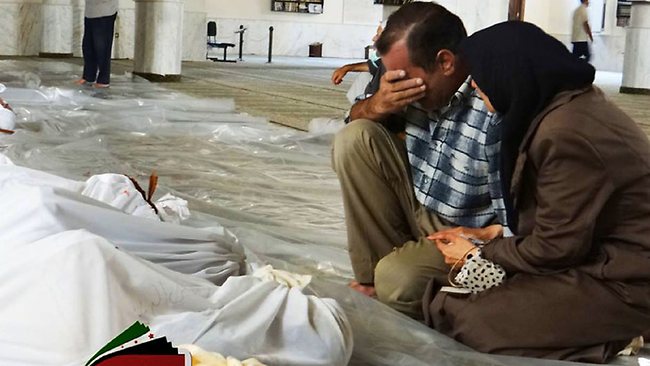 Yassin al-Haj Saleh, from the suburbs of the eastern Ghouta, writes this plea at the New York Times.
THE story is simple. Here in Syria, there is a regime that has been killing its subjects with impunity for the last 30 months. The notion that there is a mysterious civil war that is inextricably linked to the nature of the Middle East and its complicated sectarian divisions is far from the truth.
The primary perpetrator of violence is the government of Bashar al-Assad, which controls public resources, the media, the army and the intelligence services. The civilians who rose up against that regime, first peacefully and then through armed resistance, constitute a broad spectrum of Syrian society.
When a government murders its own citizens and they resist, this can hardly be called a civil war. It is a barbaric campaign of the first degree.
During the revolution’s first year, Syrians demanded international protection. First we asked for no-flight zones or humanitarian corridors, and later for weapons and military aid for the Free Syrian Army, but to no avail.
Not a month went by without some American or NATO official expressing little appetite for intervention. Realizing that this attitude was not about to change, the regime escalated the violence. It attacked the rebels with everything it had: first with rifles, then with tanks, helicopters, jet fighters, missiles and toxic gases.
Meanwhile, Western powers masked their diplomatic inertia with empty rhetoric about a “political solution.” Yet they have failed to coax the regime — which has not once indicated that it is ready to abandon its “military solution” — to the negotiating table.
Inaction has been catastrophic. While the world has dithered, Syrians have experienced unprecedented violence. Around 5,000 Syrians were killed in 2011. About the same number are now being killed each month. The regime has targeted lines outside bakeries; it has used Russian cruise missiles to bomb densely populated areas; and local activists say they have documented 31 occasions when it has used chemical weapons (United States officials have confirmed only some of these attacks).
Countless Syrians, among them women and children, have been subjected to arbitrary detention, rape and torture. A staggering seven million people — one-third of Syria’s population — are now displaced, either internally or externally.
Ground Zero Syria
A documentary on Assad’s war on the Syrian people.
Debating Intervention
This morning I participated in a discussion on the BBC World Service Radio’s World Have Your Say concerning potential strikes on the Assad regime. Listen here.
Later in the day I made a brief contribution to Newshour (in the last ten minutes). Here it is.
Intervention?
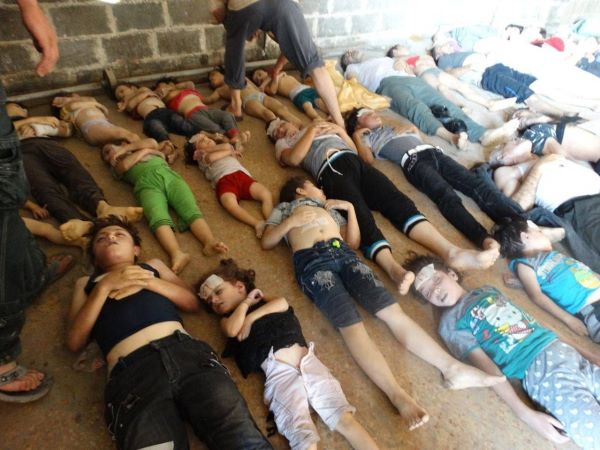 If the US-led West wished to invade and occupy Syria, or to engineer regime change from afar, it would have taken advantage of the two-and-a-half-year chaos in Syria to intervene long before now.
When the US-led West invaded Iraq in 2003, Saddam Hussain was contained. He’d committed his genocides in the past, when he was an ally of the West against Iran, and in 1991, under Western military noses (as he slaughtered Shia rebels and their families en masse, the allied forces in Kuwait and southern Iraq gave him permission to use helicopter gunships, and watched). But in 2003 Saddam was contained and reasonably quiet. There was no popular revolution against him. The West invaded anyway, on the pretext of inexistent Weapons of Mass Destruction.
The Syrian regime’s ultra-violent repression of a peaceful protest movement spawned an armed resistance. The regime met the armed resistance with genocide and ethnic cleansing. Then a week ago the regime struck multiple targets in the Damascus suburbs with chemical weapons, perhaps killing as many Syrians in three hours as Palestinians were killed in Israel’s month-long rampage in Gaza (2008/9).
The conflict has been well and truly internationalised for a long while now. Saudi Arabia, Qatar and Turkey have provided limited and intermittent military supplies to various parts of the opposition (the US has prevented them from delivering heavy weapons). The international brigades of the Islamic State of Iraq and al-Sham – an enemy both of the regime and the democratic opposition to the regime – has been empowered in pockets of northern Syria. The regime has received much more serious financial and military help from Russia and Iran, and has brought in Hizbullah and Iraqi sectarian militias to help it fight its battles. Hizbullah’s switch from defence against Zionism to repression of a revolutionary Arab people has propelled Lebanon back to the verge of civil war. Meanwhile, between a quarter and a third of Syrians are displaced, destabilising Turkey and Jordan as well as Lebanon.
Doing the Rounds
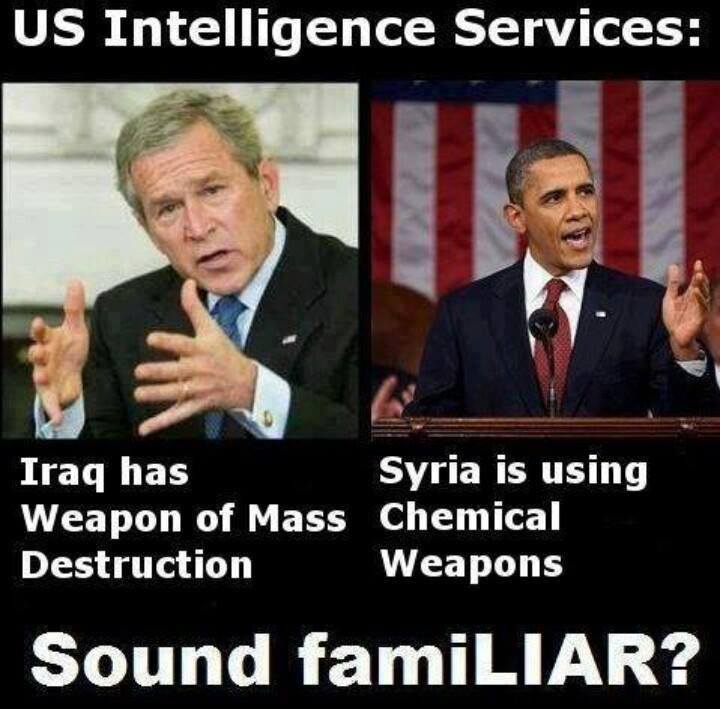 So much lazy thinking. Here’s an agit-prop picture doing the rounds, the sort to appeal to the George Galloway crowd. And here’s my comment: “Except it isn’t familiar. In one case they wanted to invade and used chemical weapons as an excuse. There were no chemical weapons. In the other case a genocide has been going on for over two years, they don’t want to invade, don’t even want to arm the people resisting, they don’t have the economic power or pliant international scene to do so even if they wanted; and chemical weapons not only exist, they have been used on a vast scale. Oppose potential US air attacks against Assad bases if you like, but don’t insult the victims of genocide while you’re doing it.”
Another one doing the rounds is this supposedly very clever letter: 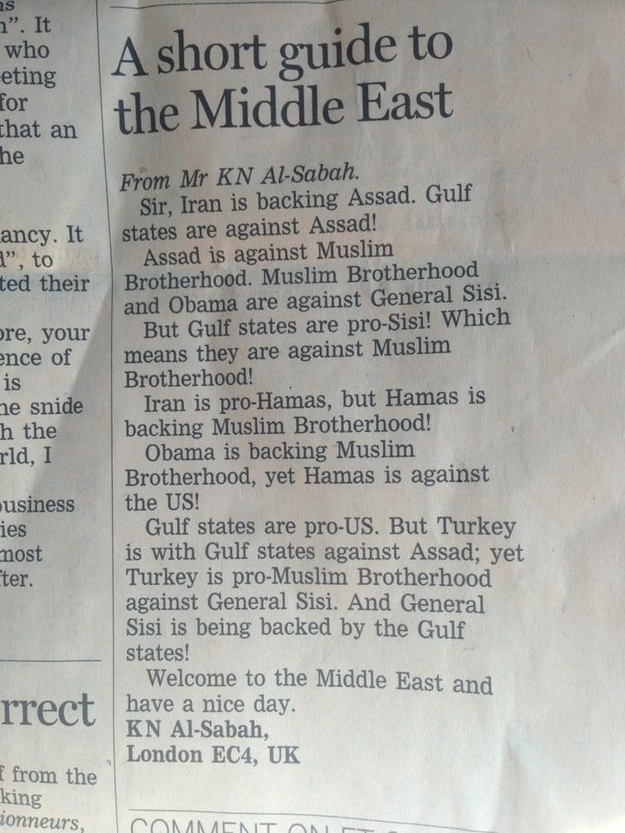 A Short Guide to the Middle East. And here’s Idrees’s response to that:
“To the hundreds of people who’ve been passing this fatuous bit of village-idiocy around, let me explain a few things:
1) States, like individuals, balance competing and contradictory interests. Like you, after two of your friends brawl, they don’t disown one to please the other.
2) States are not unitary, self-aware entities, whose interests are constant and indivisible. Like you, they carry in them multiple impulses and their attitudes towards others change based which impulses predominate under a given circumstance.
3) You might resent the tendency to treat the east as somehow exceptional and throw words like “orientalism” around, but like bad breath, you only notice it when others others have it. (Or perhaps the US is really a middle eastern country since it treated Communism as the ultimate evil but allied itself with Stalin to defeat Hitler; and then with right-wing Germans to defeat Communism. It was allied with France, yet supported Algerian independence. And so on ).
4) You have very little regard for facts. (Obama is anti-Sisi and is backing the Muslim Brotherhood? Really?)
5) Since you expect that states should be as one dimensional as Ayn Rand characters, you are unfit to comment on the Middle East or international affairs.”
A Curse on Dostoevsky
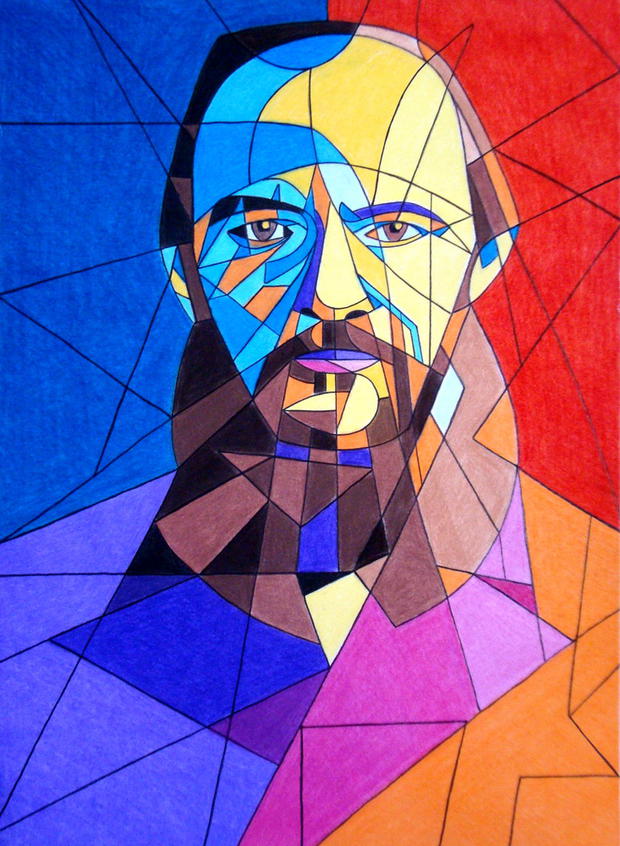
This review was published at the Guardian. As so often, in places it’s been edited so it makes little sense and becomes clumsy. (Not a Guardian-specific problem, but a general problem with subeditors. I’ve never worked out why writers are paid to write, then non-writers are paid to mess up the writer’s writing.) Anyway, the unedited version is below.
As its title suggests, Atiq Rahimi’s “A Curse on Dostoevsky” puts itself in conversation with the great Russian writer, specifically with “Crime and Punishment”. Instead of Saint Petersburg, the action unfolds in Kabul. In place of Raskolnivok, Rassoul (though in his solipsism and misanthropy he may bear more resemblance to Dostoevsky’s underground man); in place of Sonia, Rassoul’s fiancee Sophia, a character who never quite comes into focus; and in place of the detective Porfiry, a series of commanders and militiamen. The murderee is, like Dostoevsky’s, a pawnbroker, also a landlady and a madam. Rassoul doesn’t know why he kills her, but potential motives include saving Sophia from her clutches, theft, and justice.
The text justifies its relationship with Dostoevsky’s novel thus: “This book is best read in Afghanistan, a land previously steeped in mysticism, where people have lost their sense of responsibility.” The murder of the pawnbroker sparks an investigation of crime and punishment (and law and lawlessness, sacrifice and vengeance) in Afghan society. Dostoevsky claimed that if God didn’t exist, everything would be permitted. Yet in Afghanistan God exists not to prevent sins but to justify them. Sophia’s father poisoned the director of the National Archives with counterfeit alcohol, a punishment for selling documents to the Russians. “These days,” he says, “any idiot thinks he can take the law into his own hands, with no investigation and trial. As I did then.” (The setting seems to be the period after the Russians and before the Taliban, when Islamist warlords struggled for power.)
According to the novel’s logic, Rassoul’s motto – “I’d rather be a murderer than a traitor” – could just as well be Afghanistan’s: “You can kill, rape, steal… the important thing is not to betray. Not to betray Allah, your clan, your country, your friend.” Yet the pages brim with real or perceived traitors, those who desert their friends for ideology or material gain.
 P U L S E