The Fall of the House of Asad

This review of David Lesch’s book was written for the Scotsman.

Until his elder brother Basil died in a car crash, Bashaar al-Assad, Syria’s tyrant, was planning a quiet life as an opthalmologist in England. Recalled to Damascus, he was rapidly promoted through the military ranks, and after his father’s death was was confirmed in the presidency in a referendum in which he supposedly achieved 97.29% of the vote. Official discourse titled him ‘the Hope.’

Propaganda aside, the mild-mannered young heir enjoyed genuine popularity and therefore a long grace period, now entirely squandered. He seemed to promise a continuation of his father’s “Faustian bargain of less freedom for more stability” – not a bad bargain for a country wracked by endless coups before the Assadist state, and surrounded by states at war – while at the same time gradually reforming. Selective liberalisation allowed for a stock market and private banks but protected the public sector patronage system which ensured regime survival. There was even a measure of glasnost, a Damascus Spring permitting private newspapers and political discussion groups. It lasted eight months, and then the regime critics who had been encouraged to speak were exiled or imprisoned. Most people, Lesch included, blamed the Old Guard rather than Bashaar.

“I got to know Assad probably better than anyone in the West,” Lesch writes, and this is probably true. Between 2004 and 2008 he met the dictator frequently. His 2005 book “The New Lion of Damascus” seems in retrospect naively sympathetic. He can be forgiven for this. Most analysts (me included), and most Syrians, continued to give Bashaar the benefit of the doubt until March 2011.

Continue reading “The Fall of the House of Asad”

Save the Children in Za’atari Camp

Save the Children has released a report on the suffering of Syria’s children, based mainly on interviews with children in Jordan’s very basic Za’atari refugee camp. The Guardian reports on it here. I contributed to a discussion of the report on the BBC World Service’s World Have Your Say programme. My interjections come between thirteen and seventeen minutes.

Blasphemy

This video is not suitable for children nor for those of a nervous disposition. I include myself in the latter category. At first I couldn’t watch it, then I made myself do so in order to hear the words. Before the usual “Freedom? You want freedom?” the torturee is forced to declare that Bashaar al-Asad is his ‘lord’ (the Arabic word ‘rabb’, which means God). The violent (but very small) protests which have swept the Muslim world in response to a ridiculous low-budget smear of the Prophet Muhammad are in part the expression of a deeply humiliated people who remember Western support of Zionism and Muslim dictatorships, Western invasions of Iraq and Afghanistan, and so on. They are in part the result of the failure of Arab and Muslim dictatorships to build functioning education systems, and a symptom of a profound and generalised despair that requires wounded symbols through which to manifest itself. Most importantly, they are signals of an opportunistic power play by the extreme right-wing Salafist minority. It’s a case of extreme right-wing Islamophobes, Zionists, Coptic extremists and American Republicans on the one hand and extreme right-wing Islamists on the other, feeding off each other. The furore has made the ridiculous anti-Islam film a Youtube hit. Nobody would have heard of it had Egyptian Islamists not publicised it, and had the American ambassador to Libya, apparently a friend of the Arabs who was critical of US policy on Palestine, not been murdered. As with all the episodes in the ‘culture wars’, it’s an enormous diversion from the really serious issues. The torture video here was first pointed out by the Syrian activist Wissam Tarif. He asked a simple question. Where are the furious demonstrations against this blasphemy? Why have no Syrian embassies been burnt following the repeated bombing of mosques and churches, the murder, rape, torture and humiliation of tens of thousands of Syrian Muslims?

Continue reading “Blasphemy”

Embedded Fisk

In this piece, first published at Open Democracy, Yassin al-Haj Saleh and Rime Allaf, two of Syria’s brightest intellectuals, discuss Robert Fisk’s moral and professional collapse.

The international media has not always been kind to Syria’s revolutionary people. For months on end, many of the latter turned themselves into instant citizen-journalists to document their uprising and the violent repression of the Syrian regime, loading clips and photos taken from their mobile-phones to various social networks; still, the established media, insinuating that only it could really be trusted, covered these events with an ever-present disclaimer that these images could not be independently verified. Since the Damascus regime was refusing to allow more than a trickle of foreign media personnel into the country, chaperoned by the infamous minders, what the Syrians themselves were reporting was deemed unreliable.
Nevertheless, an increasing number of brave journalists dared to sneak into Syria at great personal risk, reporting the same events which activists had attempted to spread to the world. For the most part, experienced journalists were perfectly capable of distinguishing between straight propaganda from a regime fighting for its survival and real information from a variety of other sources. Overwhelmingly, ensuing reports about Syria gave a voice to “the other side” or at least quoted opposing points of view, if only for balance. In some cases, journalists found no room to cater for the regime’s claims, especially when reporting from civilian areas under relentless attack by Bashar al-Assad’s forces.

It was from the wretched Homs district of Baba Amr, under siege and shelling for an entire month, that the late Marie Colvin, amongst others, testified on the eve of her death under the regime’s shells about the “sickening situation” and the “merciless disregard for the civilians who simply cannot escape.” Like her, most of those who managed to get into Syria have testified about the regime’s repression of a popular uprising, even after the latter evolved to include an armed rebellion.

Continue reading “Embedded Fisk”

The Left, Imperialism, and the Syrian Revolution

by Corey Oakley

This was first published at Socialist Alternative.

Of the millions of people who have risen up in revolt across the Arab world these past 19 months, few have suffered as much for their courage as the revolutionaries fighting the Assad dictatorship in Syria.

The decision of Bashar al-Assad’s regime to use the full force of his security forces against what was a largely peaceful protest movement has transformed the uprising into a full blown civil war, in which up to 20,000 people have died.

Yet the Syrian revolution – in the eyes of some on the left – lacks legitimacy. The uprising is denounced as a Western plot, a CIA- or Israeli-backed conspiracy to overthrow a regime that defends the Palestinians. Those fighting Assad’s troops on the ground are condemned as stooges of outside forces – variously Saudi Arabia, the US, Israel and Al Qaeda, among others.

In the West, open support for Assad has been mostly confined to hardline Stalinists or a minority of Assad loyalists among the Palestinian movement. Most on the left initially took a version of what has been called the “third way” – support for the revolution, combined with opposition to imperialist intervention from the West.

But over the last few months, this “third way” has begun to crack apart.

Prominent British leftists Tariq Ali and George Galloway have come out stridently in opposition to the insurrectionary aims of the uprising, claiming that the revolution has been taken over by reactionaries and arguing that a negotiated settlement with the regime is the only answer. Ali, in an interview with Russia Today, said the choice was between a “Western imposed regime, composed of sundry Syrians who work for the Western intelligence agencies…or the Assad regime.” Galloway, the left populist MP best known as a campaigner against the Iraq war, goes even further, denouncing the Syrian resistance for not accepting the peace plan advanced by the UN.

Much of this left-agonising about the Syrian revolt reflects the legacy of Stalinism, which led many to identify leftism with various despotic but “anti-imperialist” regimes that opposed the West and oppressed their own people in equal measure. But others on the left not weighed down by the legacy of Stalinism echo Galloway’s attitude over Syria. John Rees, until a few years ago a leading member of the Socialist Workers’ Party, wrote last month that he was in “broad agreement” with Galloway and Ali.

Continue reading “The Left, Imperialism, and the Syrian Revolution”

To Kill, and to Walk in the Funeral Procession

photo by Razan Ghazzawi

Updated with a postscript noting Robert Fisk’s obscene pro-regime propaganda while embedded with the regime army in Darayya, and the response of the LCCs to Fisk’s nonsense.

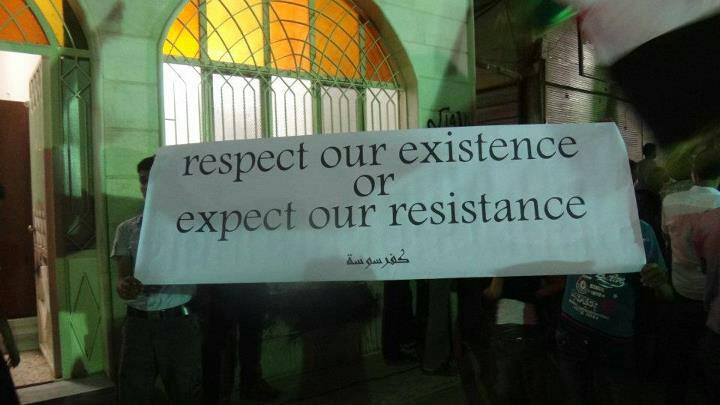
The Syrian regime is now perpetrating crimes against humanity at a pace to match its crimes in Hama in 1982 and at the Tel Za’atar Palestinian camp in 1976. All of Syria is a burning hell. Savage aerial bombardment (such as that causing the apocalypse here in Kafranbel, which held such beautifully creative demonstrations) and continuous massacres have raised the average daily death toll to well above two hundred, most of them in Damascus and its suburbs. The other day 440 people were murdered in twenty four hours.

The worst hit area has been the working class suburb of Darayya. I visited people in Darayya some years ago, and once bought a bedroom set for a friend’s wedding in the town. I remember it as a lively, friendly, youthful place. Last year Darayya became a cultural centre of the revolution. Ghiath Matar and others developed wonderful methods of non-violent protest there. When security forces arrived to repress demonstrations, Darayya’s residents handed the soldiers flowers and glasses of water. But Matar was murdered, and Darayya has been repeatedly raided, its young men detained and tortured, its women and children shot and bombed. Nevertheless, for some months the regime was kept out of Darayya. The town ruled itself in a civilised manner, successfully keeping a lid on crime and sectarianism.

The recent pattern is already well established (remember the massacre at Houla), but this time has played out on a larger scale. The regime bombed Darayya for days, mainly from artillery stationed on the mountains overlooking Damascus. Once any armed resistance had retreated, soldiers and shabeeha militia moved in, with knives and guns. This stage reminds one of Sabra and Shatila. It seems there was a list of suspected activists and resistance sympathisers, but the field executions included old men, women and children. About three hundred bodies have been counted so far, found in the street or in basements or in family homes.

Continue reading “To Kill, and to Walk in the Funeral Procession”

All Things Considered

Me on BBC Radio Wales discussing Syria’s Christian minority with Harry Hagopian, the lovely Nadim Nassar, and the strange English priest and admirer of the tyrant Christopher Gilham.

Blanket Thinkers

Yarmouk camp demonstrates

One of my infantile leftist ex-friends recently referred to the Free Syrian Army as a ‘sectarian gang’. The phrase may well come from Asa’ad Abu Khalil, who seems to have a depressingly large audience, but it could come from any of a large number of blanket thinkers in the ranks of the Western left. I admit that I sometimes indulged in such blanket thinking in the past. For instance, I used to refer to Qatar and Saudi Arabia as ‘US client states’, as if this was all to be said about them. I did so in angry response to the mainstream Western media which referred to pro-Western Arab tyrannies as ‘moderate’; but of course Qatar and Saudi Arabia have their own, competing agendas, and do not always behave as the Americans want them to. This is more true now, in a multipolar world and in the midst of a crippling economic crisis in the West, than it was ten years ago. Chinese workers undertaking oil and engineering projects in the Gulf are one visible sign of this shifting order.

(My talk of ‘infantile leftists’ does not include the entire left of course. Simon Assaf of the Socialist Workers, for instance, understands what’s happening. So does Max Blumenthal. And many others.)

The problem with blanket thinkers is that they are unable to adapt to a rapidly shifting reality. Instead of evidence, principles and analytical tools, they are armed only with ideological blinkers. Many of the current crop became politicised by Palestine and the invasion of Iraq, two cases in which the imperialist baddy is very obviously American. As a result, they read every other situation through the US-imperialist lens.

Continue reading “Blanket Thinkers”

Beirut Three: Social Life

I’ve just come back from the Hay Literature Festival in Beirut. Literature Across Frontiers asked me to write three posts on the experience. Here’s the third.

At this year’s Karachi Lit Fest, Hanif Qureishi asserted that the purpose of such festivals was “to give writers a social life.” I concur wholeheartedly, but still I admit I was a little scared to go to Beirut and socialise there. This is because several Syrians had advised me to avoid speaking about the revolution while in the city, and to watch my back in areas controlled by Syrian regime allies. “They know who you are,” they muttered darkly.

But I was fine. At no point did I feel under any threat. I presume the warnings tell us more about the fear so successfully planted in Syrian hearts than they do about the capacity of the flailing regime to hunt down obscure writers. True, one Syrian slit another Syrian’s throat outside the Yunes Cafe just a couple of minutes’ walk from my hotel one night. Reports varied as to whether the killing was personally or politically motivated. And true, writer Khaled Khalifa’s arm was still in a sling after being broken by regime goons during the funeral of murdered musician Rabee Ghazzy back in May. Khaled, whose most famous novel ‘In Praise of Hatred’ is about to be published in English by Doubleday (I’m writing the introduction), is a warm and gentle man who smiles irrepressibly despite it all. He spoke fearlessly during his event at the Hay Festival. He’ll be back in Syria now. In Beirut I asked him why he didn’t stay outside, in safety. He said he can’t, he becomes scared for his friends and family when he’s outside.

Continue reading “Beirut Three: Social Life”

Beirut Two: Everyone in their Box

I’ve just come back from the Hay Literature Festival in Beirut. Literature Across Frontiers asked me to write three posts on the experience. Here’s the second.

When a Scottish-based writer, an escapee from the perma-gloom, visits Beirut for a mere four days, he must prioritise his activities very carefully. As previously stated, I aimed first of all to immerse myself in the sea.

A small group of us hailed a cab to take us southwards down the coast to Jiyeh, where a beach had been recommended. Jiyeh wasn’t very far – we could still see Beirut jutting into the sea behind us – but it was still a good third of the way to the South and the troublesome border with Israel-Palestine.

Lebanon is a small, closely-packed country chopped again into still-smaller zones. Our driver (he was called Abdullah) inched us through the snarled traffic of central Beirut and past Tariq Jdaideh, a Sunni area loyal to the Hariri family, whose posters were prominent. Then along the edge of the Shi‘i southern suburb which was hit so brutally by Israel’s assault in 2006. Here Hizbullah controls one side of the road, with its pictures of Nasrallah and the late Ayatullah Fadlullah; the Amal movement rules over the other, shabbier side, where the pictures feature Nabih Berri, speaker of the Lebanese parliament. As the building density eased, banana plantations alternated with churches and seaside resorts. We sped up past Khalde, which had housed an illegal Druze port during the civil war fragmentation, and then Ouzai, which had housed an illegal Amal movement port. Inland, the Shouf mountains rose, the Druze heartland where the Junblatt family predominates. In this country, it seemed, everyone fitted into their specific box.

Continue reading “Beirut Two: Everyone in their Box”