The Arab of the Future

This was my review for the Guardian of Riad Sattouf’s graphic memoir.araboffuture
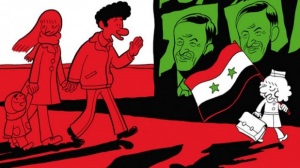
The graphic novel has proved itself over and over. It already has its classical canon: Spiegelman on the Holocaust, Satrapi on girlhood in Islamist Iran, and (perhaps most accomplished of all) Joe Sacco’s ‘Footnotes in Gaza’, a work of detailed and self-reflexive history. Edging towards this company comes Riad Sattouf’s ‘The Arab of the Future’, a childhood memoir of tyranny.

Little Riad’s mother, Clementine, is French. His father, Abdul-Razak, is Syrian. They meet at the Sorbonne, where Abdul-Razak is studying a doctorate in history. Those with Arab fathers will recognise the prestige value of the title ‘doctoor’. But Abdul-Razak is more ambitious. He really wants to be a president. Studying abroad at least allows him to avoid military service. “I want to give orders, not take them,” he says. When humiliated, he sniffs and rubs his nose.

Abdul-Razak is a pan-Arabist who believes the people (“stupid filthy Arab retards!”) must be educated out of religious dogma. For reasons of both vanity and ideology he turns down an Oxford teaching post for one in Libya. The family takes up residence in a flat which doesn’t have a lock, because Qaddafi has ‘abolished private property’. Little Riad sees Libya all yellow, its unfinished buildings already crumbling. He sings the Leader’s speeches with kids in the stairwell and queues with his mother for food (only eggs one week, just bananas the next).

When Qaddafi decrees that all must change jobs, teachers becoming farmers and vice versa, the family leaves, via France, for Syria, another country which “seemed to be under construction”. A disturbed Abdul-Razak has already absorbed news of the 1982 massacre in Hama. Now one dictator’s portraits are replaced by another’s. The bribery starts in the arrival hall.

Then to the ancestral village outside Homs, which is sexually segregated, afflicted by power cuts, soundtracked by howling dogs and calls to prayer. Riad’s weathered grandmother licks specks from children’s eyeballs. It’s this sort of detail, drawn with the cartoon clarity of childhood perception, which makes the book such a success.

The village boys, fascinated by Riad’s European toys, kick a puppy about for fun. Mokhtar and Anas, his bullying cousins (Riad is related to everyone in the village) call him Yahudi (Jew) on account of his blonde shock of hair.

Riad’s father – though by no means a hateful character – is the story’s foremost authoritarian, incapable of admitting ignorance or error, guilty of sectarianism, anti-black racism, misogyny and superstition (these last two intertwined). He suffers the inferiority/ superiority complex of the rapidly upwardly mobile, and he believes in strong men – Qaddafi, Saddam, Hafez al-Assad – against the evidence of their depredations. All these are faults typical of his Arab generation.

Continue reading “The Arab of the Future”

On Boston’s Radio Opensource

This was a strange experience. We were told in a long pre-interview that the actual interview would be just us (Leila and I), and would be focused on civil society in Syria. On the day, however, they brought in LRB-contributor Hugh Roberts and American commentator Jeffrey Sachs, so the conversation became enwebbed in a US-centric alternate reality. The host is Chris Lydon. Listen to it here.

Binet, Hitler and Putin

Putin1This (slightly subedited) was first published at the New Arab/ al-araby al-jadeed.
I’ve just finished “HHhH”, an excellent ‘non-fiction novel’ by the French writer Laurent Binet. It tells the true story of Operation Anthropoid, the assassination of top Nazi official Reinhard Heydrich co-ordinated by the Czechoslovak resistance and the British government.

In the Nazi surveillance agency, the SS, Heydrich was second in command only to Heinrich Himmler (or perhaps he was even more important than his boss – “HHhH” is the German acronym for ‘Himmler’s Brain is Called Heydrich’). He was the highest official in Nazi-occupied Czechoslovakia, and the chief architect of the ‘final solution’ for Europe’s Jews – the Holocaust.

The larger background to the drama of the assassination is Britain and France’s betrayal of Czechoslovakia, the final layer in these states’ disastrous appeasement of Hitler in the 1930s.

Germany had been defeated in World War One. The post-war settlement forced Germany to pay enormous reparations to the victors. This national humiliation was immediately followed by economic collapse and social disorder. Hitler emerged from this context, a strong leader promising to restore German order and pride, identifying enemies domestic and foreign, and lamenting the scattering of the German people across various borders.

Continue reading “Binet, Hitler and Putin”

With Syria Solidarity UK

It was a pleasure to give a talk at the LSE. The talk was organised by the brilliant Syria Solidarity UK.

Here is Part One:

and (after the break) Part Two:

Continue reading “With Syria Solidarity UK”

Free City Radio

Here I am talking about the Syrian revolution and our book ‘Burning Country’ on Canada’s Free City Radio. Topics include democracy, how Assad engineered a war, and the meanings of the word ‘jihad’.

Drawing Blood

mollyThis review was published at the National.

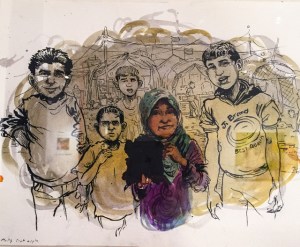
Molly Crabapple’s “Drawing Blood” – “the story of a girl and her sketchbook” – is at once memoir, reportage, literary description, aesthetic enquiry, road novel and romance.

Crabapple’s painting, lying somewhere between Toulouse Lautrec and surrealism, is increasingly celebrated. The surprise here is that her best writing is as provocatively beautiful as her visual art. Her prose is sweet and sour in equal measure, the eye she watches with is both refined and raw. Very often she watches herself. The comfortable clash in her personality of cynic and idealist, highbrow and lowbrow, recalls Saul Bellow’s early characters. Like Augie March, a young Molly shoplifts high-canonical texts and reads them on the elevated trains which pass above slums.

Native of New York, of a stimulating Puerto Rican (Marxist) and Jewish (artist) background, Molly nevertheless hated being a child. School diagnosed her with “oppositional defiant disorder”; by twelve she’d become a goth-punk. At seventeen she was travelling in Paris and Morocco, an American on tour – “nothing but an eye, soaking up the world” – but one seeing a freshly unexotic vision.

“When you draw you are performing quietly,” she writes, “inviting strangers to engage you.” Strangers engage her, of course, wherever he is, whether she’s drawing or not, simply because she possesses (or is possessed by) an attractive female body. This she finds to be both a power and a vulnerability. The financial power leads her to pose for photo shoots. “When I thought of every proposition and threat that I got just walking down the street in my girl body, I decided I might as well get paid for the trouble.” And so she became “rendered into image, untouchable yet tradable.”

Continue reading “Drawing Blood”

‘Democratic Confederalism’ or Counter-Revolution?

ocalan
Abdullah Ocalan (the Turkish ‘c’ is pronounced ‘j’)

This is my latest article for al-Araby al-Jadeed/ the New Arab.

The first fact is this: the Kurds have suffered a terrible historical injustice. The Arabs were rightly enraged when Britain and France carved bilad al-Sham (the Levant) into mini-states, then gave one of them to Zionism. But the post-Ottoman dispensation allowed the Kurds no state at all – and this in an age when the Middle East was ill with nationalist fever. Everywhere the Kurds became minorities in hyper-nationalist states.

Over the years an estimated 40,000 people have been killed in Turkish-Kurdish fighting, most of them Kurds. In the late 1980s, Saddam Hussain’s genocidal Anfal campaign murdered somewhere between 50 and 200,000 Iraqi Kurds. In Syria, where Kurds formed about 10% of the population, or around two million people, it was illegal to teach in Kurdish. Approximately 300,000 Kurds (by 2011) were denied citizenship by the state, and were therefore excluded from education and health care, barred from owning land or setting up businesses.

While oppressing Kurds at home, President Hafez al-Assad (Bashaar’s father) cultivated good relations with Kurdish groups abroad. This fitted into his regional strategy of backing spoilers and irritants as pawns against his rivals.

Continue reading “‘Democratic Confederalism’ or Counter-Revolution?”

KCRW

I was talking alongside journalists Anne Barnard and Borzou Daragahi, and aid worker Dalia al-Awqati, on KCRW, a Californian radio station. The discussion concerns the Munich theatre and the effects of the military onslaught on Syrian civilians.  If you follow this link you’ll hear it. I come in between 20.40 and 27.15.

‘Iran the Protector’

iran
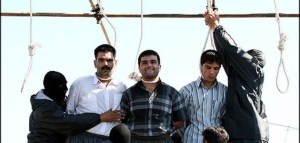
Iran executes more people than any country except China. Many victims are Ahwazi Arabs or from other minorities. Many are political dissidents. And many, of course, are Shia Muslims.

This was published at al-Araby al-Jadeed/ the New Arab.

I recently gave a talk in a radical bookshop in Scotland. The talk was about my and Leila al-Shami’s “Burning Country: Syrians in Revolution and War”, a book which aims to amplify grassroots Syrian revolutionary voices and perspectives. My talk was of course critical of the Iranian and Russian interventions to rescue the Assad regime.

During the question and answer session afterwards, a young man declared: “You’ve spoken against Iran. You’ve made a good case. But the fact remains, Iran is the protector of Shia Muslims throughout the region.”

In reply I asked him to consider the Syrian town of al-Qusayr at two different moments: summer 2006 and summer 2013.

During the July 2006 war between Israel and Hizbullah, hundreds of thousands of Lebanese fled south Lebanon and south Beirut – the Hizbullah heartlands where Israeli strikes were fiercest – and sought refuge inside Syria. Syrians welcomed them into their homes, schools and mosques. Several thousand were sheltered in Qusayr, a Sunni agricultural town between Homs and the Lebanese border.

It made no difference that most of these refugees were Shia Muslims. They were just Muslims, and Arabs, and they were paying the price of a resistance war against Israeli occupation and assault. That’s how they were seen.

Continue reading “‘Iran the Protector’”

Shouting on TRT World

There’s an urgent need for discussion between revolutionary Syrians and Syrians who are scared of the revolution. The two sides need to hear each other. Alawis and others have good reason to fear aggressive forms of Islamism and the possibility of generalised ‘revenge’ against their community when the regime falls.

The TV argument below, of course, is not the discussion required. On the revolution’s side, for a start, there’s me, resident in Scotland and not at all a ‘proper’ Syrian revolutionary. And on the other side is an outright propagandist called Ammar Waqqaf, a deliberate purveyor of misinformation and a slanderer of the Syrian people.

Where are the  serious representatives of anti-revolution Syrians? The ones who are able to recognise the genocidal slaughter and displacement suffered by their Sunni neighbours? The ones who don’t (pretend to) consider an imperialist invasion of the country to be an expression of sovereignty? The sad truth is that such people are silenced and eliminated by the regime, which has silenced and eliminated oppositional or just independent Alawis over decades.

The shouting starts at 4.37.