‘Burning Country’ Extract: On Islamisation

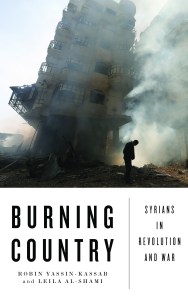
Yassin T03090The excellent Books pages at the National have published an extract from our book “Burning Country: Syrians in Revolution and War” (now available in the US too). Before the extract comes an introduction to the book and the situation.

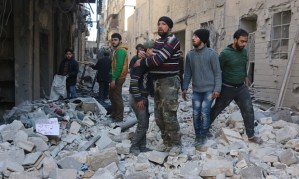
The revolution, counter-revolutions and wars in Syria are terribly misunderstood, particularly in the English-speaking West, by policy makers and publics alike. There are many shining exceptions, but in general poor media coverage, ideological blinkers and orientalist assumptions have produced a discourse which focuses on symptoms rather than causes, and which is usually unencumbered by grassroots Syrian voices or any information at all on Syrian political and cultural achievements under fire.

The consequent incomprehension is disastrous for two reasons – one negative, one positive.

First, the exponentially escalating crisis in Syria is a danger to everybody – Syrians and their neighbours first, but Europe immediately after. Russia’s terror-bombing is creating hundreds of thousands of new refugees. Meanwhile there’s good reason to believe President Putin is funding far-right anti-immigrant parties across Europe. It is very possible that this year’s flood of refugees will re-establish Europe’s internal borders, destroying the ‘Schengen’ free movement area, seen by some as Europe’s key political achievement since World War Two. With eleven million homeless, traumatised people on the eastern Mediterranean, terrorism is sure to increase. And the long-term geopolitical consequences of allowing, even facilitating, Russia, Iran and Assad to crush the last hopes of democracy and self-determination in Syria will create a still more dangerous world for our children. Yet European heads are being buried in the sand. Some still imagine a peace process is underfoot.

And the positive reason. Amidst the depravities of war, Syrians are organising themselves in brave and creative ways. The country now boasts over 400 local councils, most democratically elected, as well as tens of free newspapers, radio stations, women’s centres, and an explosion in artistic production. We shouldn’t just be feeling sorry for Syrians, but learning from them too. Their democratic experiments are currently under full-scale international military assault. They may be stamped out before most non-Syrians have even heard of them.

Continue reading “‘Burning Country’ Extract: On Islamisation”
The Darkest Days

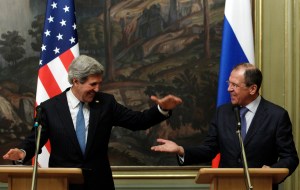
lavrov kerryI’m very happy to be published at al-Araby al-Jadeed, or the New Arab, which has attracted some very on-point political and cultural voices, in both languages.

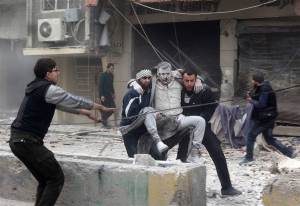
Syria is entering its darkest stage yet. Intense Russian bombardment and Iranian-backed militias  have almost encircled rebel-held Aleppo. The city’s last hospital has been hit by a Russian airstrike. In the liberated south too – where provincial elections were recently held – the revolution is being driven back. Hundreds of thousands of new refugees are fleeing, seeking shelter in caves or under trees. Several refugee camps have also been bombed.

Russia is winning the country back for Assad, supposedly for the sake of stability. But the notion that the revolutionary areas of the Arab world can return to stability under the old security states is every bit as a-historically nostalgic and supernatural as the Islamist idea that the Muslims can return to peace and justice under a medieval caliphate.

The Arab revolutions erupted for a reason – because, over decades, the regimes had failed their people economically, politically, socially and culturally. The regimes collapsed inevitably – are still collapsing – under the the weight of this historical failure.

Faced with a democratic uprising and incapable of genuine reform, Syria’s Assad regime provoked a civil war. Five years later it has lost four-fifths of the country, a reality which massive imperialist intervention – the Iranian-organised trans-national Shia jihadists on the frontlines and the Russian bombers overhead – is only now changing.

Even within regime-held territory, the old ‘national’ regime has already fallen, replaced by a condominium of foreign states and local warlords. The army, bled by casualties, desertions and defections, is a shell of its former self.

Continue reading “The Darkest Days”

The Depopulation of Syria

If you follow this link, I’m speaking between 6 minutes and 10.30 minutes on the international assault on Syria, the complicity of the United States, and the demographic realities which mean this is far from over.

Peace or Pacification

aleppoThis was published at the Canadian Centre for Policy Alternatives.

As I write, state representatives are attending the theatre in Geneva. (The talks were stopped on February 3rd). In Syria, meanwhile, reality prevails: in one day a tented camp of the displaced in the Lattakia hills is bombed, barrel bombs rain on the south and the Damascus suburbs, Russia’s cluster bombs crumple over the north, and up to a hundred people are asphyxiated by chlorine gas in Moadamiyah. Let’s hope the seats in the theatre are nice and comfy.

Russia, the prime mover of the process, is inviting its own ‘opposition’ delegates. It complains (with Assad and Iran) that the actual opposition delegation contains ‘terrorists’. The thousands of Iranian-backed transnational Shia jihadists in Syria are not considered terrorists and should not be discussed at this stage.

The United States accepts these terms, and instead of the ‘transitional government’ agreed upon as the ultimate goal in previous Geneva talks, it speaks now of a ‘national government’. In other words Assad – responsible for the overwhelming number of civilian casualities and displacements – can stay, so that all may confront the ‘greater evil’ of jihadism.

Yet 80% of Russian bombs are falling not on ISIS but on the opposition to both ISIS and Assad, that is, on the communities which previously drove ISIS from their areas. A quarter of a million more have been displaced as a result of the Russian assault, which hits courthouses, schools, hospitals and aid convoys.

Continue reading “Peace or Pacification”

Speaking at Chatham House

Here I am on stage at Chatham House last week with the journalist Mina al-Oraibi. Mina was a lot more optimistic about Russia’s ‘peace process’ than I was. Am I allowed to point out without seeming rude that the process has already dramatically collapsed?

The Happy Marriage

A very slightly different version of this review was published at the Guardian.jelloun

Tahar Ben Jelloun is a Moroccan who has contributed a series of important works to French literature, perhaps foremost amongst them the brilliant ‘non-fiction novel’ of incarceration “This Blinding Absence of Light”. His latest novel, “The Happy Marriage”, bears echoes of Tolstoy’s grim relationship-degeneration tale “Happy Ever After”, but Jelloun’s tale is thrown into question by a counter-narrative.

Our protagonist is semi-paralysed, recovering from a stroke, his face twisted like a Francis Bacon painting. He is a successful artist, a demanding perfectionist who now struggles to move his fingers while watching TV athletics and thinking about tightrope walking. His contextual musings on deterioration and dependency – “When your life is in someone else’s hands, is it still a life?” – form a suitable backdrop to his memories of a two-decade marriage, in Paris and Casablanca, in sickness and health.

Part One (called, with a nod to Truffaut, The Man who Loved Women Too Much) is the artist’s own carefully-crafted account, in third person. The accomplishment of the writing here recalls Philip Roth’s more sober moods, or Saul Bellow’s studies of older men suffering the humiliations of body and soul. The psychological depth, high-cultural detail, sometimes even the dense but fluid prose (ably translated by André Naffis-Sahely) are reminiscent of that American master.

Continue reading “The Happy Marriage”

Five Year Reflection

picture from anadolu agency
Russian bombing in the eastern Ghouta. picture from Anadolu Agency.

The Guardian asked ten Arab writers to reflect on the revolutions five years on (or in). My piece is here below. To read the others too (including Alaa Abdel Fattah from Egyptian prison, Ahdaf Soueif, and notable others), follow this link.

Five years ago the Guardian asked me to evaluate the effects of the Tunisian uprising on the rest of the Arab world, and specifically Syria. I recognised the country was “by no means exempt from the pan-Arab crisis of unemployment, low wages and the stifling of civil society”, but nevertheless argued that “in the short to medium term, it seems highly unlikely that the Syrian regime will face a Tunisia-style challenge.”

That was published on January 28th. On the same day a Syrian called Hassan Ali Akleh set himself alight in protest against the Assad regime in imitation of Mohamed Bouazizi’s self-immolation in Tunisia. Akleh’s act went largely unremarked, but on February 17th tradesmen at Hareeqa in Damascus responded to police brutality by gathering in their thousands to chant ‘The Syrian People Won’t Be Humiliated’. This was unprecedented. Soon afterwards the Deraa schoolboys were arrested and tortured for writing anti-regime graffiti. When their relatives protested on March 18th, and at least four were killed, the spiralling cycle of funerals, protests and gunfire was unleashed. Syria not only witnessed a revolution, but the most thoroughgoing revolution of all, the one that has created the most promising alternatives, and the one that has been most comprehensively attacked.

Continue reading “Five Year Reflection”

More Talking

And if you follow this link, and listen from 40 minutes till the end, you’ll hear me talking On BBC Radio 4’s ‘The World Tonight’ about Syria’s revolution and war. I was invited because our book Burning Country has been released. It tells the Syrian people’s stories first and foremost, before examining the global responses and results. We feel this drama has been very badly reported in the main, and we hope the book will fill some important gaps. So please read it.

Talking About the Councils

If you follow this link you’ll hear me talking on BBC World Service radio (‘Newshour’) about Syria’s revolutionary councils, decentralisation, refugees, and the ‘peace process’ illusion.

(I made a mistake here. I said Syrians need at least one or two hundred dollars to escape Syria. Slip of the tongue. I should have said they need one or two thousand.)