by Najate Zouggari
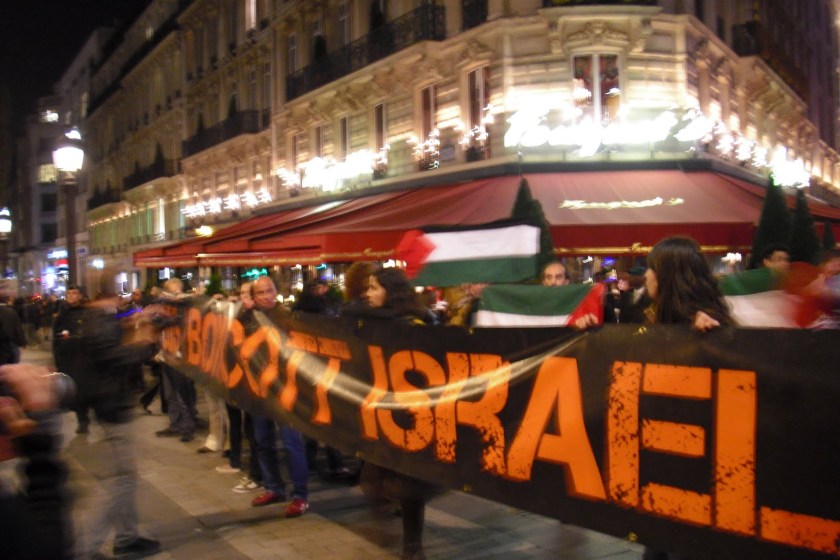
French authorities received the request of pro-Israeli plaintiffs who finally managed to turn the international solidarity movement – and its non-violent expression of resistance against the colonial state of Israel – into a potentially punishable action.
Before reaching the tribunals and the symbolic weight of a juridical expression, this criminalizing discourse was previously set as a clear position on the opinion battlefield: many journalists and commentators harshly criticized the BDS campaign, some of them even smart enough to admit that even if the IDF — “the most moral army in the world” of “the only democracy of the Middle-East” — was perhaps not perfect, Israeli artists should still be encouraged to meet up and present their work in French festivals, universities. Apart from the fact that with such a specious reasoning racial segregation would still exist in South Africa, this discourse is omitting – either by dangerous naïveté or immoral bad faith – that culture is strictly related to the state’s apparatus: materially, through the reception of grants-in-aid, and ideologically, as an instance of reciprocity with the rest of the society. Israeli artists based in Israel are not floating in the air of abstraction: whether some complacently idealist French commentators like it or not, artists are legitimate and recognized members of the society they live in — the margin is still inside the sheet. The fact Israeli artists pay taxes to the Israeli state and serve in the Israeli military while their army bombs Palestinian civilians (with even white phosphorus as some allege) makes them indirectly but firmly responsible of the ongoing colonization, ethnic-cleansing and racist policies promoted by their government. Exempting Israeli artists and intellectuals of their moral responsibility is subsequently a poisoned gift in the long-term, and an easy way to criminalize the BDS movement in the short-term.

 I received an education yesterday.


 P U L S E