Part II of NYTimes eXaminer interview with Belén Fernández

The following is a the second half of an interview conducted by the new NYTimes eXaminer with PULSE co-editor Belén Fernández about her book The Imperial Messenger: Thomas Friedman at Work. Read the first half here.

Q: Did you come away with a lower opinion of Friedman or of the people and institutions that continually give him platforms to spew his idiotic, loathsome views?  I find it so telling that, when Friedman did his “suck on this” performance on Charlie Rose, Rose just nods and leans in for the next question instead of calling Friedman out for saying one of the most offensive things ever said on television.  Or to put it another way:  Do you think the New York Times would allow one of their columnists to consistently dehumanize entire groups of people – to the point of openly calling for civilian deaths in Gaza, Afghanistan and Iraq – if those people weren’t Arab/Muslim?

Unfortunately, Orientalist dehumanization is institutionalized in US media discourse, the result being that there is no overwhelming public concern when over a million Iraq lives are lost thanks to America’s bellicose projects or when 1400 Palestinians perish in a matter of 22 days at the hands of the Israel Defense Forces.

It is utterly appalling that neither Charlie Rose nor anyone else in the US establishment media took issue with Friedman’s obscene proclamation, and that he was never required by his employer to apologize for it in the interest of maintaining a pretense of objectivity. One can imagine the uproar that would have ensued—and over which Friedman himself would have presided—had, for example, Yasser Arafat instructed Israelis to suck on things, or had Osama bin Laden justified 9/11 with similar terminology. Friedman, on the other hand, is permitted to continue blissfully peddling his contemptuous analyses of the Arab/Muslim world, such as his 2007 assessment—with regard to the US military—that Iraqis “don’t deserve such good people… if they continue to hate each other more than they love their own kids.”

Of course, it is safe to assume that most Iraqis exhibit normal human affection for their offspring, including for those millions of offspring that have been killed, maimed, displaced or otherwise made to suffer as a result of a US military-inflicted sucking, and that the half a million Iraqi children previously killed by US-championed sanctions were probably also loved by their parents.

Even if Charlie Rose et al. fail to comprehend that sucking orders do not qualify as proper journalistic etiquette, they should at least be able to comprehend that Friedman’s argument for why the sucking should occur is in complete defiance of logic. According to Friedman, Iraqis must be made to suck so that the US can effectively combat the “terrorism bubble” that has developed in “that part of the world” and that poses a “fundamental threat to our open society,” something Americans discovered on 9/11. However, this very same Friedman also explains that the real threat to “open, Western, liberal societies today” consists not of “the deterrables, like Saddam, but the undeterrables – the boys who did 9/11.” The resulting argument—made by someone who himself criticizes the Bush administration for implying a link between bin Laden and Saddam Hussein—is that war against deterrables whose weapons are not the problem will solve the problem of undeterrables who are the weapons and who by definition cannot be deterred anyway.

Continue reading “Part II of NYTimes eXaminer interview with Belén Fernández”

Why I “Assaulted” Defense Chief Leon Panetta

by 
Alli McCracken 

Alli McCracken being arrested by the police for protesting at the Congressional hearing

“Assault? Who — or what — did I assault?” I asked the police officer incredulously as I sat in his office at the police station, handcuffed to the wall. “Well, looks like it was Leon Panetta himself,” the officer responded as he flipped through a pile of paperwork.

Me? A 22-year-old mild-mannered peace activist, assaulted the Secretary of Defense? I had simply tried to tell him how I felt about the wars. 

On the morning of October 13th about 25 activists who are occupying Washington DC, as part of the nationwide occupations, went on a field trip to Congress. We wanted to attend the House Armed Services Committee hearing where Leon Panetta, the Secretary of Defense, and Martin Dempsy, Chairman of the Joint Chiefs of Staff, were testifying about “lessons learned by the Department of Defense over the preceding decade” and “how those lessons might be applied in the future in light of anticipated reductions in defense spending.” After all, these hearings are open to the public. And shouldn’t we have a say in where our money is being spent?

As a peace activist with the group CODEPINK for the past 10 months, I have done my fair share of sending letters and emails and delivering petitions to our government representatives, asking them to stop pouring trillions of our taxpayer dollars into the endless cycle of death, destruction and reconstruction halfway across the world. There are so many critical things that we could spend that money on here in America, such as education, healthcare, helping the homeless, the elderly, the disabled, the veterans.

Continue reading “Why I “Assaulted” Defense Chief Leon Panetta”

Whatever Happened to Women and Children First?

by Johnny Barber

“All wars, whether just or unjust, disastrous or victorious, are waged against the child.” — Eglantyne Jebb, founder of Save the Children, 1919.

In Kabul, the children are everywhere. You see them scrounging through trash. You see them doing manual labor in the auto body shops, the butchers, and the construction sites. They carry teapots and glasses from shop to shop. You see them moving through the snarled traffic swirling small pots of pungent incense, warding off evil spirits and trying to collect small change. They can be found sleeping in doorways or in the rubble of destroyed buildings. It is estimated that 70,000 children live on the streets of Kabul.

The big news story on CNN this morning is the excitement generated as hundreds of people line up to buy the newest iphone. I can’t stop thinking of the children sitting in the dirt of the refugee camp, or running down the path pushing old bicycle tires, or the young boy sitting next to his overflowing sacks of collected detritus. He has a deep infection on the corner of his mouth that looks terribly infected. These images contrast with an image of an old grandfather, dressed in a spotless all white shalwar kameez squatting on the sidewalk outside a huge iron gate, embracing his beautiful young grand daughter in a huge hug, each smiling broadly, one of the few moments of joy I have witnessed on the streets of Kabul.

In Afghanistan, one in five children die before their 5th birthday, (41% of the deaths occur in the first month of life). For the children who make it past the first month, many perish due to preventable and highly treatable conditions including diarrhea and pneumonia. Malnourishment affects 39% of the children, compared to 25% at the start of the U.S. invasion. 52% don’t have access to clean water. 94% of births are not registered. The children are afforded very little legal protection, especially girls, who are stilled banned from schools in many regions, used as collateral to settle debts, and married through arranged marriages as young as 10 years old. Though not currently an issue, HIV/AIDS looms as a catastrophic possibility as drug addiction increases significantly, even among women and children. Only 16% of women use modern contraception, and children on the streets are vulnerable to sexual exploitation. This is why the “State of the World’s Mothers” report issued in May 2011 by Save the Children ranked Afghanistan last, with only Somalia providing worse outcomes for their children.

Continue reading “Whatever Happened to Women and Children First?”

The Darkness Approaches, a Light Shines Bright

by Johnny Barber

Today in Afghanistan people feel an unnamable horror lurking just below the surface of their everyday lives. It has been described as a tension, a feeling of pressing apprehension, as if a breaking point is about to be breached. People wake each day with this feeling; it accompanies them through their dreams each night.

Driving through the streets of Kabul I watch people set about their business deliberately. There is little laughter, the absence of joy as palpable as the heavy brown dust swirling through the streets choking off the sun.

We turn down a pock marked dirt road. Reminded of a video game my son used to love, we swerve from side to side to miss as many obstacles as possible, including oncoming traffic of all varieties, crashing through spine-jarring potholes with regularity. We spot the large pink building behind a huge steel gate. The guard points to a door and tells us to call inside.

We have arrived at the New Learning Center, a school serving the children of Afghanistan. It was founded and directed by Andeisha Farid, a young Afghan woman, who was herself a displaced person during the Soviet war and grew up in refugee camps in Iran and Pakistan. Andeisha had one simple idea. If she could help one child, that child would return to her family and influence the family. In turn, the family would influence the village, the village would influence the province, the province would influence the country. This simple idea has turned into 11 orphanages, serving 700 children, and the New Learning Center, newly opened in May 2011.

Continue reading “The Darkness Approaches, a Light Shines Bright”

10 Years After: Welcome to the Failed State of Americastan.

by Johnny Barber

Kabul–As we step off the Turkish Air flight and walk across the dusty tarmac to the terminal, we are greeted by a large billboard. In big bold English it proclaims, “Welcome to the Home of the Brave.” It stops me in my tracks. I shake my head, thinking, “damn weird” and continue in to passport control. After waiting in a short line, I present my American passport to the guard in the booth. He doesn’t acknowledge me. He flips through the shiny new pages until he gets to the visa. He stamps it. He turns to the picture. He gives me a precursory glance and hands the passport back to me. I turn and enter Afghanistan.
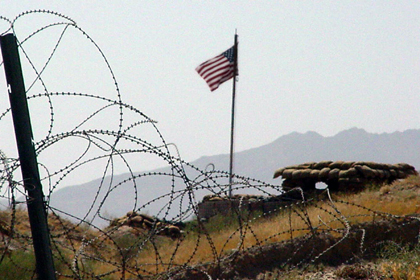
I have come here with two friends from Voices for Creative Non-Violence, forming a small delegation interested in developing relationships with ordinary Afghans and gathering stories of everyday life since the American invasion in 2001. After collecting our luggage and taking a short bus ride to the parking area, Hakim, Mohammed Jan, and his brother Noor greet us warmly. Hakim and Mohammed Jan are our hosts and the organizing force of the Afghan Youth Peace Volunteers.

Continue reading “10 Years After: Welcome to the Failed State of Americastan.”

Just Obstructed at Bagram as at Guantanamo

by Brian Terrell

BAGRAM AIR BASE, Afghanistan (U.S. Air Force photo by Staff Sgt. Scott T. Sturkol)

Despite ten years of occupation and untold millions of dollars spent on rebuilding Afghanistan’s broken judicial and criminal justice system, the Afghan courts are “still too weak,” the Washington Post reported on August 12, for the United States to relinquish its control over the Parwan Detention Center on Bagram Air Base in Afghanistan. On September 21, the same paper reported that the U.S. military is seeking contractors to significantly increase the capacity of the prison there.

The number of Afghans detained at Bagram has tripled over the past three years to more than 2,600 and the new construction will raise the capacity to 5,500 prisoners. Capt. Kevin Aandahl, a spokesman for the U.S. task force that oversees detention operations in Afghanistan, told the Post that the expansion was necessary to “accommodate an increase in the number of suspected insurgents being detained as a result of intelligence-based counter- terrorism operations, which we conduct with our Afghan partners.”

Many of those held at Bagram have been there since the U.S. occupied the former Soviet air base in 2001, and some two thirds of prisoners there have not been charged with or convicted of any crime. Corruption is rampant in Afghan courts and among police there as it is in many other places but the major fear of the United States is not that the Afghan courts will not function according to their constitution and accepted norms of law, but that they will. In order for Afghanistan to take sovereignty over its own judiciary and prison system, the Afghans must first fix the “cracks of an undeveloped legal system” and adopt essential “reforms,” including adoption of the U.S. practice of detaining suspected insurgents indefinitely without trial.

Continue reading “Just Obstructed at Bagram as at Guantanamo”

Ten years too long: What is the True Cost of the Afghanistan War?

Narrated by Tony Benn, with music by Brian Eno. The clip ends with a call to join the Antiwar Mass Assembly in Trafalgar Square on 8 October: http://www.antiwarassembly.org

What we are Forgetting to Remember: The Social Context of 9/11

by Mike King

September 11, 2001 is a world historic moment, a historical signpost – “9/11” – marking more than a deadly attack, but a moment that truly changed history, one that can help us understand both the past and the present.  This week marks the tenth anniversary of the 9/11 attacks.  Of the memorials given, documentaries aired and news stories published this week, few will address the causes and effects of 9/11 in a way that gives a sense of the root causes, social context and contradictions that surround that moment and continue to define our present.
9/11 grew out of everything from Cold War contradictions to longstanding political grievances and anti-imperialism in the Muslim world.  9/11 propelled two unending wars, Afghanistan being the longest in US history, bankrupting both State finances and global moral legitimacy.  Despite the killing of Osama bin Laden, and his mysterious burial at sea, and despite the fact that there have been no successful terror attacks in the US since 9/11, the US has lost the “War on Terror” in every other conceivable way.  Whether in terms of lost economic hegemony or in terms Federal budget deficits (and their social effects), largely caused by the costs of wars, or in terms of a loss of geopolitical control over much of the Western hemisphere or North Africa, the US leveraged its Empire to fund a new Crusades which has them clutching to their global thrown with one hand, munitions with the other, as the other world powers and financiers wait for the right moment to pull the rug out from under them, as multiple occupations meet persistent resistance.

Continue reading “What we are Forgetting to Remember: The Social Context of 9/11”

The Terrorism Issue that Wasn’t Discussed

by Gareth Porter

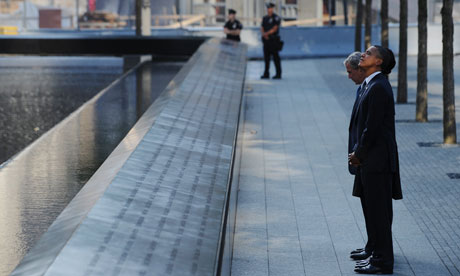
George W. Bush and President Barack Obama visit the 9/11 memorial (Mandel Ngan/AFP/Getty Images

In the commentary on the tenth anniversary of 9/11, the news and infotainment media have predictably framed the discussion by the question of how successful the CIA and the military have been in destroying al Qaeda. Absent from the torrent of opinion and analysis was any mention of how the U.S. military occupation of Muslim lands and wars that continue to kill Muslim civilians fuel jihadist sentiment that will keep the threat of terrorism high for many years to come.

The failure to have that discussion is not an accident. In December 2007, at a conference in Washington, D.C. on al Qaeda, former State Department Coordinator for Counterterrorism Daniel Benjamin offered a laundry list of things the United States could do to reduce the threat from al Qaeda. But he said nothing about the most important thing to be done: pledging to the Islamic world that the United States would pull its military forces out of Afghanistan and Iraq and end its warfare against those in Islamic countries resisting U.S. military presence.

During the coffee break, I asked him whether that item should have been on his list. “You’re right,” he answered.  And then he added, “But we can’t do that.”

“Why not,” I asked.

“Because,” he said, “we would have to tell the families of the soldiers who have died in those wars that their loved ones died in vain.”

His explanation was obviously bogus. But in agreeing that America’s continuing wars actually increase the risk of terrorism against the United States, Benjamin was merely reflecting the conclusions that the intelligence and counter-terrorism communities had already reached.

Continue reading “The Terrorism Issue that Wasn’t Discussed”

Staying in Afghanistan

by Ross Eventon

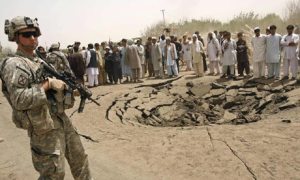
A US soldier keeps watch at the site of an explosion in Logar Province south of Kabul Photograph: Omar Sobhani/Reuters

Reports that the US is determined to maintain a presence in Afghanistan will surprise no one except 99% of foreign policy analysts.  Responding to the announcement that the US is in negotiations to maintain a presence until 2024, Mahdi Hassan, senior editor at the New Statesman, writes “the US-led invasions and occupations of both countries have been a dismal failure” because “the presence of western troops in Muslim lands has provoked more terrorism than it has prevented.”

Regardless, Obama escalated the conflict on coming to office.  Citing research that outlines the primary goal of suicide terrorism is to end foreign military occupations, Hassan asks, “Why does an intelligent politician such as Barack Obama have such difficulty understanding this?”

The Afghan and Iraq invasions were launched on the expectation they would increase the terrorist threat to domestic populations, as they duly did.   It is a remarkable example of extreme naivety or intellectual subservience that claims the US is concerned with reducing terror not be met with widespread ridicule.

As Julien Mercille, a lecturer at University College Dublin, points out in the journal Critical Asian Studies, the War on Drugs is equally vacuous.

Continue reading “Staying in Afghanistan”