Repression in Honduras continues unabated

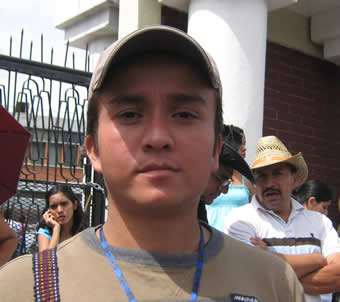
In front of the occupied National Autonomous University, a sign reads: "Maria Otero, go home". (Photo: Karen Spring)

by Karen Spring

Last Thursday and Friday (Aug. 26-27), police and military violently repressed public school teachers who have taken to the streets for almost 3 weeks to demand, among other things, that the Pepe Lobo regime return 4 billion lempiras – some 200 million dollars – that were taken from INPREMA, an institution that manages teachers’ pension funds, after the military-oligarchic coup against President Mel Zelaya on Jun. 28, 2009.

The 6 teachers’ unions that form the umbrella organization FOMH – representing 63,000 teachers nation-wide – believe that the funds taken from this institution were used to fund the military regime after the coup headed by Roberto Micheletti and General Romeo Vasquez Velasquez, which repressed and terrorized the pro-democracy movement critical of the coup and its perpetrators.

Continue reading “Repression in Honduras continues unabated”

The Coup Is Not Over: Marking a Year of Resistance in Honduras

by Joseph Shansky

At one point during the military coup in Honduras last year, a US representative to the Organization of American States (OAS) joked that Hondurans were living in a state of “magical realism”, a folkloric literary genre blurring reality and the surreal, often in the historical or political context of Latin America.

He wasn’t far off, despite the bizarre comparison: A democratically-elected president is overthrown by an elite conspiring against him, forced out of the country, the military takes over, the people revolt in massive opposition, while governments across the world refuse to recognize the new regime and withdraw their ambassadors. Only the United States, the most powerful of all countries, remains on the fence, then hops off onto the side of the golpistas (coup-makers) while presenting a straight face of diplomacy.

Continue reading “The Coup Is Not Over: Marking a Year of Resistance in Honduras”

Chávez Takes on Little Red Riding Hood

Colombian presidential candidate Juan Manuel Santos.

By Ken Kelley

I was surprised during my trip to Colombia last month when my seemingly enlightened Bogotá cab driver, who had been telling me about his support for Green Party presidential candidate Antanas Mockus in the upcoming elections, suddenly shifted gears and announced that Venezuelan President Hugo Chávez was loco.

The mental state of its leader was not the only issue the driver had with the neighboring country, and he added that money for Venezuela’s social programs came not from oil wealth but rather from proceeds Chávez received as part of an international drug smuggling ring.  Among the co-conspirators in the ring, I learned, was ex-President Manuel Zelaya of Honduras, ousted in a coup last summer which according to the cabbie had been justified based on the fact that Zelaya was also loco.

Continue reading “Chávez Takes on Little Red Riding Hood”

“I for you and you for me”

Garífuna ELAM graduates Wendy Pérez (l) and Luther Castillo (r), members of the group of students who founded “For the Health of our People¨, at the house where Cuban medical personnel live in Ciriboya. (Photo courtesy of Diane Appelbaum of MEDICC)

By Joanne Shansky

“¡Elsa!  ¿Cómo estás?” exclaimed Dr. Luther Castillo with a huge smile and a very warm hug.  In a rare relaxing moment during a recent whirlwind visit to Milwaukee, Wisconsin, Dr. Castillo was reunited with a family friend from his Garífuna community on the northern coast of Honduras.

Dr. Castillo, founder of the first Garífuna hospital and head of the largest international team of physicians working in Haiti, was in town to share his experiences and speak on the topic of health care as a universal right.  He traveled with Dr. Juan Almendares, rector of the National University of Honduras, long-time human rights activist, and highly-respected leader of the resistance movement against the June, 2009 military coup.

Continue reading ““I for you and you for me””

US covering up reality in Honduras

Produced by Jesse Freeston of The Real News Network, the following video explores the current human rights situation in Honduras and the reasons we should question Hillary Clinton’s claim that the Pepe Lobo administration has “taken the steps necessary to restore democracy.”

Graphic History of the Honduran Coup, final part

Dan Archer, comics journalist and instructor at Stanford University, has the following to say about the final installment of his 3-part graphic history of the Honduran coup, which can be viewed below:

In the final part… I focus on piecing together the evidence of the repression that went mostly undocumented in the wake of the Nov 29th Honduran elections. Despite the media’s portrayal of a democratic transition to Porfirio Lobo’s inauguration as president a week ago, the de facto government’s use of violence and threats against resistance members should stand as an ominous augury, especially given its clear links to Lobo and his cabinet. Most troubling of all is the United States’ involvement under the banner of promoting ‘democracy,’ a term that is being increasingly used as a pretext for supporting a regime whose sympathies correspond to the American agenda (be it CAFTA or alarmist left-wing conspiracies), regardless of popular feeling or their worrying record of human rights abuses.”

Continue reading “Graphic History of the Honduran Coup, final part”

Killing Activists in Honduras

 
Walter Trochez

By Joseph Shansky

“As a revolutionary I will be today, tomorrow and forever on the front lines of my people, all the while knowing that I may lose my life.” – Walter Trochez, 25, murdered in Tegucigalpa on 12/13/09

The bodies of slain activists are piling up in Honduras. While it’s being kept quiet in most Honduran and international media, the rage is building among a dedicated network of friends spreading the word quickly with the tragic announcement of each compañero/a.

Now that the world heard from mainstream news outlets such as the New York Times of a “clean and fair” election on Nov. 29 (orchestrated by the US-supported junta currently in power), the violence has increased even faster than feared.

The specific targets of these killings have been those perceived as the biggest threats to the coup establishment. The bravest, and thus the most vulnerable: Members of the Popular Resistance against the coup. Their friends and family. People who provide the Resistance with food and shelter. Teachers, students, and ordinary citizens who simply recognize the fallacy of an un-elected regime taking over their country. All associated with the Resistance have faced constant and growing repercussions for their courage in protesting the coup. With the international community given the green light by the US that democratic order has returned via elections, it’s open season for violent forces in Honduras working to tear apart the political unity of the Resistance Front against the coup.

Continue reading “Killing Activists in Honduras”

ON PRESIDENTS AND PRECEDENTS: IMPLICATIONS OF THE HONDURAN COUP

By Joseph Shansky

First published in Upside Down World, 10 December 2009

President Obama was elected partly because of his promise to a large Hispanic constituency to give both new attention and new respect to Latin America. Judging from the US role in the military coup in Honduras, he must think that one of the two is enough.

For those who closely followed the coup and its aftermath, a tiny fear sat in the back of our minds. Eventually it was confirmed. As the State Department position shifted from condemning to condoning the illegal government, the outline of a bigger picture became clear. If this violent takeover were really to be approved by the US, it would mark a frightening new focus on the region.

In late June, Honduran President Manuel Zelaya was kidnapped by the military and forced out of the country. For the next five months, an illegitimate government, headed by Congressional leader Roberto Micheletti, suppressed the outrage of many Honduran citizens against this regime through a number of violent means including murder, torture, and detention of citizens.

Throughout this time, the US response to these allegations was silence.

Continue reading “ON PRESIDENTS AND PRECEDENTS: IMPLICATIONS OF THE HONDURAN COUP”

The Honduran Coup: A Graphic History

Media creativity in the aftermath of the 28 June coup against Honduran President Mel Zelaya has generally been limited to such things as CNN’s classification of the military coup as “military-led,” Honduran media classification of tomorrow’s illegitimate elections as a “fiesta cívica,” and the publication of articles in mainstream Honduran newspapers with titles like “Zelayista Guerrillas Train in Nicaragua.” This particular article, published by El Heraldo on 2 August, is accompanied by a photograph of a ragtag group of joggers—some of them barefoot, one in a cowboy hat, and one in all pink—and bears a caption announcing that “Manuel Zelaya’s followers have begun military exercises in fields in Nicaragua.”

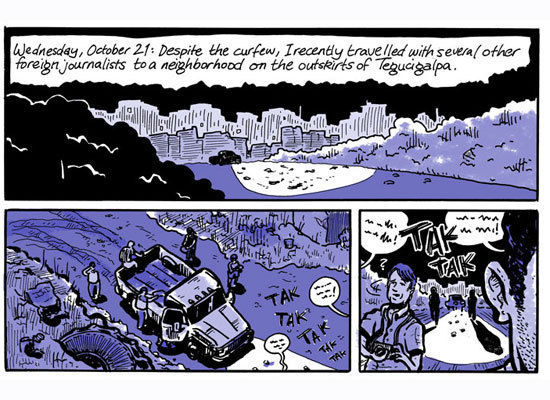
More substantive creative endeavors have been undertaken by Dan Archer and Nikil Saval, who have put together a graphic history of the Honduran coup in two parts thus far. The latter part is based on Joseph Shansky’s piece “Smashing the Silence: Community Defiance in Honduras,” first published on PULSE, and can be viewed below (note: all annotations appear in the original version). The first part of the graphic history can additionally be viewed here, and information on other projects can be found on Archer’s website.

Continue reading “The Honduran Coup: A Graphic History”

From Guantanamo to Honduras: Psychological Wars Then and Now

embajada
Honduran military surrounds Brazilian embassy in Tegucigalpa. (Photo: AFP)

By Joseph Shansky

Recently, musicians such as Rage Against the Machine, Steve Earle and Pearl Jam joined the newly-formed National Campaign to Close Guantanamo Bay.  It’s a public effort to protest the past misuse of recordings during “enhanced interrogation techniques” at Guantanamo prison.  An exaggerated volume and incessant repetition of loud music are just a few auditory torture techniques famously used by the American government overseas to disorient prisoners. 

However, the issue of psychological warfare should not only be seen in a past context.  Since these revelations, the question of its continued use in other parts of the world deserves exposure.

One timely example is Honduras.  In June of this year, President Manuel Zelaya was violently removed from power in a military coup d’état and replaced with a non-elected government, led by former National Congress leader Roberto Micheletti.  Since his return to Honduras September 21, President Zelaya has been residing with supporters in the Brazilian embassy in Tegucigalpa, with Honduran armed forces stationed outside.

Following orders by coup government officials, the army has been frequently directing harsh noises at the embassy occupants.  The most recent example took place early in the morning of October 21, when the broadcast included military anthems, rock music, and animal noises (pig grunts, in an apparent attempt to add insult to injury) at an excessive volume, and on a constant loop from around 1:30 am to 7 am. 

Continue reading “From Guantanamo to Honduras: Psychological Wars Then and Now”