As Bradley Manning faces charges of espionage over the Wikileaks cables Inside Story Americas asks if the US government is overreacting.
Bradley Manning, a private in the US army, has been accused of perpetrating the biggest intelligence leak in US history.
Now a military judge is trying to determine whether Manning should face a court martial. He could face as many as 22 specific allegations in the charges that include aiding the enemy and espionage. Continue reading “Punishing the whistleblower?”
Harry Kreisler talks to Glenn Greenwald in the latest episode of Conversations with History.
Conversations host Harry Kreisler welcomes writer Glenn Greenwald for a discussion of his new book, “With Liberty and Justice for Some.” Greenwald traces his intellectual odyssey; analyzes the relationship between principle, power, and law; and describes the erosion of the rule of law in the United States. Highlighting the degree to which the legal system frees the powerful from accountability while harshly treating the powerless, Greenwald describes the origins of the current system, its repudiation of American ideals, and the mechanisms which sustain it. He then analyzes the media’s abdication of its role as watchdog role. He concludes with a survey of the the record of the Obama administration in fulfilling its mandate, argues for an alternative politics, and offers advice for students as they prepare for the future. Series: “Conversations with History”
It says something about American society that on the day a true hero, PFC Bradley Manning, goes to trial, less than twenty people show up to support him. Shame.
The following appears in The Arabs Are Alive, edited by Ziauddin Sardar and Robin Yassin-Kassab.
On 7 December 2010, Tunisian despot Zine el Abidine Ben Ali’s regime blocked internet access to the Beirut daily Al-Akhbar for publishing a US embassy cable which painted the dictator, his wife and her family in a deeply unflattering light. In the July 2009 cable, US ambassador Robert Godec had accused Ben Ali’s regime of having ‘lost touch with the Tunisian people…[tolerating] no advice or criticism whether domestic or international,’ and of increasingly relying ‘on the police for control and focus on preserving power.’ The cable mentioned the growing ‘corruption in the inner circle,’ particularly around first lady Leila Trabelsi and her family, whom it said the Tunisians ‘intensely dislike, even hate.’ It finally concluded that ‘anger is growing at Tunisia’s high unemployment and regional inequities. As a consequence, the risks to the regime’s long-term stability are increasing.’
Ten days later in Sidi Bouzid, 26-year-old street vendor Muhammad Bouazizi immolated himself in front of the local municipality building after his vegetable cart was confiscated by Faida Hamdi, a female municipal official who had then slapped him, spat in his face, and insulted his dead father. Anguished friends and sympathizers soon took to the streets to protest, and Youtube, Facebook and Twitter helped spread the fire further—the long deferred anger of the Tunisians had finally erupted. On 4 January 2011, when Bouazizi succumbed to his wounds, the 5,000 mourners at his funeral were heard chanting, ‘Farewell, Mohammed, we will avenge you. We weep for you today. We will make those who caused your death weep.’ Ten days later, as the protests reached a crescendo, Ben Ali and his wife hoarded their loot and decamped to Saudi Arabia. Some suggested that Wikileaks had drawn first blood.
Fresh from his scrimmage with the Murdoch press, Steve Coogan, creator of the comedy classic ‘I’m Alan Partridge’, takes on the casual racism of the BBC’s Top Gear. (via The Guardian)
The trio of jackasses that hosts BBC's Top Gear
As a huge fan of Top Gear, I normally regard the presenters’ brand of irreverence as a part of the rough and tumble that goes with having a sense of humour. I’ve been on the show three times and had a go at their celebrity-lap challenge, and I would love to receive a fourth invite. But I think that’s unlikely once they have read this. If, however, it makes the Lads question their behaviour for a second – ambitious, I know – it will be worth it.
I normally remain below the parapet when these frenetic arguments about comedy and taste break out. But this time, I’ve had enough of the regular defence you tend to hear – the tired line that it’s “just a laugh”, a bit of “harmless fun”.
Some of the Lads’ comments again, in case you missed them. “Mexican cars are just going to be lazy, feckless, flatulent, overweight, leaning against a fence asleep looking at a cactus, with a blanket with a hole in the middle on as a coat” (Richard Hammond). Mexican food is “sick with cheese on it” (James May).
Jeremy Clarkson added to the mirth by suggesting that the Mexican ambassador (a certain Eduardo Medina-Mora Icaza) would be so busy sleeping he wouldn’t register any outrage. (He wasn’t and he did.)
OK, guys, I’ve got some great ideas for your next show. Jeremy, why not have James describe some kosher food as looking like “sick with cheese on it”? No? Thought not. Even better, why not describe some Islamic fundamentalists as lazy and feckless?
Billed as “an antidote to the ‘paper of record'”, the NYTimes eXaminer‘s Advisory Council is composed of such distinguished figures as Richard Falk, Phyllis Bennis, and Edward Herman.
See Phil Weiss’ comment on the interview at Mondoweiss.
Q: Why Tom Friedman? And can you talk a little about how the book is organized?
A: My decision to write the book was not the product of any sort of long-standing obsession with Thomas Friedman, whose journalistic exploits I remained mercifully immune to for most of my existence up until 2009.
Kidding. In 2009 I watched with simultaneous fascination and horror as Friedman flitted on pedagogical missions from Lebanon to Iraq to Afghanistan to Palestine to Africa, where he discovered the root cause of oppression in Zimbabwe by going on safari in Botswana.
Later that same year, Friedman’s decades-long lecture to the Arab/Muslim world on how to behave reached new levels of absurdity with his pronouncement according to which:
A corrosive mind-set has taken hold since 9/11. It says that Arabs and Muslims are only objects, never responsible for anything in their world, and we are the only subjects, responsible for everything that happens in their world. We infantilize them.
Arab and Muslims are not just objects. They are subjects. They aspire to, are able to and must be challenged to take responsibility for their world.
Arab/Muslim subjectivity was of course called into question not only by the fact that Friedman in this very same article instructed the Islamic world to engage in a civil war equal in ferocity to the US civil war, but also by the fact that—approximately 10 days prior to criticizing the infantilizing of Arabs and Muslims—he had remarked to an amused Fareed Zakaria of CNN that Afghanistan was like a “special needs baby” adopted by the US. (Friedman had refrained in this case from throwing in his regular complaint that the US was “baby-sitting a civil war” in Iraq—a complaint he apparently felt was not irreconcilable with his own declaration of the need for an Iraqi civil war.)
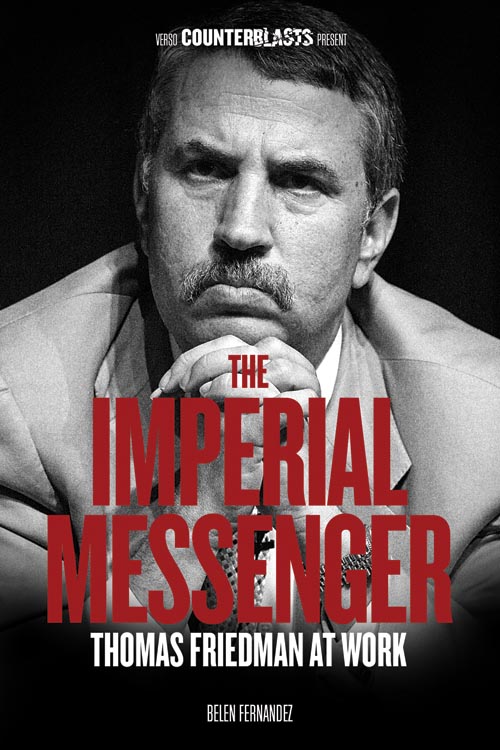
Jadaliyya recently interviewed PULSE co-editor Belén Fernández about her book The Imperial Messenger: Thomas Friedman at Work, to be released by Verso Nov. 7. The interview appears in Jadaliyya’s New Texts Out Now (NEWTON) section and includes an excerpt from the book. The following is the start of the interview:
Jadaliyya: Why did you write this book?
Belén Fernández: I asked myself this question several thousand times, particularly during my third rereading of every Friedman column published since 1995.
The idea for the book came about in a far less climactic fashion than Friedman’s ideas tend to occur—i.e. it did not involve “Quarter-Pounder[ing] my way around the world,” being struck by a “bolt out of the blue that must have hit somewhere between the McDonald’s in Tiananmen Square in Beijing, the McDonald’s in Tahrir Square in Cairo and the McDonald’s off Zion Square in Jerusalem,” and unfurling the Golden Arches Theory of Conflict Prevention, according to which American fast food is the key to world peace.
Rather, in May of 2009, following a four-month hitchhiking trip through Colombia, Ecuador, and Venezuela, I returned to Buenos Aires, where my parents were living at the time. Though up to that point I had been blessedly sheltered from the phenomenon that is Thomas Friedman and had only read a smattering of his dispatches over the years, he happened to publish a spate of articles that summer which caught my attention.
Topics ranged from how Iraqis should appreciate the US military legacy of “a million acts of kindness and a profound example of how much people of different backgrounds can accomplish when they work together” in their country, to how Barack Obama had defeated Mahmoud Ahmadinejad in the Lebanese elections, which somehow indicated a triumph of Lebanese sovereignty. Also reported by Friedman that summer was the encouraging fact that the more than 50,000 Facebook fans of Iranian opposition leader Mir Hossein Mousavi far exceeded the capacity of a mosque, thus reiterating the positive role technology can play in the hands of proper Muslims, as opposed to those concerned with conducting “J.O.L.” (Jihad Online).
Don’t worry, this isn’t another article about “Social Media and the Arab Spring”. Not that it’s unimportant, but it strikes me that those involved in the revolutions are better placed to examine these questions. In any case, I’m sure the booming industry in Arab Spring conferences, books, and special journal issues will sufficiently suck out any revolutionary joy and furnish us with reports on the minutiae of what they think is important. I’ll leave them to it. Besides, the revolutionary potential of communication technologies which can sometimes allow you to talk to each other and broadcast information that would otherwise be repressed seems kind of self evident. While Western leaders implore foreign autocrats (with a vigour which varies proportionally to some ‘tipping point’ calculus of self-interest) to ‘tear down this firewall!’, and op-ed after op-ed is written about the impact of technology on autocracies I want to reverse the lens: how is social media changing the way liberal Western governments operate? What are the implications of the American embrace of ‘internet freedom’ for US Government foreign policy and military practice?
The key focus of US government communication efforts is influence on publics, both foreign and domestic, as a means to winning legitimacy. This element of state activity is seen as all the more important in the post-9/11 ‘battle of ideas’ in which Robert Gates has said success “will be less a matter of imposing one’s will and more a function of shaping behaviour – of friends, adversaries, and most importantly, the people in between”. Militarily, contemporary conflict has seen, one theorist suggests, a “shift in the classical centres of gravity away from the will of governments and armies to the perceptions of populations”. In these circumstances, it is not difficult to see why the rise of Web 2.0 has forced widespread and serious consideration of communication policy. As Ali Fisher has written, “the internet provides a unique environment for the ideological clashes that have occurred” since 9/11, as new communication platforms produce a situation where “the hegemonic group is unable to use the organs of the State for coercion”. A cursory look at the most memorable events of the Iraq war support this: while early on the system of ‘embedding’ journalists seemed a massive PR coup for the Coalition, providing a largely compliant media with heart-of-the-action footage, what history will remember will be the unofficial ‘emergent’ images from Abu Ghraib, Fallujah, and Saddam Hussein’s execution chamber. Influence and communication has had to be re-thought.


 Don’t worry, this isn’t another article about “Social Media and the Arab Spring”. Not that it’s unimportant, but it strikes me that
 P U L S E