The Ghetto in the Ghetto

by Michal Schwartz

The past year has witnessed two cases of discrimination in the religious schools [in Israel]: ultraorthodox Jews of West European descent (Ashkenazis) discriminating against ultraorthodox Jews of darker hues. In August 2009, private religious schools in Petach Tikva refused to admit Ethiopian Jews. In response, the Education Ministry threatened to withdraw financial support for these schools and even to shut them down. In this way it compelled them to admit a hundred pupils.

The second, more recent instance occurred at the ultraorthodox West Bank settlement of Immanuel, where a Hasidic group known as the Slonim is dominant. In September 2008 the Slonim separated their daughters from the Mizrahi girls in the settlement’s school. (Mizrahis, also known as Sephardim, derive from North Africa and Arab lands.) The Slonim built a plaster wall the length of the school and put a fence through its yard, covering it with canvas so that their daughters wouldn’t see the Mizrahis. They changed the hours of the breaks and forbade association between the groups.

Continue reading “The Ghetto in the Ghetto”

How Gilad Shalit Will Save Netanyahu

Mosaic Intelligence Report: Netanyahu says he will release 1,000 Palestinian prisoners in return for Gilad Shalit. 
Why the sudden change of heart? And will Netanyahu survive?

Palestinian homes under threat

A tragedy for the Palestinians, an outrage for the world, and another slap in the face of the American president.

In Silwan, a Palestinian neighbourhood near Jerusalem’s Old City, Israeli settlers are increasingly encroaching on Palestinians’ land. Tension there are high after the Jerusalem municipality approved a controversial plan to demolish 22 Palestinian homes to make way for a park and shopping complex. The European Union has warned Israel over its plans to demolish dozens of Palestinian homes in occupied East Jerusalem. “Settlements and the demolition of homes are illegal under international law, constitute an obstacle to peace, and threaten to make a two-state solution impossible,” a statement issued by Catherine Ashton, the EU’s foreign policy chief, said.

Al Jazeera’s Sherine Tadros visited the families whose homes are threatened by Israel’s demolition plans.

Sinking Ship: Israel’s bleak future

by John J. Mearsheimer

Israel’s botched raid against the Gaza-bound humanitarian flotilla on May 31 is the latest sign that Israel is on a disastrous course that it seems incapable of reversing. The attack also highlights the extent to which Israel has become a strategic liability for the United States. This situation is likely to get worse over time, which will cause major problems for Americans who have a deep attachment to the Jewish state.

The bungled assault on the Mavi Marmara, the lead ship in the flotilla, shows once again that Israel is addicted to using military force yet unable to do so effectively. One would think that the Israel Defense Forces (IDF) would improve over time from all the practice. Instead, it has become the gang that cannot shoot straight.

The IDF last scored a clear-cut victory in the Six Day War in 1967; the record since then is a litany of unsuccessful campaigns. The War of Attrition (1969-70) was at best a draw, and Israel fell victim to one of the great surprise attacks in military history in the October War of 1973. In 1982, the IDF invaded Lebanon and ended up in a protracted and bloody fight with Hezbollah. Eighteen years later, Israel conceded defeat and pulled out of the Lebanese quagmire. Israel tried to quell the First Intifada by force in the late 1980s, with Defense Minister Yitzhak Rabin telling his troops to break the bones of the Palestinian demonstrators. But that strategy failed and Israel was forced to join the Oslo Peace Process instead, which was another failed endeavor.

Continue reading “Sinking Ship: Israel’s bleak future”

Palestine in Pieces: Graphic Perspectives on the Israeli Occupation

When you have seen the vast extent and permanence of Israeli settlements throughout the West Bank and East Jerusalem; when you have endured the checkpoints that squeeze and confine Palestinians and stop any hope of Palestinian economic development in its tracks; when you have watched homes, the very center of people’s lives, being demolished for no other reason than that their owners are not Jews; when even inside Israel you have seen the homes and villages of Palestinians and Palestinian Bedouins who are citizens of Israel  being destroyed because they stand in the way of Jewish development and expansion — when you have seen all these things, it is crystal clear that Zionism’s design is absolute Jewish control over the entirety of Palestine swept clean of Palestinians.
Kathleen and Bill Christison’s Palestine in Pieces: Graphic Perspectives on the Israeli Occupation is a labor of love. Compellingly written and meticulously structured, this book combines historical fact with narrative accounts and photographic images of the everyday realities faced by Palestinians in the West Bank, Gaza and East Jerusalem in order to provide the reader with an experience-near understanding of what it means to live in a state of dispossession.

Continue reading “Palestine in Pieces: Graphic Perspectives on the Israeli Occupation”

Plight of Palestinian refugees in Lebanon

Palestinian refugees are living in miserable conditions across Lebanon due to many factors such as scarce financial resources. Shunned by many employers, not allowed to own property and facing discrimination, Palestinian refugees are reduced to a miserable existence in overcrowded and unsanitary camps. On Sunday, thousands are expected to march to highlight their plight.

Al Jazeera’s Rula Amin reports from Lebanon.

Continue reading “Plight of Palestinian refugees in Lebanon”

Blockade ‘eased’ as Gaza starves more slowly

‘Let Them Eat Coriander!’

by Jonathan Cook in Nazareth

As Israel this week declared the “easing” of the four-year blockade of Gaza, an official explained the new guiding principle: “Civilian goods for civilian people.” The severe and apparently arbitrary restrictions on foodstuffs entering the enclave – coriander bad, cinnamon good – will finally end, we are told. Gaza’s 1.5 million inhabitants will have all the coriander they want.

This “adjustment”, as the Israeli prime minister Benjamin Netanyahu termed it, is aimed solely at damage limitation. With Israel responsible for killing nine civilians aboard a Gaza-bound aid flotilla three weeks ago, the world has finally begun to wonder what purpose the siege serves. Did those nine really need to die to stop coriander, chocolate and children’s toys from reaching Gaza? And, as Israel awaits other flotillas, will more need to be executed to enforce the policy?

Continue reading “Blockade ‘eased’ as Gaza starves more slowly”

Whose protests are they?

June 20 Beit Jala Demonstration (Photo: Joseph Dana)

by Joseph Dana

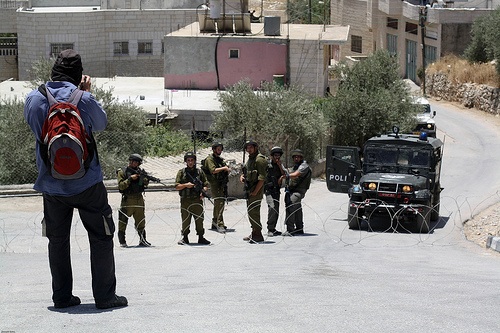
Beit Jala is a small city outside of Jerusalem. The wall that Israel is building in order to expropriate land and create a physical barrier between Israeli and Palestinian society is being built through the middle of this city. Palestinians have decided to begin a series of weekly demonstrations against the construction. The demonstrations are usually composed of Palestinians, international activists and a handful of Israelis. In the middle of last week’s protest, baking in the summer heat, I wondered how helpful the international activists were. Instead of maintaining a low profile and letting the Palestinians demonstrate, the internationals were at the front of the protest yelling slurs at the Israeli troops in the city. The Palestinian right to protest, resist and demonstrate is real, yet I am curious about the outcome when internationals to engage in the same actions, with their own style and individual behaviors. Israelis that want to assist and take on a supportive role often do so at the directive of the Palestinians. The Anarchists against the Wall are the most profound example of this movement in Israel. Are international activists who travel to Israel for short amounts of time part of the protest movement in Palestine? It is one thing to support a protest movement and another thing to join a protest movement.

Continue reading “Whose protests are they?”

Revealed: The Palestinian Authority tried to undermine Turkey’s push for UN flotilla probe

The Electronic Intifada has published a damning report by journalist Asa Winstanley which shows that the Palestinian Authority attempted to neutralize a United Nations Human Rights Council resolution condemning Israel’s deadly attack on the Gaza Freedom Flotilla which killed nine Turkish citizens, including a dual US-Turkish citizen, and injured dozens of others aboard the Mavi Marmara in international waters. The Electronic Intifada has published one of the several UN and Palestinian Authority documents that were obtained by Winstanley. Here are highlights from the report:

Download the document leaked to EI [PDF]

The Electronic Intifada (EI) today publishes one of the documents it obtained, containing proposed amendments to a draft Human Rights Council (HRC) resolution. Annotations to the resolution indicate the Palestinian Authority (PA) stood with European Union (EU) countries against Turkey’s calls for robust action to hold Israel accountable.

The PA’s apparent collusion to shield Israel will recall for many its efforts to undermine UN action on the Goldstone report last October.

Apparently written by a European delegate, the document’s amendments would have seriously diluted Turkey’s original wording. The most damaging change would have removed the call for an independent UN investigation under HRC auspices. The document was provided to EI by a source who described how it was obtained inside the UN Office at Geneva, and asked to remain anonymous.

Turkey rejected the EU-PA amendments, and the final resolution on 2 June declared that the council “Decides to dispatch an independent international fact-finding mission to investigate violations of international humanitarian and human rights law resulting from the Israeli attacks” (“The Grave Attacks by Israeli Forces against the Humanitarian Boat Convoy,” United Nations Human Rights Council, Fourteenth session, A/HRC/14/L.1, Adopted on 2 June 2010).

The language in the final resolution was very similar to the January 2009 HRC resolution which led to the Goldstone report, the independent investigation that detailed war crimes committed during Israel’s 2008-09 invasion of Gaza.

Continue reading “Revealed: The Palestinian Authority tried to undermine Turkey’s push for UN flotilla probe”