A People’s History of Gaza in Cartoons

by Paul de Rooij

The launch of a new book by Joe Sacco is a major event, and with considerable expectation a crowd recently gathered in London to hear the great Maltese-American cartoonist and author discuss his latest book: Footnotes in Gaza. [1] Sacco spent seven years researching and drawing about two sordid events that took place in November 1956 when Israeli forces invaded Gaza as part of the joint British-French attack against Egypt. The Israeli army conducted two massacres where hundreds of Palestinians were murdered, and Sacco set out to collate the oral histories of the Palestinians who witnessed or were the victims of the events. Sacco engaged in a detailed investigative work finding the witnesses who could credibly recollect what happened, sifted through the accounts to eliminate the factual inconsistencies due to the deteriorated memories, and then spent four years bringing these histories to life in his inimitable style. The book doesn’t only focus on the past, but the present is also very much part of his account; in present day Gaza giant armoured bulldozers flatten houses in Rafah and where the ongoing siege affects everybody’s lives. Sacco says: “… the past and the present cannot be so easily disentangled; they are part of a remorseless continuum…”

Contemporary history is usually written by academics with access to the main protagonists, usually politicians or military commanders, inert archives, and press accounts. This history is usually antiseptic – there are no piles of corpses to embarrass the generals. It is also imbued with certainty – historians usually don’t question the politician’s say-so. It is rare for mainstream historians to listen to victims; their accounts are seldom incorporated into the victor’s history. What sets Joe Sacco apart is that not only is he a great artist, but also a peoples’ historian who is willing to listen to the victims; his historiography is imbued with sympathy and respect for the these victims; their history is worthwhile recording. Sacco also focused on a usually-ignored slice of history. In 2001, he travelled in Gaza with Chris Hedges, the American journalist, to research an article about the 1956 massacres for an article for Harper’s magazine. When the article finally appeared, the history of the massacres had been editorially expunged; not all histories are treated equally. Perhaps it was this incident that piqued his interest to write about the neglected massacres.

Continue reading “A People’s History of Gaza in Cartoons”

Tony Judt’s remarkable journey

Tony Judt

UPDATE: the Guardian has a good piece by Ed Pilkington and a video of Judt speaking about his condition. He calls it ‘one of the worst diseases on the Earth’.

Tony Judt, the acclaimed English historian and author, has made a remarkable journey from his days as a volunteer for the IDF during the 1967 war to his recent transformation into one of the staunchest critics of Israel and its lobby. He outraged many old associates from his Zionist days when in 2003 he penned an eloquent call for a bi-national state in 2003. (His friendship with the late Edward Said must have likely played a part in this transformation.) He was dropped from The New Republic‘s editorial board shortly afterwards. Shortly after the Iraq war, he wrote a scathing attack on what he called Bush’s Useful Idiots — the liberal interventionists who argued for war using the language of humanitarianism and liberal values.

In 2006, when John Mearsheimer and Stephen Walt wrote their ground-breaking essay on the Israel lobby, he was one of the very few progressive Jewish voices to come to their defence, even as self-proclaimed ‘radicals’ demurred. Shortly afterwards he wrote a brilliant essay for Ha’aretz calling Israel ‘the country that wouldn’t grow up‘. He later joined John Mearsheimer in a debate organized by the London Review of Books in which they argued against apologists for the lobby. In the same year an event organized by Network 20/20 at which Judt was slated to speak was cancelled following pressure from the ADL and AJC. This prompted Mark Lilla and 114 writers and intellectuals to write a letter of protest to the ADL. Judt later recounted this incident in his appearance in an excellent Dutch documentary on the lobby. All his writings and his reflections on his journey from Zionism to universalism are collected in his 2008 book Reappraisals: Reflections on the Forgotten Twentieth Century.

Continue reading “Tony Judt’s remarkable journey”

Israeli Exceptionalism: A Grim Prognosis

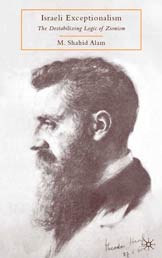
Cover Image GIFIn the coming weeks we’ll be publishing reviews and responses to M. Shahid Alam’s new book Israeli Exceptionalism: The Destabilizing Logic of Zionism (New York: Palgrave Macmillan, 2009). Following is the first from political scientist Ahrar Ahmad.

Dr. Shahid Alam is primarily an economist and an educator.  But, he is also a public intellectual, and often a lively polemicist, who writes with insight and conviction on issues dealing with culture, identity, religion, globalization, imperialism, and terrorism.  But nothing stirs his passions as intensely as the issue of the Palestinians – their dispossession, marginalization, despair.  His feelings are ardent, his language combative, his intellectual engagement prickly and zealous.  It is largely this pre-occupation that has earned him a place in David Horowitz’s book on the Hundred Most Dangerous Academics in the US (an ignominy that he probably wears as a badge of honor).  His latest book distills, clarifies and deepens much of his previous thinking on Zionism, the creation of the state of Israel, and the injustices inflicted on the Palestinians.

The trope along which this book is organized is the concept of “Exceptionalism” that is often claimed by the state of Israel, and sometimes by Jews themselves.  To Alam this is nothing other than a rhetorical device, and a moral posture, to ensure the West’s indulgence and support, to protect Israelis from any criticism, and exempt them from standards and behavioral norms that apply to other peoples.  This “exceptionalism” is derived from their Biblical covenants and the belief in their inherent “chosen-ness”, their wrenching history of suffering and persecution, their considerable achievements in science, philosophy and philanthropy, and their current status as a people allegedly besieged by Islamic fundamentalists, anti-Semitic bigots, and the barbaric and self-destructive Arabs.  To question anything about Israel is tantamount to denigrating every aspect of its special status.

Continue reading “Israeli Exceptionalism: A Grim Prognosis”

Gaza’s Forgotten Children

The 1990 United Nations Convention on the Rights of the Child delineates children’s civil, political, social, economic and cultural rights. Every country in the world has ratified the Convention except of course for the United States and Somalia.

In article 6, it is stated that a child has the right to life. Governments should “ensure that children survive and develop healthily.” Article 19 states that governments should “ensure that children are properly cared for, and protect them from violence, abuse and neglect by their parents or anyone else who looks after them.” Article 27 declares that a child has a “right to a standard of living that is good enough to meet its physical and mental needs.” Finally, article 38 concerns the right to receive “special protection” in war zones.

In 1991, Israel ratified the Convention. It is therefore bound to respect and promote the rights of all children in Israel and in the occupied Palestinian territories.

This moving video speaks for itself. You are not alone, dear children of Gaza.

Viva Palestina breaks Gaza siege

The Viva Palestina aid convoy has broken the siege of Gaza despite Egyptian attempts to violently disrupt their progress.

Continue reading “Viva Palestina breaks Gaza siege”

Moshe Halbertal and the Goldstone Report

Jerome Slater refutes Moshe Halbertal’s attack on the Goldstone Report published in The New Republic, an Israel Lobby mouthpiece.

Judge Goldstone in Gaza

As an academic of nearly fifty years, I take seriously that the core principle and highest calling of our profession is to seek and tell the truth, as best as one can. For those who know the full historical facts about the Israeli-Palestinian conflict, one of the most shocking and depressing phenomena is the extent to which many leading Israeli and American Jewish intellectuals and academicians ignore, conceal, or willfully deny them.

I am not speaking here of ordinary citizens, who might simply be unaware that many of the most cherished Israeli mythologies are historically unsustainable; rather I refer only to the media commentators, political scientists, historians, and even moral philosophers who regularly write about the conflict and whose distortions or outright falsifications cannot be explained away by ignorance.

What, then, does explain this situation? For some, their ideology is simply so impenetrable that the facts can’t get through. For others, I assume that they knowingly, or at least semi-knowingly, conceal the truth because they fear that revealing it will harm Israel. If so, they are also wrong about the consequences — over sixty years of Israeli repression of the Palestinians has done incalculable harm to Israel’s own best interests. In any case, no matter what their motives, the academics who seek to defend Israel against the most reasonable criticisms betray their calling.

Continue reading “Moshe Halbertal and the Goldstone Report”

If you tolerate this…

“If You Tolerate This Your Children Will Be Next” by Manic Street Preachers. Video by friend of PULSE Lauren Booth, from her 2009 cycle ride across Occupied Palestine, from Jordan to Jerusalem, with her daughter Alex Booth. Here is life in the West Bank through a child’s eyes.

Viva Palestina faced with 2,000 riot police in the port of Al-Arish

2,000 Egyptian riot police have reportedly besieged the Viva Palestina convoy. Here is a report and and appeal from convoy leader Kevin Ovenden.

UPDATE: Congratulations to Viva Palestina for breaking the siege despite Egypt’s attempt to violently thwart their efforts.

URGENT: Viva Palestina faced with 2,000 riot police in the port of Al-Arish!

To all friends of Palestine,

Our situation is now at a crisis point! Riot has broken out in the port of Al- Arish.

Continue reading “Viva Palestina faced with 2,000 riot police in the port of Al-Arish”

Stephen Walt chooses five books on US-Israel relations

A few weeks back The Browser interviewed British author Ziauddin Sardar for its Five Books section. Among the books he selected on the theme of Travel in the Muslim World was one, The Road from Damascus, by PULSE editor Robin Yassin-Kassab. When Robin was in turn asked to choose his five on the theme of the Israel-Palestine Conflict, he chose among others John Mearsheimer and Stephen Walt’s The Israel Lobby and the US Foreign Policy. In its current interview The Browser turned to Stephen Walt — one of PULSE’s 20 top global thinkers for 2009 — to present his selection of the five most important books on the US-Israel relationship. In the following interview Walt presents his selection and explains why he chose these particular books.

Stephen M. Walt

So, we’re trying to understand how the US has come to identify so closely with Israel in recent decades, and your first book is The Israel Lobby and US Foreign Policy, which you wrote along with John Mearsheimer. Why is that on the top of your list?

The only way to understand the special relationship that now exists between the United States and Israel is to understand the critical role that a number of organisations have played in actively promoting that relationship over the last 60 years. The US has supported Israel since its founding in 1948, but it did not have the same sort of special relationship for the first 20 or so years after Israel’s creation. The US backed it in certain ways, but was also willing to put lots of pressure on it in other circumstances and didn’t provide a lot of economic or military assistance until after 1967. But today the US backs Israel no matter what it does and American politicians are careful never to say anything that is very critical of Israel, even when it is acting in ways that are contrary to US interests and values. The key to understanding this ‘special relationship’ is the operation of various groups in the Israel lobby, and our book lays out in great detail how that works, and why it’s not good for the US or Israel.

Continue reading “Stephen Walt chooses five books on US-Israel relations”

Student Activism and Change in the Real World

by SU Ahmad and Z Rahim

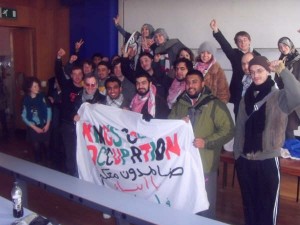
With just days before the UK Viva Palestina convoy is due to arrive in Gaza, we look back at the remarkable recent history of activism at King’s College London (KCL).

On 18 November 2008, the Israeli President Shimon Peres was awarded an honorary doctorate by KCL, a move which sparked outrage amongst students of the college, and saw the beginning of a student movement for its revocation.

“Why the big fuss about the Israeli President?” many asked. Shimon Peres has to his name the sale of arms to the apartheid regime in South Africa and the bombing (twice) of the UN headquarters in Qana. He has directed various Israeli invasions of Lebanon, saw through the 1985 bombing of Tunis, and continues to support Israel’s murderous policies towards the Palestinians, sharing much of the blame for why Gaza has been described as  “the largest open air prison” on the planet by major Human rights agencies, UN and Vatican officials. He is also the father of Israel’s nuclear bomb. These are but a few of the highlights of Mr. Peres’s career. Both students and several members of staff felt that by honouring someone who is essentially a war criminal, KCL had dishonoured its own good name. A college-wide petition with close to a thousand signatures calling for the revocation of the doctorate was handed to the College’s Principal Professor, Rick Trainor.

Continue reading “Student Activism and Change in the Real World”