Why Support the Syrian Revolution

Those infantile apologists for fascism who imagine against the facts that Syria’s popular revolution is a foreign conspiracy won’t like this piece by Michael Neumann, a frequent contributor to Counterpunch and the son of Franz Neumann, the analyst of modern fascism. It is however, one of the most morally compelling pieces on Syria that I have read. Originally published at Insufficient Respect.
Many reasons are given for supporting either the Syrian revolution or the units of the Free Syrian Army (FSA).  But while there is sympathy for the Syrian people, hardly ever do those reasons speak to or from Syrian needs.  Instead the appeal is to the quite narrow interests of others, always in negative terms:  not supporting the FSA will encourage Islamic extremism, invite a regional conflagration, squander opportunities to ‘have a say in Syria’s future'(!), counter-productively encourage uncontrolled arms proliferation, leave a legacy of anti-Western sentiment in Sreutersyria.  Syrians are essentially seen either as a menace, or as weaklings likely incapable of countering some menace in their midst.
Of course the idea here is that solid reasons can only rest on hard-headed realism, not sloppy sentiment.  But there may be at least two other reasons rooted in a less myopic assessment of the situation.  They invoke principles and large historical opportunities – which does not distinguish them from the sort of ‘higher’ motives that in fact drive a good deal of political activity.  They do have implications for the whole world, but they originate not only in the interests but also in the achievements of the Syrian people and their revolution  One reason is ‘negative’, the other, positive.
The negative reason has to do with what Syrians suffer.
It’s taken me a while to realize that most people probably don’t really know the full extent of Assad’s cruelties, or how they compare to the cruelty we know has been inflicted in so many times and places.  It’s not the sort of material that makes the front pages.  An appendix to this post gives some details.  For several reasons,  none solely sufficient but in combination decisive, the horrors of Syria have unique significance.
First there is the sheer barbarism.  Many régimes which have inflicted tortures perhaps as ghastly as Assad’s – Chile’s Pinochet and the Iran under the Shah come to mind – do not quite match his barbarism for one simple reason:  Assad’s tortures are not confined to adults, much less to those who have ever posed any threat, but also to children not into their teens.  The torture of injured people in their hospital beds, and of medical staff, is also very unusual.  Sometimes victims are tortured in order to reveal information, or at least to admit to something, whether or not they did it.  Often they are simply tortured to death, simply to have them die in agony.
Second there is the scale of it.  Those tortured run into the tens, perhaps the hundreds of thousands.  Multiple deaths under torture are reported almost daily.  Perhaps as many suffered in Cambodia, or Rwanda, or the Congo; no figures are available.
Solidarity with Syria

Published at the Global Campaign of Solidarity with the Syrian Revolution, this petition in support of the Syrian people’s struggle against dictatorship and genocide has been signed by leftist luminaries such as Norman Finkelstein, Gilbert Achcar and Tariq Ali (how good it is to welcome the latter back), academics of the stature of Frederic Jameson, Syrian intellectuals such as Yassin al-Haj Saleh, novelists such as Khaled Khalifa, and on the ground activists such as Razan Ghazzawi.

Who we are

As intellectuals, academics, activists, artists, concerned citizens, and social movements we stand in solidarity with the Syrian revolution and people’s struggle against dictatorship. Join us on Facebook.

Solidarity With the Syrian Struggle for Dignity and FreedomWe, the undersigned, stand in solidarity with the millions of Syrians who have been struggling for dignity and freedom since March 2011. We call on people of the world to pressure the Syrian regime to end its oppression of and war on the Syrian people. We demand that Bashar al-Asad leave immediately without excuses so that Syria can begin a speedy recovery towards a democratic future.

Since March 2011, Asad’s regime has steadily escalated its violence against the Syrian people, launching Scud missiles, using weapons banned by the Geneva Convention such as cluster bombs and incendiary munitions, and using aerial bombardment. The regime has detained and tortured tens of thousands of people and committed untold massacres.

It has refused political settlements that do not include Asad in power, and it has polarized the society through strategic acts of violence and by sowing seeds of division.  The regime has also, since the early days of the uprising, sought to internationalize the crisis in order to place it within geopolitical battles that would only strengthen the regime.
Staying true to the logics of an authoritarian regime, Asad could never accept the legitimate demands of the Syrian people for freedom and dignity. Thus, there is no hope for a free, unified, and independent Syria so long as his regime remains in power.This is a revolt that was sparked by the children of Deraa and the sit-ins and demonstrations of the youth in the cities, the peasants of the rural areas, and the dispossessed and marginalized of Syria. It is they who rallied non-violently through protests and songs and chants, before the regime’s brutal crackdown.

Since then, the regime has pushed for the militarization of the Syrian nonviolent movement. As a result, young men took up arms, first out of self-defense. Lately, this has resulted in attempts by some groups fighting the regime to force a climate of polarization, and negation of the Other politically, socially and culturally. These acts that are in themselves against the revolution for freedom and dignity.Yet, the revolution for freedom and dignity remains steadfast.  It is for this reason that we, the undersigned, appeal to those of you in the global civil society, not to ineffective and manipulative governments, to defend the gains of the Syrian revolutionaries, and to spread our vision: freedom from authoritarianism and support of Syrians’ revolution as an integral part of the struggles for freedom and dignity in the region and around the world.

The fight in Syria is an extension of the fight for freedom regionally and worldwide.  It cannot be divorced from the struggles of the Bahrainis, Egyptians, Tunisians, Libyans, Yemenis, and other peoples who have revolted against oppression and authoritarianism as well as against those seeking to usurp or destroy the uprisings and divert them for their own agendas. It is connected to the Palestinians’ struggle for freedom, dignity and equality.

The revolution in Syria is a fundamental part of the North African revolutions, yet, it is also an extension of the Zapatista revolt in Mexico, the landless movement in Brazil, the European and North American revolts against neoliberal exploitation, and an echo of Iranian, Russian, and Chinese movements for freedom.The Syrian revolution has confronted a world upside down, one where states that were allegedly friends of the Arabs such as Russia, China, and Iran have stood in support of the slaughter of people, while states that never supported democracy or independence, especially the US and their Gulf allies, have intervened in support of the revolutionaries. They have done so with clear cynical self interest. In fact, their intervention tried to crush and subvert the uprising, while selling illusions and deceptive lies.

Given that regional and world powers have left the Syrian people alone, we ask you to lend your support to those Syrians still fighting for justice, dignity, and freedom, and who have withstood the deafening sounds of the battle, as well as rejected the illusions sold by the enemies of freedom.

As intellectuals, academics, activists, artists, concerned citizens, and social movements we stand in solidarity with the Syrian people to emphasize the revolutionary dimension of their struggle and to prevent the geopolitical battles and proxy wars taking place in their country. We ask you to lend your support to all Syrians from all backgrounds asking for a peaceful transition of power, one where all Syrians can have a voice and decide their own fate.

We also reject all attempts of any group to monopolize power, and to impose its own agenda, or to impose unitary or homogenous identities on the Syrian people. We ask you to support those people and organizations on the ground that still uphold the ideals for a free and democratic Syria.
Continue reading “Solidarity with Syria”

Syria: Across the Lines | Dispatches | Channel 4

If the film is blocked in your region try here.

Syria: Across the Line, Channel 4 Dispatches:  Olly Lambert has spent weeks living deep inside Syrian territory – with both government and opposition supporters – to explore how the two-year-old conflict is tearing communities apart.

An opposition divided

Pulse editor Robin Yassin-Kassab discusses Syria on Al Jazeera’s Inside Syria.

We look at the internal divisions inside the Syrian National Coalition as they wrestle for legitimacy. To understand the reasons behind internal divisions inside the Syrian opposition, Inside Syria with presenter Hazem Sika discusses with guests: Najib Ghadbian; a representative of the National Coalition of Revolution and Opposition Forces in the UN; Robin Yassin-Kassab, a novelist and commentator; and in Athens-Ohio, Amr al-Azm, a professor of Middle East history and anthropology at Shawnee State University.

A Subtle Shift

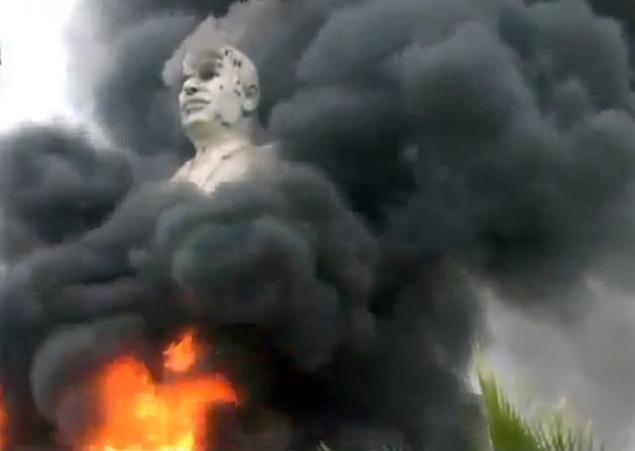
Hafez al-Assad burns in liberated Raqqa. AP photo

This was published in the National.

From the very start, some commentators convinced themselves that the Syrian popular revolution was plotted, funded and armed by the West. From Seamus Milne to John Pilger, from Glenn Greenwald to George Galloway, they described the West supplying oppositionist ‘jihadist elements.’ Former leftist icon Tariq Ali spoke on Russia Today of “Russia and China resisting attempts by the West to take Syria over.” Russia is resupplying the Assad regime with the materiel with which to slaughter the Syrian people, making Ali’s performance on Russia’s satellite as unedifying, and as distant from reality, as that of a commentator telling Fox News that Palestinian resistance is simply an Iranian attempt to take over Israel.

These journalists have staked their positions against the evidence. They have done so by forcing Syrian realities, breaking the edges of these jigsaw pieces, to fit their prior geopolitical concerns (their opposition to concurrent Israeli-American and Saudi enmities towards Iran) or ideological stances (that, following Iraqi and Palestinian models, the West must always be the troublemaker in the Arab world).

But Syria is neither Palestine nor Iraq; Syrian events are moved primarily by internal dynamics – namely the violence of the regime and the agency of the rising Syrian people. The conspiratorial leftist perspective misses this, first by vastly overestimating Western influence on current events (a failure to accurately diagnose the historical moment) and, secondly, by misunderstanding how unenthusiastic the West is for any rapid democratic or revolutionary change in Syria.

Continue reading “A Subtle Shift”

Agony in Aleppo: a city abandoned by the world?

From Channel 4: In the first of a Channel 4 News series charting Syria’s descent in the face of civil war, German filmmaker Marcel Mettelsiefen’s spends several weeks in Aleppo witnessing a civilian population isolated and under siege. (Caution: contains highly distressing scenes of war including images of children who have been wounded and killed)

A History of Syria

Dan Snow travels to Syria, for the BBC’s This World series, to see how the country’s fascinating and tumultuous history is shaping the current civil war.

For the Law of the Powerful over the Weak

Gunfire, torture until death, rape on a mass scale, artillery, aerial bombardment, targetting of hospitals, bakeries and petrol lines, and now scud missiles. A boy in Aleppo describes the effects of the latter.

Syria’s Peace: What, How, When?

Fawaz Gerges and Rosemary Hollis in conversation with Pulse editor Robin Yassin-Kassab.

Activist Trip to Liberated Syria

Highlights from the trip  organized by SAC, where a group of young activists visited parts of liberated Syria in December 2012 to deliver aid and form relationships with civilian activists on the ground.