An artist’s take on the revolution in Syria.
Category: Syria
Sarmada
A slightly shorter version of this review appeared in The Independent.
Places have moods, this novel reminds us. Sometimes Sarmada, a mountain village rising from the Hauran plain of southern Syria, is all “oblivion, dust and tedium”; at other times it’s a shimmering delight, each rock, tree, spring, cliff and cave owning rich meanings and histories. Sarmada is also “a Sheherazade”, a generator of tales, so many tales we can’t possibly hear them all. “I thought about telling her the joke about the overweight fortune-teller,” Azzam writes, “but..”
Like the Arabian Nights, “Sarmada” contains stories within a frame story. The frame and trigger is a meeting with Azza Tawfiq, an expert in chaos theory at the Sorbonne who (following the Druze tenet of transmigration) believes she lived in Sarmada in a past life as a murdered girl called Hela Mansour. Bemused, disbelieving, the narrator returns from “chasing dreams in Paris and delusions in Dubai” to excavate the village’s memories, at first on Azza’s behalf.
The Other Pole
Rime Allaf has an unmissable piece in the Guardian. As a counterpoint to the sectarian war scenario we’re hearing so much about, Rime offers the other pole.
From 1946, spoiled by the US-sponsored coup of 1949 which first brought military rule to the region, Syria witnessed a shortlived parliamentary democracy, a vibrant civil society and a brief period of a free press, and it elected leaders whose names remain embedded in the national memory as examples of the Syria it can be, and it should be. While perhaps initially elitist in nature, unlike the current varied spectrum of opposition groups and revolutionary committees, it is a logical inspiration for the future.
The whole article is well worth reading. There are good observations on how the supposed fractiousness of the ‘opposition’ is not necessarily a bad thing, and important commentary on the future ramifications of Iranian miscalculations.
One major issue may change in the post-Assad era: relations with Iran and Hezbollah. The strategic alliance with Iran since the Islamic revolution flourished under Bashar al-Assad’s reign, especially following the invasion of Iraq, but Iranian support in repressing the current protests won’t easily be forgotten. Likewise, the Hezbollah leader Hassan Nasrallah’s support for the Syrian regime has incensed many, especially after his praise for every other Arab uprising; only last year, it would have been unimaginable to see Hezbollah’s flag burned in Syria, as it has been recently.
Turn It Up
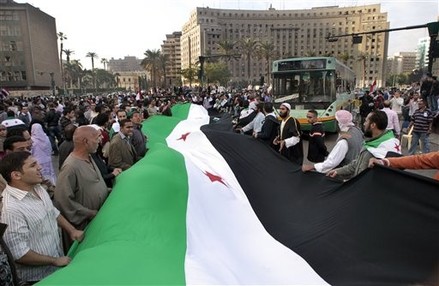
For Syrians it’s an exhilarating experience simply to express honest political opinions out loud in a public place. For decades anti-regime gripes have been expressed in private, in whispers. Many were frightened to speak even in the home, lest the children repeat what they’d heard at school. But now people are screaming and singing against the regime every morning, afternoon and night. The sense of solidarity amongst the revolutionaries – breaking the fear barrier together, facing possible torture and death together – is enormous. These two films demonstrate the sometimes carnivalesque quality of the revolution as well as the Syrian people’s musicality. In the first, filmed in Da’el in the Hawran, a romantic tune is turned into an anti-Asad anthem. In the second, filmed in the Baba Amro neighbourhood of Homs, the authorities cut electricity to a protesting area; the protestors illumine their mobile phone screens and keep on going. Both films should be watched with the volume on maximum.
Revolutionary Alawis

Novelist, screenwriter and journalist Samar Yazbeck in interview: “The regime has indeed destroyed the Alawite religion, a peaceful religion, as it engaged in things foreign to the faith, leading some to become its Alawite thugs. But many of us are opponents, in jail, in exile, or banned from travel. The regime is playing with sectarianism to terrify “its” minority and get support. A game that will end, but first, I fear, there will be clashes between the communities. ”
In this interview an Alawite member of the Syrian Revolution General Council based in Homs argues, “We need to break down the myth that the regime is the defender of Alawites and other minorities. It is just defending itself, and using us for its own ends.”
And in this interview actress Fadwa Sulaiman explains why she’s thrown her lot in with revolutionaries in a besieged area of Homs (she’s currently on hunger strike): – “I just wanted to go just to say we Syrians are one people. I wanted to contradict the narrative of the regime.“
Reporting Syria
The Syrian regime’s blanket ban on journalist access has some carefully selected exceptions. Robert Fisk, for instance, who seems to be compensating for the naive anti-Syrian and pro-March 14th line in his reporting of Lebanon over the last years by treating the statements of Syrian regime figures – professional liar Boutheina Shaaban is one – with great naivety. At least he didn’t apply the ‘glorious’ epithet to her which he used to describe Walid Jumblatt’s wife. Fisk’s book on Lebanon “Pity the Nation” is a classic, his account of the massacres at Sabra and Shatila remain fresh in the mind (the blood-footed flies clambering over his notebook), and for many years he was one of the very few English-language journalists with some real knowledge of the Middle East. Sadly, his knowledge doesn’t extend to a working familiarity with Arabic. In several recent articles he has informed us that that the slogan of the Ba‘ath Party – umma arabiya wahda zat risala khalida – means ‘the mother of the Arab nation.’ In fact it means ‘one Arab nation with an eternal message’. Fisk is confusing ‘um’ – mother – with ‘umma’ – nation. It’s a rather disastrous mistake. Someone ought to tell him about it.
Maher Arar on the Syrian Conflict
Maher Arar, who was rendered to Syria by the CIA and tortured by the regime on behalf the United States, speaks about the conflict in Syria.
Fadwa Sulaiman
Samar Yazbeck, Ibrahim Qashoush, Khaled Khalifa, Rasha Omran, Ali Farzat, Mai Skaf, Samih Shqair – there’s an impressive list of Syrian writers, musicians, songwriters, and artists who have bravely and unambiguously supported the people’s aspirations for dignity. And now the actress Fadwa Sulaiman. Here she is in besieged Homs leading chants of ‘no Salafis, no Brotherhood, the Syrians want freedom’ and ‘One, One, the Syrian People are One.’ Here she is on Jazeera (Arabic) interviewed via skype. And, below, here she is announcing her hunger strike until the prisoners are released and the siege of the besieged cities is lifted. Translation of her words follows after the page break.
Syrian Eid al-Adha 2011
Not a great Eid in Syria. The traditional open air Eid prayers turned into anti-regime demonstrations and, as usual, the regime’s insecurity forces fired at the demonstrators. At least twenty three people were murdered today, including an infant. Many of the dead were in the central city of Homs, which has been a veritable war zone for weeks, the site of clashes between loyalist and defected soldiers as well as tank bombardments and sniper fire from the regime. In the last four days, since the regime supposedly agreed to release prisoners and withdraw its forces from civilian areas according to the Arab League plan, at least 80 people have been reported killed in the city.
There is one piece of very important good news, however. Burhan Ghalyoun, leader of the Syrian National Council, delivered an Eid address to the Syrian people which was carried by al-Jazeera. Ghalyoun, who does not wish to become a future president, was truly presidential. He appealed to those Syrians still hesitant or afraid to support the revolution, assuring them that the future Syria will be a state of citizenship and equal rights, and that minorities will be protected. Bringing larger sections of the Alawi and Christian minorities on board is the only way for the revolution to move forward, so Ghalyoun’s speech is most welcome, and long overdue. The English translation which follows after the break was posted at al-Jazeera’s live blog, but I found it at the excellent Walls.
 P U L S E