The Passion of Bradley Manning

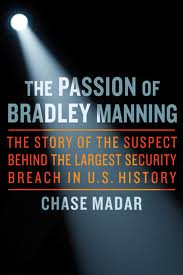
Essayist, lawyer, and PULSE contributor Chase Madar’s much-awaited book The Passion of Bradley Manning: The Story of the Suspect behind the Largest Security Breach in U.S. History is out this month from O/R Books.

The following is an excerpt from Kelly B. Vlahos’ recent review of the book at Antiwar.com:

It might be too easy to invoke Manning as martyr two days after Palm Sunday, when Christians observe the betrayal, humiliation and crucifixion of Jesus Christ two thousand years ago. While it is not our intention to compare Manning to the Christian Son of God, who according to Gospel, rose from the dead, humanity’s sins forgiven, on Easter Sunday, author Chase Madar lays out a deft argument that Manning has indeed sacrificed everything for his country’s sins in his aptly entitled new book, The Passion of Bradley Manning.

“I wanted to write a full-out defense of his alleged deeds — a political and moral defense,” Madar told Antiwar.com in a recent interview. And he has. As Madar points out, there are “many people in history who have died and sacrificed for their cause.” The Passion makes an industrious case that Manning did what he did for a cause: to give the people the information they need and deserve about what their government is doing in their name. Transparency — Robin Hood style.

“What I find remarkable and praiseworthy is, he was not — despite having this terrible time getting bullied and messed with constantly — leaking these things to get revenge,” Madar said. “He was a true believer in patriotic duty and military service, I think. If you look at the chat logs, he was very clear about his motives for leaking, that this was what the public should know, so that we as a country could make better decisions.”

Continue reading “The Passion of Bradley Manning”

Obama Administration Silencing Pakistani Drone-Strike Lawyer

by Medea Benjamin

Shahzad Akbar (left) with Karim Khan, a resident of North Waziristan whose 18-year-old son and 35-year-old brother were killed in a CIA drone strike which destroyed his family home. (Reuters)

When is the last time you heard from a civilian victim of the CIA’s secret drone strikes? Sure, most of them can’t speak because they’re deceased. But many leave behind bereaved and angry family members ready to proclaim their innocence and denounce the absence of due process, the lack of accountability, the utter impunity with which the U.S. government decides who will live and die.

In the wake of the 9/11 attacks, the U.S. government has increasingly deployed unmanned drones in the Middle East, South Asia and Africa. While drones were initially used for surveillance, these remotely controlled aerial vehicles are now routinely used to launch missiles against human targets in countries where the United States is not at war, including Pakistan, Somalia and Yemen. As many as 3,000 people, including hundreds of civilians and even American citizens, have been killed in such covert missions.

The U.S. government will not even acknowledge the existence of the covert drone program, much less account for those who are killed and maimed. And you don’t hear their stories on FOX News, or even MSNBC. The U.S. media has little interest in airing the stories of dirt poor people in faraway lands who contradict the convenient narrative that drone strikes only kill “militants.”

Continue reading “Obama Administration Silencing Pakistani Drone-Strike Lawyer”

Our War Against the Pashtuns

by Anatol Lieven

The situation in Afghanistan is beginning to remind me of an old Russian joke about the difference between an optimist and a pessimist. The optimist says, “Things are so bad, they couldn’t possibly be worse.” And the pessimist says, “No, they could be worse.” That thought came to me when I read yet again someone expressing the fear that after US and NATO troops leave Afghanistan, the country “may descend into civil war.” What exactly do they think is happening now between the Taliban and the Afghan security forces?

This has always been an Afghan civil war, as well as a war between the Taliban and Western forces in Afghanistan. It is a continuation of the civil war which had been going on since 1992 between different groups among the Mujahedin forces which overthrew the Communist regime in that year; just as for the 14 years before that, Afghanistan had been in a state of civil war between the Communists and their enemies. What happened in 1979 and again in 2001 was that outside superpowers intervened on one side of a civil war. This meant that the military balance was violently tipped in the direction of that side—for a while.

Some of my students at King’s College have chosen this year to write their MA essays on the subject of Edward Luttwak’s argument a dozen years ago against humanitarian intervention, “Give War a Chance”. This has made me think about the relevance of his ideas to Afghanistan over the past two generations. I am certainly not advocating a US strategy of allowing civil war in Afghanistan to play out as it will. Nor of course were either the Soviet invasion of 1979 or the US invasion of 2001 humanitarian interventions intended to do so: both had the effect of trying to maintain and extend Afghanistan’s limited modern progress in the face of Islamist and tribal conservative resistance.

Continue reading “Our War Against the Pashtuns”

Enlisting Michelle Obama—and the American public—to Stop War on Iran

By Rae Abileah and Medea Benjamin

On Friday, March 30, First Lady Michelle Obama received an unusual request at her San Francisco fundraiser. Instead of “Can I have a picture with you?,” one major donor asked, “Will you use your leadership to prevent an attack on Iran?”  Kristin Hull hand delivered to Ms. Obama a petition against war on Iran that was signed by prominent women including Gloria Steinem, Alice Walker, and Eve Ensler, and over 20,000 American women and allies. Hull implored the First Lady to think of the military families and veterans who have paid the price of war.  Ms. Obama has championed veterans’ issues while in office and for this reason, in addition to her obvious proximity to the President, women’s groups have made her a focus of their peace efforts.

Ms. Obama thanked Hull for her advocacy and said, “Keep up the great work.”  As Hull was walking away after her photo with the First Lady, Michelle Obama grabbed her hand, squeezed it and said, “We really need you.”

The petition implores three powerful American female politicians—Secretary of State Hillary Clinton, Ambassador Susan Rice and First Lady Michelle Obama—to use their influence to push for diplomacy, not bombing, in US relations with Iran.  The next step will be to hand-deliver the petition to Clinton.  CODEPINK launched this petition online on March 20th, the 9th anniversary of the US invasion of Iraq (coincidentally also on the Iranian New Year, Norooz), with a call from Pulitzer Prize-winning author Alice Walker. “Nine years ago, I joined CODEPINK in front of the White House in an act of civil disobedience to try to stop our government from bombing Iraq,” said Alice Walker. “None of us could live with ourselves if we sat by idly while a country filled with children was blown to bits using money we needed in the United States to build hospitals, housing and schools. We must not let another tragic war begin.”

Continue reading “Enlisting Michelle Obama—and the American public—to Stop War on Iran”

Time for a Reciprocated Monroe Doctrine: Failed Latin American Policies Applied in the Middle East

by John Washington

Money doesn’t solve, salve, cure, stabilize, forge peace, make or keep promises. And aid packages, no matter how much they’re needed or with how much philanthropic goodwill they’re sent, will not help anyone by themselves. It matters as much in whose hands the money falls as fast as it flows. The United States State Department should have considered this when deciding to continue to fund and arm the Egyptian military regime.
As pivotal as Egypt has been as an historical ally and an advocate for various degrees of peace in the region, and as necessary as the country may be as a counterweight to the militant authoritarianism of Iran, the United States cannot afford to fund another oppressive regime. Or, rather, it can afford it, but it shouldn’t. And funding is what the Obama administration and Hilary Clinton are doing: sending 1.3 billion dollars of military assistance to the military regime despite clear evidence of human rights abuses.

Since 1979 annual U.S. military aid to Egypt has grown, according to the State Department’s own statistics, to over $1.3 billion dollars a year. A few months ago, because of increasing concern of human rights violations, when we allocated this year’s $1.3 billion package we did so contingently, based on the implementation of “policies to protect freedom of expression, association, and religion, and due process of law.” And yet, as detailed in a letter from Amnesty International urging Clinton not to send more money and arms to Egypt, “Egyptian security forces have killed numerous civilians, and the Egyptian government has demonstrated a systematic failure to rein in security forces and stop the attacks on Egyptian and foreign non-governmental organizations (NGOs) working in Egypt.”

Continue reading “Time for a Reciprocated Monroe Doctrine: Failed Latin American Policies Applied in the Middle East”

Above the Drone of War, Voices for Peace

by Davis Smith-Ferri

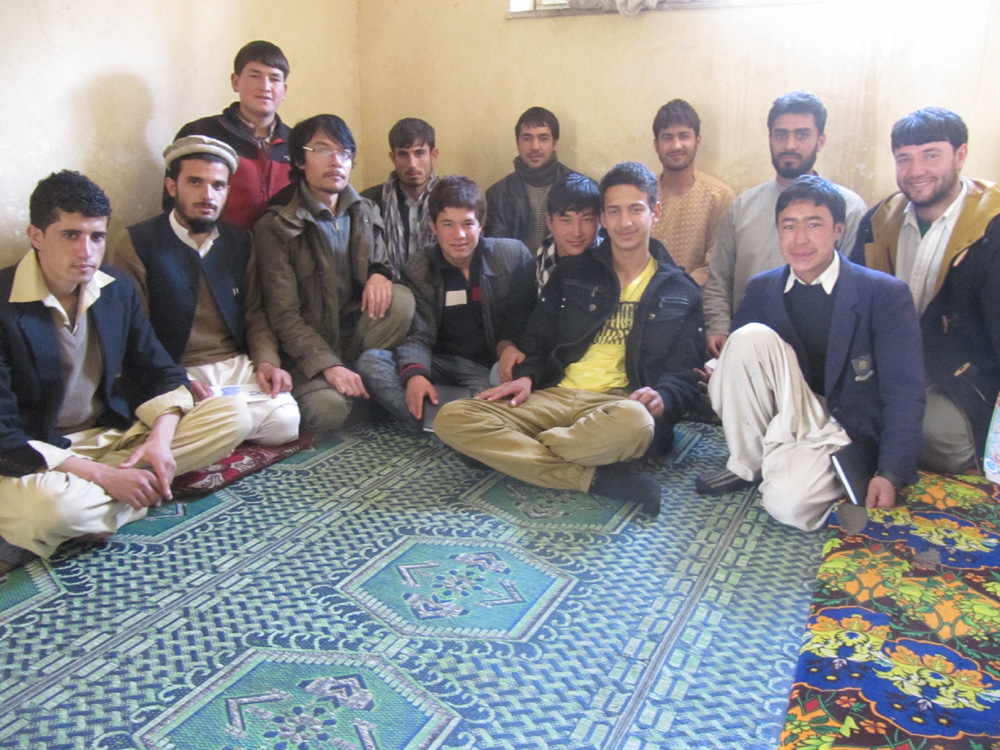
Afghan Youth Peace Volunteers from Kabul and Bamiyan visiting with Afghan youth at Nangarhar University in Jalalabad.

In 1876, at the so-called Battle of the Little Bighorn when U.S. Cavalry regiments attacked an Indian village along the Little Bighorn River in Wyoming, the first casualty was a ten-year old Lakota Sioux boy named Deeds. Unaware that U.S. troops were nearby planning an attack, he and his father were combing a hillside looking for a lost pony when U.S. troops encountered and killed him. The next casualties were six Lakota women and four children, who were murdered while in a field gathering wild radish bulbs, one of the many indigenous plants that Native people depended on for their livelihood, and hardly a threatening activity.

I think of these events today because of the recent killings of Afghan civilians, not only the 17 women and children killed in villages outside Kandahar, but also two recent and less publicized atrocities resulting from NATO airstrikes that killed civilians in Kapisa Province, including eight Afghan boys who were tending their sheep. Sheepherding, of course, is an activity as integral to their livelihood as gathering indigenous plants was to Lakota people.

Continue reading “Above the Drone of War, Voices for Peace”

Obama administration’s war on the US constitution

Col. Lawrence Wilkerson: Obama, Panetta and Holder undermine basic constitutional rights by justifying killing American citizens without judicial process and bypassing Congress in declaring war

Anatol Lieven at the Karachi Literature Festival

Dawn.com’s Salman Haqqi interviews Anatol Lieven, author of “Pakistan: A hard country” during the Karachi Literature Festival 2012.

AIPAC Works for the 1 Percent

by Chris Hedges

The battle for justice in the Middle East is our battle. It is part of the vast, global battle against the 1 percent. It is about living rather than dying. It is about communicating rather than killing. It is about love rather than hate. It is part of the great battle against the corporate forces of death that reign over us—the fossil fuel industry, the weapons manufacturers, the security and surveillance state, the speculators on Wall Street, the oligarchic elites who assault our poor, our working men and women, our children, one in four of whom depend on food stamps to eat, the elites who are destroying our ecosystem with its trees, its air and its water and throwing into doubt our survival as a species.Illustration by Mr. Fish

What is being done in Gaza, the world’s largest open-air prison, is a pale reflection of what is slowly happening to the rest of us. It is a window into the rise of the global security state, our new governing system that the political philosopherSheldon Wolin calls “inverted totalitarianism.” It is a reflection of a world where the powerful are not bound by law, either on Wall Street or in the shattered remains of the countries we invade and occupy, including Iraq with its hundreds of thousands of dead. And one of the greatest purveyors of this demented ideology of violence for the sake of violence, this flagrant disregard for the rule of domestic and international law, is the American Israel Public Affairs Committee, or AIPAC.

Continue reading “AIPAC Works for the 1 Percent”

Kandahar ‘killing-spree’ militarism

A call for U.S. and Afghan citizens to question the Strategic Partnership Agreement.

Anar Gul points to the body of her murdered grandchild

By the Afghan Youth Peace Volunteers

13th March 2012 — The Afghan Youth Peace Volunteers question the presumption that the U.S. military strategy in Afghanistan is necessary for American or Afghan peace.

Tragedies like the Kandahar killing spree which massacred 16 Afghan civilians in their sleep ( including 6 children and 3 women )  are tragedies repeated in any war, including the U.S. war in Afghanistan. This failed military strategy that is designed for U.S. power and economic interests is being sold to the U.S. electorate through the mainstream media doublespeak of ‘withdrawal’ and ‘negotiations’, but is quietly being pursued in what President Obama and President Karzai called ’progress’ towards the signing of the U.S Afghanistan Strategic Partnership Agreement. The Agreement will entrench U.S. military presence in Afghanistan till 2024 and beyond and is based on the same militarism that has resulted in the pathologicalurinating on Afghan corpses by U.S. soldiers, the morbid keeping of severed finger-trophies by the Kill Teamthe burning of the Quran and many other ‘unforgiveable’ tragedies.

Continue reading “Kandahar ‘killing-spree’ militarism”