Greenwald discusses Wikileaks on FAIR’s Counterspin

On this week’s Counterspin Glenn Greenwald of Salon discusses new developments in the Wikileaks saga.

(I think Al Jazeera is head and shoulders above competitors in the mainstream as a media institution. But I can’t say I am a fan of its media watch show The Listening Post. The show lacks political edge, and the media analysis is trite. One wishes they would follow the hard hitting style of FAIR‘s excellent Counterspin.)

This week on CounterSpin: The journalism organization WikiLeaks is under massive attack by U.S. government officials, corporations, and journalists. Many are calling for the group and its spokesperson Julian Assange to be prosecuted; some have even called for Assange’s execution or assassination. Transnational companies like Visa, MasterCard and Paypal have cut off services, and even liberal US pundits are attacking the group with inaccurate smears. WikiLeaks crime? Making leaked U.S. diplomatic cables available to the world both directly and through its mainstream media partners. In this special extended CounterSpin interview, we’ll talk to Salon.com’s Glenn Greenwald about the assault on WikiLeaks and Assange, and what it means for journalism.

Bradley Manning: The man accused of leaking US secrets

He is the true heir to Daniel Ellsberg. And he is being treated inhumanely by the establishment whose inhumanities he helped expose.

Naomi Wolf schools CNN’s secrecy apologist

Nir Rosen on the aftermath of America’s wars

Nir Rosen, is a fellow at NYU’s Center on Law and Security, and one of the best war reporters in the world.    Aftermath: Following the Bloodshed of America’s Wars in the Muslim World is his account of the impact of US wars in the Middle East and Central Asia. In this interview he speaks to Glenn Greenwald of Salon about his book.

And here is the transcript:

Glenn Greenwald: My guest today on Salon Radio is Nir Rosen who I think is unquestionably one of the best war journalists and commentators in the country probably in the world. He is a freelance writer photographer, film-maker, and he is currently a scholar associated with the New York University Center on Law and Security, and he has just written a book that I finished reading actually today entitled Aftermath: Following the Bloodshed of America’s Wars in the Muslim World. It’s really an amazing book. It describes the impact of multiple American wars on families and people in various countries including Iraq, Afghanistan, Lebanon, and other countries where Nir has spent a great amount of time. I’m really excited to talk about this book. Thanks so much for taking the time to talk to me today.

Nir Rosen: Thanks for reading the book.

Continue reading “Nir Rosen on the aftermath of America’s wars”

The War You Don’t See

A new John Pilger documentary is always a media event. For over four decades he has set the bar for incisive and intrepid investigative journalism. In The War You Don’t See, his latest, Pilger indicts the mainstream media for its responsibility in enabling wars by sanitizing its image and glorifying its aims.

Michael Moore on why he helped bail out Assange

Michael Moore on why he supports Assange and Wikileaks and why he posted part of his bail (other contributors included John Pilger and our dear friend Tariq Ali)

Also, FAIR has circulated this petition which we encourage you to signt:

We Support WikiLeaks
Stand with Daniel Ellsberg, Barbara Ehrenreich, Arundhati Roy, Noam Chomsky and others–sign FAIR’s petition in support of Wikileaks today.

December 14, 2010

As journalists, activists, artists, scholars and citizens, we condemn the array of threats and attacks on the journalist organization WikiLeaks. After the website’s decision, in collaboration with several international media organizations, to publish hundreds of classified State Department diplomatic cables, many pundits, commentators and prominent U.S. politicians have called for harsh actions to be taken to shut down WikiLeaks’ operations.

Continue reading “Michael Moore on why he helped bail out Assange”

Ostrich America?

by Chase Madar

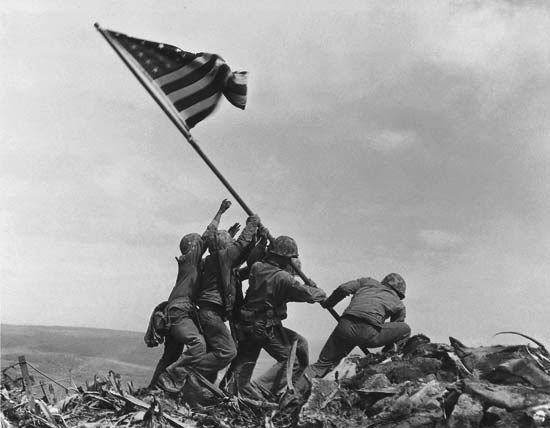
Famous photograph of the US isolating itself in Iwo Jima. (Photo: Joe Rosenthal, 1945)

Of all the received ideas that clog America’s foreign-policy discourse, none is more at variance with reality than the threat of isolationism. We have never been more engaged with every corner of the world, yet we have never been lectured more often about the consequences of “retreating within our borders.” The more countries we attack—Pakistan, Somalia, Yemen—the more dire warnings we get about national introversion. The specter of isolationism has never looked healthier.

A case in point was George W. Bush’s 2006 State of the Union address, a venue he used to tell a spine-chilling tale. With his foreign policy exploding all around him, Bush warned against an even more disastrous alternative: there were those who would “tie our hands” and have us “retreat within our borders.” From the tenor of his talk, he seemed to think that Americans were about to burn down both the Pentagon and Department of State, beat defense intellectuals into postal workers, and force every house in the land to set up a little steel foundry in the back yard—just like in the Great Leap Forward—while learning to live on grubs and wild mountain honey.

Of course, this is absurd: as many pointed out in response to this scaremongering, there are no isolationists in America—not in either political party, not in the media, and not in the academy. (The i-word is often used as a synonym for unilateralism. Here I am assigning only its most common meaning: a tendency to ignore security threats beyond territorial borders and disengage diplomatically, politically, and economically from the rest of the world.) Nevertheless, the menace of a return to geopolitical autarky is carted out whenever our sclerotically narrow foreign-policy consensus gets an unwelcome jolt. This habit of mind did not end with the exit of George W. Bush.

Continue reading “Ostrich America?”

Neocons holding up START treaty

The neoconservatives represent the Likud wing of the Israel lobby. In the 1970s, when the United States was reeling from the defeat in Vietnam, and reconsidering its imperial stance, the neocons joined the military-industrial complex and unreconstructed Cold Warriors to derail the Strategic Arms Limitation Treaty (SALT) and Nixon’s detente. The Cold War is over, but the neocons still have an interest in maintaining a state of conflict. Once again, therefore, they are derailing a worthy arms control initiative. Here are some wise words from Ivan Eland as to why the neocons are so afraid of New START.

The START treaty, which would reduce the United States and Russia’s nuclear arsenals by 30%, has been held up in Congress for months by neoconservatives. Will the treaty gain any traction before more conservatives join Congress in January? RT’s Dina Gusovsky is joined by Jacob Hornberger from The Future of Freedom Foundation and Ivan Eland from the Independent Institute to discuss the START treaty.

Careless Words and Callous Deeds

by David Bromwich

It has lately become usual for right-wing columnists, bloggers, and jingo lawmakers to call for the assassination of people abroad whom we don’t like, or people who carry out functions that we don’t want to see performed. There was nothing like this in our popular commentary before 2003; but the callousness has grown more marked in the past year, and especially in the past six months. Why? A major factor was President Obama’s order of the assassination of an American citizen living in Yemen, the terrorist suspect Anwar al-Awlaki. This gave legal permission to a gangster shortcut Americans historically had been taught to shun. The cult of Predator-drone warfare generally has also played a part. But how did such remote-control killings pick up glamor and legitimacy? Here again, the president did some of the work. On May 1, at the White House Correspondents dinner, he made an unexpected joke: “Jonas Brothers are here tonight. Sasha and Malia are huge fans. But boys, don’t get any ideas. Two words: predator drones. You will never see it coming.” The line caught a laugh but it should have caused an intake of breath. A joke (it has been said) is an epigram on the death of a feeling. By turning the killings he orders into an occasion for stand-up comedy, the new president marked the death of a feeling that had seemed to differentiate him from George W. Bush. A change in the mood of a people may occur like a slip of the tongue. A word becomes a phrase, the phrase a sentence, and when enough speakers fall into the barbarous dialect, we forget that we ever talked differently.

Continue reading “Careless Words and Callous Deeds”

WikiRebels

This is the first in depth documentary on Wikileaks, produced by Swedish Television. (The rest of the parts are over the fold)

Exclusive rough-cut of first in-depth documentary on WikiLeaks and the people behind it!

From summer 2010 until now, Swedish Television has been following the secretive media network WikiLeaks and its enigmatic Editor-in-Chief Julian Assange.

Reporters Jesper Huor and Bosse Lindquist have traveled to key countries where WikiLeaks operates, interviewing top members, such as Assange, new Spokesperson Kristinn Hrafnsson, as well as people like Daniel Domscheit-Berg who now is starting his own version – Openleaks.org!

Where is the secretive organization heading? Stronger than ever, or broken by the US? Who is Assange: champion of freedom, spy or rapist? What are his objectives? What are the consequences for the internet?

Continue reading “WikiRebels”