Tales in a Kabul Restaurant

by Kathy Kelly

Afghan children
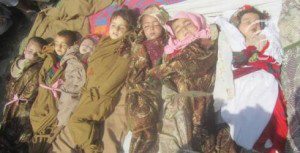
Twelve children killed in the Kunar province, April 2013 (Photo credit: Namatullah Karyab for The New York Times)

May 21, 2013 – Kabul–Since 2009, Voices for Creative Nonviolence has maintained a grim record we call the “The Afghan Atrocities Update” which gives the dates, locations, numbers and names of Afghan civilians killed by NATO forces.  Even with details culled from news reports, these data can’t help but merge into one large statistic, something about terrible pain that’s worth caring about but that is happening very far away.

It’s one thing to chronicle sparse details about these U.S. led NATO attacks. It’s quite another to sit across from Afghan men as they try, having broken down in tears, to regain sufficient composure to finish telling us their stories.  Last night, at a restaurant in Kabul, I and two friends from the Afghan Peace Volunteers met with five Pashtun men from Afghanistan’s northern and eastern provinces. The men had agreed to tell us about their experiences living in areas affected by regular drone attacks, aerial bombings and night raids.  Each of them noted that they also fear Taliban threats and attacks. “What can we do,” they asked, “when both sides are targeting us?”

Continue reading “Tales in a Kabul Restaurant”

Everybody has to buy bread

The following piece appears on the London Review of Books Blog.

For most of the world’s media, Pakistan’s general election was about terrorism. Candidates were identified according to their attitude towards the Taliban, and labelled as ‘secular’ or ‘conservative’. Little was said about party platforms. Circumstances appeared to justify the focus. There was a savage campaign of intimidation by domestic extremists in the run-up to the vote. More than a hundred people died, most of them members of the outgoing ruling coalition parties. The Awami National Party (ANP) and the Pakistan People’s Party (PPP) said they were targeted because of their uncompromising attitude towards the Taliban and avowedly secular views. There is some truth to this; but their enthusiastic embrace of the ‘global war on terror’ was a more immediate cause.

Despite the violence, turnout was nearly 60 per cent, the highest in Pakistan’s history. Youth participation was unprecedented. Critics of the ‘war on terror’ roundly defeated its supporters. Imran Khan’s Pakistan Tehreek-e-Insaf (PTI), which has taken a consistent antiwar position, crushed the ANP in the north-west. The PTI did particularly well in Swat, Dir and the Federally Adminstered Tribal Areas, where most of Pakistan’s counterinsurgency operations and US drone attacks are carried out. Also leery of the war, Nawaz Sharif’s Pakistan Muslim League (PML-N) evicted the PPP from Punjab, Pakistan’s richest, most populous and developed province.

Terrorism may be foremost in the minds of Western observers; Pakistanis are more worried about the economy, education and corruption. Opinion polls showed that people’s biggest concerns are inflation and unemployment, as well as power outages and high energy costs, which have stunted economic growth and caused much misery: 20-hour blackouts are not unknown. Not all Pakistanis are exposed to terrorist violence; everyone has to buy bread.

You can read the rest here

Foreign policy and Fuzzy Maths on the Scott Horton Show

I was on the Scott Horton Show yesterday to discuss my recent article on the dubious numbers that have been used to conceal the real scale of Iraq’s tragedy.

Muhammad Idrees Ahmad, a sociologist and editor of Pulsemedia.org, discusses the highly contested estimated number of Iraqi deaths due to the 2003 US invasion; why Iraq Body Count (the media’s go-to source) vastly under-reports casualties; how “excess death” statistical studies work; and how low-balling the costs of war – in terms of blood and treasure – distorts the public debate.

True costs of Iraq War whitewashed by fuzzy maths

This article appears in The National. (Also see my earlier article on the causes of the war)

‘So many’, wrote TS Eliot, reflecting on the waste land left by the First World War. “I had not thought death had undone so many.”

This notion is unlikely to cross the minds of those surveying the devastation left by the 2003 invasion of Iraq. The most frequently quoted fatality figure – about 115,000 Iraqis killed – is shocking. But compared to major conflicts of the past century, it is a relatively modest toll. The Battle of the Somme alone killed three times as many. More were killed by a single bomb dropped on Hiroshima during the Second World War.

Former British prime minster Tony Blair, and then-US vice president Dick Cheney, were perhaps conscious of this when they expressed “no regrets” on the 10th anniversary of the war last month.

That the perpetrators of an aggressive war should accept the lowest costs for their folly is unsurprising. What is less explicable is why so many supposed critics of the war are crediting the same estimate. Brown University’s Costs of War project and the Centre for American Progress’s Iraq War Ledger use it as their main source.

You can read the rest here.

Gore Vidal and Noam Chomsky in Conversation

Wonders of Youtube! A 1991 video of a conversation between the two greats surfaces.

‘We are those two Afghan children’

by Dr. Hakim and the Afghan Peace Volunteers

Two young Afghan boys herding cattle in Uruzgan Province of Afghanistan were mistakenly killed by NATO forces yesterday.

They were seven and eight years old.

Our globe, approving of ‘necessary or just war’, thinks, “We expect this to happen occasionally.”

Some say, “We’re sorry.”

Therefore today, with sorrow and rage, we the Afghan Peace Volunteers took our hearts to the streets.

We went with two cows, remembering that the two children were tending to their cattle on their last day.

We are those two children.

We want to be human again.

Continue reading “‘We are those two Afghan children’”

Saturday Night Live does the Hagel Hearings

For some reason, SNL did not broadcast this.

Archaeology of Revolutionary Knowledge

My review of Pankaj Mishra’s From the Ruins of Empire which first appeared in Guernica.

As tsar Alexander III sat down for an evening’s entertainment at the St. Petersburg opera in late 1887, he little knew that the performance would be upstaged by one far more dramatic. Shortly after the curtains rose, a slender, goateed man with azure eyes, dressed in robe and turban, got up from a box nearby and proclaimed loudly: “I intend to say the evening prayer—Allah-u-Akbar!” The audience sat bemused and soldiers waited impatiently as the man proceeded unperturbed with his evening prayers. His sole companion, the Russian-born intellectual Abdurreshid Ibrahim, squirmed in fear of his life.

Jamal ud-Din al-Afghani was determined to recruit Russian support in his campaign against the British. Having failed to secure an audience with the tsar, he had decided to use his daring as a calling card. The tsar’s curiosity was duly piqued and Afghani had his hearing.

This could be a scene out of Tolstoy or Lermontov; but so extraordinary a figure was Afghani (1838-97) that inserting him into fiction would have compromised verisimilitude. So, renowned essayist and novelist Pankaj Mishra has opted for the genres of historical essay and intellectual biography to profile the lives of Afghani and other equally remarkable figures in From the Ruins of Empire: The intellectuals who remade Asia.

The book is a refreshing break from lachrymose histories of the East’s victimhood and laments about its past glories. It concerns a group of intellectuals who responded to the threat of western dominance with vigour and imagination. Together they engendered the intellectual currents that have shaped the last century of the region’s history. Continue reading “Archaeology of Revolutionary Knowledge”

Obama’s New Strategy in Afghanistan

On Fault Lines, Josh Rushing embeds with US troops on the front lines of Obama’s war and asks: What is the US trying to achieve in Afghanistan, and will it really make the US safer?

Obama’s torture policy

Al Jazeera’s excellent Fault Lines returns:

As a candidate for president, Barack Obama promised a new direction. Just days after taking office, the new US president issued a series of executive orders banning all acts of torture, discontinuing the use of CIA black sites, and calling for the US detention centre at Guantanamo Bay to be closed.

Continue reading “Obama’s torture policy”