Stop-Loss

In the case of the Vietnam war it took long after the war had ended for the first critical films to come out. Americans in this respect still aren’t as bad as the French, who have yet to own up to their crimes in the colonies. Even today the best they can offer is oblique references to colonial depredations (take for example the awful Flanders). The French were so sensitive about their colonial legacy in Viet Nam even in 1979 that Francis Ford Coppola had to edit out a long section from Apocalypse Now lest it upset judges at the Cannes Film Festival.

However, the Iraq war has been unique insofar as it has produced some excellent cinema even as it has continued to grind on. Yet, most of these films have failed at the box office. Some of them perhaps understandably so: War Inc., Redacted, Lambs for Lions and Battle for Haditha were well-meaning, for example, but didn’t work so well as films. In the Valley of Elah, on the other hand, had all the right elements: an a-list cast comprising of multiple Oscar winners, an Oscar-winning writer and director, a superb screenplay; and yet, it was a complete commercial failure.  So was Grace is Gone; and Rendition. So was another — perhaps one of the best — which also had all the right elements: Stop-Loss. The film is based on the experiences of director Kimberley Peirce’s own brother, and it makes news stories such as the following from the Guardian rather predictable.

An Iraq war veteran has been arrested and charged with threatening to kill his officers after recording a violent rap protest song and sending it to the Pentagon.

Marc Hall, a junior member of an infantry unit, wrote the song in protest at the US army’s unpopular policy of involuntarily extending soldiers’ service and forcing them to return to Iraq or Afghanistan.

Hall completed a 14-month spell in Iraq last year, expecting to be discharged next month, but was told he would have to go back to Iraq under the policy known as stop-loss.

Continue reading “Stop-Loss”

A People’s History of Gaza in Cartoons

by Paul de Rooij

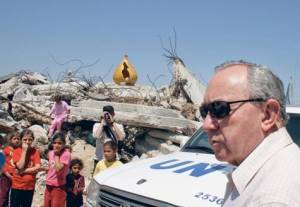
The launch of a new book by Joe Sacco is a major event, and with considerable expectation a crowd recently gathered in London to hear the great Maltese-American cartoonist and author discuss his latest book: Footnotes in Gaza. [1] Sacco spent seven years researching and drawing about two sordid events that took place in November 1956 when Israeli forces invaded Gaza as part of the joint British-French attack against Egypt. The Israeli army conducted two massacres where hundreds of Palestinians were murdered, and Sacco set out to collate the oral histories of the Palestinians who witnessed or were the victims of the events. Sacco engaged in a detailed investigative work finding the witnesses who could credibly recollect what happened, sifted through the accounts to eliminate the factual inconsistencies due to the deteriorated memories, and then spent four years bringing these histories to life in his inimitable style. The book doesn’t only focus on the past, but the present is also very much part of his account; in present day Gaza giant armoured bulldozers flatten houses in Rafah and where the ongoing siege affects everybody’s lives. Sacco says: “… the past and the present cannot be so easily disentangled; they are part of a remorseless continuum…”

Contemporary history is usually written by academics with access to the main protagonists, usually politicians or military commanders, inert archives, and press accounts. This history is usually antiseptic – there are no piles of corpses to embarrass the generals. It is also imbued with certainty – historians usually don’t question the politician’s say-so. It is rare for mainstream historians to listen to victims; their accounts are seldom incorporated into the victor’s history. What sets Joe Sacco apart is that not only is he a great artist, but also a peoples’ historian who is willing to listen to the victims; his historiography is imbued with sympathy and respect for the these victims; their history is worthwhile recording. Sacco also focused on a usually-ignored slice of history. In 2001, he travelled in Gaza with Chris Hedges, the American journalist, to research an article about the 1956 massacres for an article for Harper’s magazine. When the article finally appeared, the history of the massacres had been editorially expunged; not all histories are treated equally. Perhaps it was this incident that piqued his interest to write about the neglected massacres.

Continue reading “A People’s History of Gaza in Cartoons”

Death By Sanctions

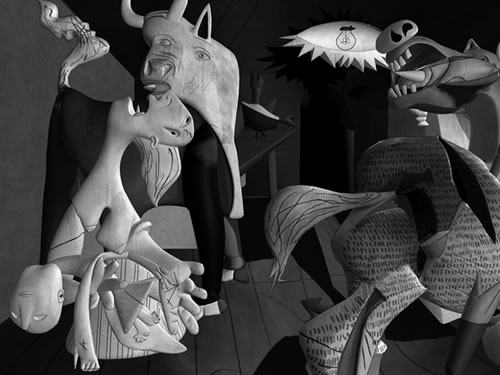
Guernica
M. Shahid Alam

Iraq deaths double under UN sanctions.”
New York Times, Feb.17, 2000

Sleep my child, do not wake now.
The portents in the sky foretell
a searing death for you.

The couriers of death have come,
stealth in their cyber gaze:
they scour the land for Saddam.

They poison every river, creek and well.
They darken school and hospital.
They warp the words you spell.

For star, for oil and cross they fly.
They will not cease to tyrannize
your dying days and hellish nights.

They will not cease their deathly watch.
Their mission is to fossilize
your bones, your heart, your eyes.

Sweet my child, do not wake now.
Your eyes once soft are hard
as rock: your hair is white as snow.

– M. Shahid Alam is professor of economics at Northeastern University. He is author of Challenging the New Orientalism (IPI: 2000). You can reach him at alqalam02760@yahoo.com.

Moshe Halbertal and the Goldstone Report

Jerome Slater refutes Moshe Halbertal’s attack on the Goldstone Report published in The New Republic, an Israel Lobby mouthpiece.

Judge Goldstone in Gaza

As an academic of nearly fifty years, I take seriously that the core principle and highest calling of our profession is to seek and tell the truth, as best as one can. For those who know the full historical facts about the Israeli-Palestinian conflict, one of the most shocking and depressing phenomena is the extent to which many leading Israeli and American Jewish intellectuals and academicians ignore, conceal, or willfully deny them.

I am not speaking here of ordinary citizens, who might simply be unaware that many of the most cherished Israeli mythologies are historically unsustainable; rather I refer only to the media commentators, political scientists, historians, and even moral philosophers who regularly write about the conflict and whose distortions or outright falsifications cannot be explained away by ignorance.

What, then, does explain this situation? For some, their ideology is simply so impenetrable that the facts can’t get through. For others, I assume that they knowingly, or at least semi-knowingly, conceal the truth because they fear that revealing it will harm Israel. If so, they are also wrong about the consequences — over sixty years of Israeli repression of the Palestinians has done incalculable harm to Israel’s own best interests. In any case, no matter what their motives, the academics who seek to defend Israel against the most reasonable criticisms betray their calling.

Continue reading “Moshe Halbertal and the Goldstone Report”

Chomsky on Empire and Ideology

Hostility and Hospitality in Contemporary World Politics

This is Chomsky at his best, highlighting the exceptionalism that characterizes US political discourse, and the ideological memes that have accompanied US imperialism with few modulations over the years. The follow-up speaker Stephen Pfohl is also very good. (thanks Doug)

Obama kills over 700 Pakistanis in 44 drone strikes in 2009

Victims of Obama's drone attacks

The Pakistani daily Dawn — a pro-US paper not known for its antiwar stance — reports that US drones killed over 700 civilians in 44 bombings since Obama took office in January 2009. Of the 44 attacks, only five succeeded in hitting their target. In other words, Obama has surpassed his predecessor’s murderous record in Pakistan. (Of course these attacks are carried out with the complicity of Pakistan’s ruling elites — as Jane Mayer reported, and as Pervez Musharraf confessed — and are cheered on by native informers such as Ahmed Rashid).

PESHAWAR: Of the 44 predator strikes carried out by US drones in the tribal areas of Pakistan over the past 12 months, only five were able to hit their actual targets, killing five key Al-Qaeda and Taliban leaders, but at the cost of over 700 innocent civilians.

Continue reading “Obama kills over 700 Pakistanis in 44 drone strikes in 2009”

PULSE: 20 Top Global Media Figures of 2009

After we published our list of 20 Top Global Thinkers, we thought we would be remiss if we did not also honor those who bring these voices to us in the first place. With the goal of recognizing those individuals and institutions responsible for exemplary reportage and awareness-raising in 2009, we asked our editors and writers to name their choices for the top 20 media figures, be they journalists, publications or publishers.  We aggregated these nominations into the following list. Like our 20 Top Global Thinkers, our criteria for choosing media figures included individuals/publications/publishers who have shown a commitment to challenging power, holding it to account, highlighting issues pertaining to social justice and producing output that bucks conventional wisdom and encourages critical thinking.

Amy Goodman

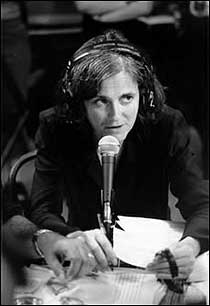
A media institution in her own right, Amy Goodman has shown the true potential of independent media over the past 12 years by turning Democracy Now! into the largest public media collaboration in the US and around the world. Free of corporate sponsorship, DN’s hard-hitting daily broadcast rejects the soundbite format of mainstream media to provide in-depth coverage of the world’s most important issues. Unlike the MSM, Democracy Now! gives less emphasis to official voices than to those affected by the abuses of their offices. Goodman relentlessly pursues her stories, and often follows them long after the mainstream media has moved on to chase new headlines. Iraq and Afghanistan have therefore remained part of DN’s coverage for all the years that they were absent in the MSM. Policy-makers may have lost interest in the story, but for Goodman, the people on the receiving end continue to live the story. Her interviewees include voices that the MSM frequently excludes, including scholars, activists, heads of states out of favor with the United States, opposition leaders, and organizers. Through her journalism, writings and lectures, Goodman continues to set the bar for what every journalist should be aspiring to.

Sherine Tadros/Ayman Mohyeldin

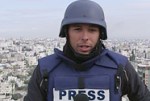
Al Jazeera has long set the bar for war reporting; Sherine Tadros and Ayman Mohyeldin have raised it even higher with their coverage of the conflict in Gaza in 2008- 2009. Tadros and Mohyeldin were the only two journalists working for an international English-language television network reporting from inside Gaza. They braved the dangers of Israel’s indiscriminate assault to bring hour-by-hour reporting the tragedy as it unfolded. Their courage was matched by the quality of their journalism. In 2009, Tadros continued to report from the region, covering the creeping ethnic cleansing of occupied Palestine.  Mohyeldin, likewise, continues to report on issues such as the network of tunnels between Egypt and Gaza which are vital for the transfer of food, medicine and fuel supplies into Gaza.

Continue reading “PULSE: 20 Top Global Media Figures of 2009”

An Afghan’s Lament

The Times reports that a team of US-Nato special forces descended on a village in Kunar and apprehended 10 Afghans, including 8 schoolchildren — grades six, nine and ten — and executed them in cold blood. Seven of the children belonged to a single family, and many were handcuffed before being shot. Following is the lament of an Afghan poet who has endured enough of the freedom brought him by the so-called Operation Enduring Freedom.

(I am unable to translate this right now, maybe later. But the pictures speak for themselves).

Continue reading “An Afghan’s Lament”

Why is Democracy Now shielding “war for oil” against reality?

In its headlines for December 14, Democracy Now followed the report on Blair’s confession about his committment to regime change in Iraq regardless of the absence of WMDs, with this:

Iraq Signs Oil Deals with 10 Foreign Companies

Blair’s comments come just as Iraq has signed a series of major oil deals. A two-day auction ended Saturday with ten foreign companies winning access to Iraq’s massive reserves. The oil giant Royal Dutch Shell won the rights to the Manjoon oilfield near Basra, one of the world’s largest. The US-based Exxon Mobil and Occidental Petroleum also submitted winning bids.

The wording is careful: it appears to suggest a connection between what Blair said and the Iraqi oil contracts. The war in other words was for oil. That is a remrkable conclusion to draw from news about an auction in which US companies were the big losers (hence DN’s careful choice of the words ‘foreign companies’). Unless Democracy Now is suggesting that the US waged a war for Russia, Norway and China — biggest winners in the auction — it is not clear why it continues to insist on the discredited “war for oil” argument? Why is it so difficult to admit who actually conceived the war?

Continue reading “Why is Democracy Now shielding “war for oil” against reality?”

Michael Mann on the Incoherent Empire

I am reading Michael Mann’s The Sources of Social Power at the moment, and I find many of his ideas, and his sociological approach to world history most stimulating. I think his IEMP Model — society as a series of overlapping and intersecting power networks with a focus on the logistics of Ideological, Economic, Military and Political power — is by far the best approach to the study of social power. However, I was underwhelmed by his own (in my view defective) application of the theory in his Incoherent Empire. This interview is old, but his observations on history and society remain relevant nevertheless. (thanks Dave)

UC Berkeley’s Harry Kreisler welcomes UCLA sociologist Michael Mann for a conversation on how comparative historical sociology can help in our understanding of U.S. foreign policy. Series: “Conversations with History”