Will Americans challenge Obama’s drone war?

by Medea Benjamin

Shakira, 4, was disfigured in one of Obama’s drone attacks.

On May 29, The New York Times published an extraordinarily in-depth look at the intimate role President Obama has played in authorizing US drone attacks overseas, particularly in Pakistan, Yemen and Somalia. It is chilling to read the cold, macabre ease with which the President and his staff decide who will live or die. The fate of people living thousands of miles away is decided by a group of Americans, elected and unelected, who don’t speak their language, don’t know their culture, don’t understand their motives or values. While purporting to represent the world’s greatest democracy, US leaders are putting people on a hit list who are as young as 17, people who are given no chance to surrender, and certainly no chance to be tried in a court of law.

Who is furnishing the President and his aides with this list of terrorist suspects to choose from, like baseball cards? The kind of intelligence used to put people on drone hit lists is the same kind of intelligence that put people in Guantanamo. Remember how the American public was assured that the prisoners locked up in Guantanamo were the “worst of the worst,” only to find out that hundreds were innocent people who had been sold to the US military by bounty hunters?

Continue reading “Will Americans challenge Obama’s drone war?”

Ali Ferzat: Breaking the barrier of fear

Al Jazeera’s Listening Post interviews the great Syrian cartoonist Ali Ferzat whose work we have featured here often.

Obama Administration Silencing Pakistani Drone-Strike Lawyer

by Medea Benjamin

Shahzad Akbar (left) with Karim Khan, a resident of North Waziristan whose 18-year-old son and 35-year-old brother were killed in a CIA drone strike which destroyed his family home. (Reuters)

When is the last time you heard from a civilian victim of the CIA’s secret drone strikes? Sure, most of them can’t speak because they’re deceased. But many leave behind bereaved and angry family members ready to proclaim their innocence and denounce the absence of due process, the lack of accountability, the utter impunity with which the U.S. government decides who will live and die.

In the wake of the 9/11 attacks, the U.S. government has increasingly deployed unmanned drones in the Middle East, South Asia and Africa. While drones were initially used for surveillance, these remotely controlled aerial vehicles are now routinely used to launch missiles against human targets in countries where the United States is not at war, including Pakistan, Somalia and Yemen. As many as 3,000 people, including hundreds of civilians and even American citizens, have been killed in such covert missions.

The U.S. government will not even acknowledge the existence of the covert drone program, much less account for those who are killed and maimed. And you don’t hear their stories on FOX News, or even MSNBC. The U.S. media has little interest in airing the stories of dirt poor people in faraway lands who contradict the convenient narrative that drone strikes only kill “militants.”

Continue reading “Obama Administration Silencing Pakistani Drone-Strike Lawyer”

Afghan My Lai — Robert Bales was not alone

That is according to Afghan child witnesses interviewed by Yalda Hakim for Australia’s SBS Dateline. (h/t Shaheen)

Hakim, who was born in Afghanistan and immigrated to Australia as a child, is the first international journalist to interview the surviving witnesses. She said American investigators tried to prevent her from interviewing the children, saying her questions could traumatize them. She said she appealed to village leaders, who arranged for her to interview the witnesses.

Noorbinak, 8, told Hakim that the shooter first shot her father’s dog. Then, Noorbinak said in the video, he shot her father in the foot and dragged her mother by the hair. When her father started screaming, he shot her father, the child says. Then he turned the gun on Noorbinak and shot her in the leg.

Continue reading “Afghan My Lai — Robert Bales was not alone”

Syria on the brink

A year ago, Syrians took to the streets in peaceful protest demanding democratic change but the regime ruthlessly crushed the uprising. Empire discusses if the world powers can do anything to stop the escalation of force.

Syria: Songs of Defiance

This is typically excellent and courageous. The journalist is supposed to be anonymous but they haven’t disguised his voice very well.

An Al Jazeera journalist who was forced to remain anonymous for security reasons offers an unusual but compelling first-person account of a country in turmoil and a revolution in progress in this intriguing episode of People and Power.

Journalists and activists killed in Homs shelling

Two foreign journalists have been killed in Homs, activists say, as shelling of a district of the Syrian city continued amid warnings of an escalating humanitarian crisis.

Omar Shakir, an activist in the city, told Al Jazeera that the deaths of Marie Colvin, a US reporter working for the UK’s Sunday Times newspaper, and French photographer Remi Ochlik occurred as a building used by activists as a media centre was shelled on Wednesday.

Police Chief Timoney, Meet Bahraini Mothers

by Medea Benjamin

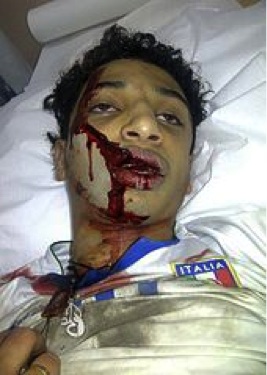
14-year-old Ali Jawad died when a tear gas canister fired at close range smashed his face.

John Timoney is the controversial former Miami police chief well known for orchestrating brutal crackdowns on protests in Miami and Philadelphia- instances with rampant police abuse, violence, and blatant disregard for freedom of expression. It should be of great concern that the Kingdom of Bahrain has brought Timoney and John Yates, former assistant commissioner of Britain’s Metropolitan Police, to “reform” Bahrain’s security forces.

Since assuming his new position, Timoney has claimed that Bahrain has been reforming it brutal police tactics in response to recommendations issued by the Bahrain Independent Commission of Inquiry. He says that there is less tear gas being used and that while tear gas might be “distasteful,” it’s not really harmful.

I have no idea what country Chief Timoney is talking about, because it’s certainly not the Bahrain I saw this past week, a week that marked the one-year anniversary since the February 14, 2011 uprising.

I was in Bahrain for five days before being deported for joining a peaceful women’s march. During my stay, I accompanied local human rights activists to the villages where protests were raging and police cracking down. Every day, I inhaled a potent dose of tear gas, and came close to being hit in the head with tear gas canisters. Every evening I saw the fireworks and smelled the noxious fumes as hundreds of tear gas canisters were lobbed into the village of Bani Jamrah, next door to where I was staying. The villagers would get on their roofs yelling “Down, Down Hamad” (referring to the King). In exchange, as a form of collective punishment, the whole village would be doused in tear gas. I went to bed coughing, eyes burning, wondering how in the world the Bahrainis can stand this.

Continue reading “Police Chief Timoney, Meet Bahraini Mothers”

America’s Lawless Empire: The Constitutional Crimes of Bush and Obama

Ralph Nader ’58 and Bruce Fein ’72 visited Harvard Law School for a talk sponsored by the HLS Forum and the Harvard Law Record. At the event, “America’s Lawless Empire: The Constitutional Crimes of Bush and Obama,” both men discussed what they called lawless, violent practices by the White House and its agencies that have become institutionalized by both political parties.

Homs under siege

Also see Jane Ferguson’s courageous reporting on the conditions inside Homs.

Continue reading “Homs under siege”