Creating a new Courage

by Jerica Arents

Editor’s Note: American peace activists Kathy Kelly, Jerica Arents and David Smith-Ferri are part of a 3 person delegation currently travelling in Afghanistan. Find more entries from their travelogues on PULSE.

Kabul, Afghanistan – After an exhausting day trekking through the dirt roads of the city of Bamiyan and outlying settlements, three Americans were guided by a dozen Afghan boys to a tent packed with overstuffed pillows and comforters. After the boys served them a delicious meal cooked over a small outdoor stove, they affixed their flashlights to the spine of the tent and invited the Americans to enter. Unlike the forts I made in my parents’ living room when I was little, this tent had a pressing message: a group of youngsters in a central province of Afghanistan want peace, not war.

The Afghan Youth Peace Volunteers, a group of ethnically diverse young men from a city one hundred miles northwest of Kabul, have been actively speaking out against the U.S- and NATO occupation for the last four years. The boys have endured grave opposition and community ridicule. However, through the help of networking sites and YouTube, this group of young men want to ask the world, “Why not love?”

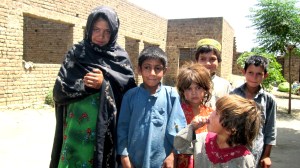
“Our life is a life of the poor”, reflected the mother of one of the boys as we sat in her simple village home. With Afghanistan now being the worst country a child can be born into, alongside the challenges of building life in a country that has been fraught with thirty years of war, the very existence of this group of gentle spirits is miraculous. Many of these boys have lost one or both of their parents to infectious disease or conflict. Their city of 60,000 has no running water, little internet access, and a few hours of generated electricity a night. A barrage of cars, bicycles, donkeys, motorcycles and vans share the single-lane paved road that bisects the city – and over and over again we experienced the striking hospitality of this tense land.
Continue reading “Creating a new Courage”

“War does this to your mind”

by Kathy Kelly

Editor’s Note: American peace activists Kathy Kelly, Jerica Arents and David Smith-Ferri are part of a 3 person delegation currently travelling in Afghanistan. Find more entries from their travelogues on PULSE.

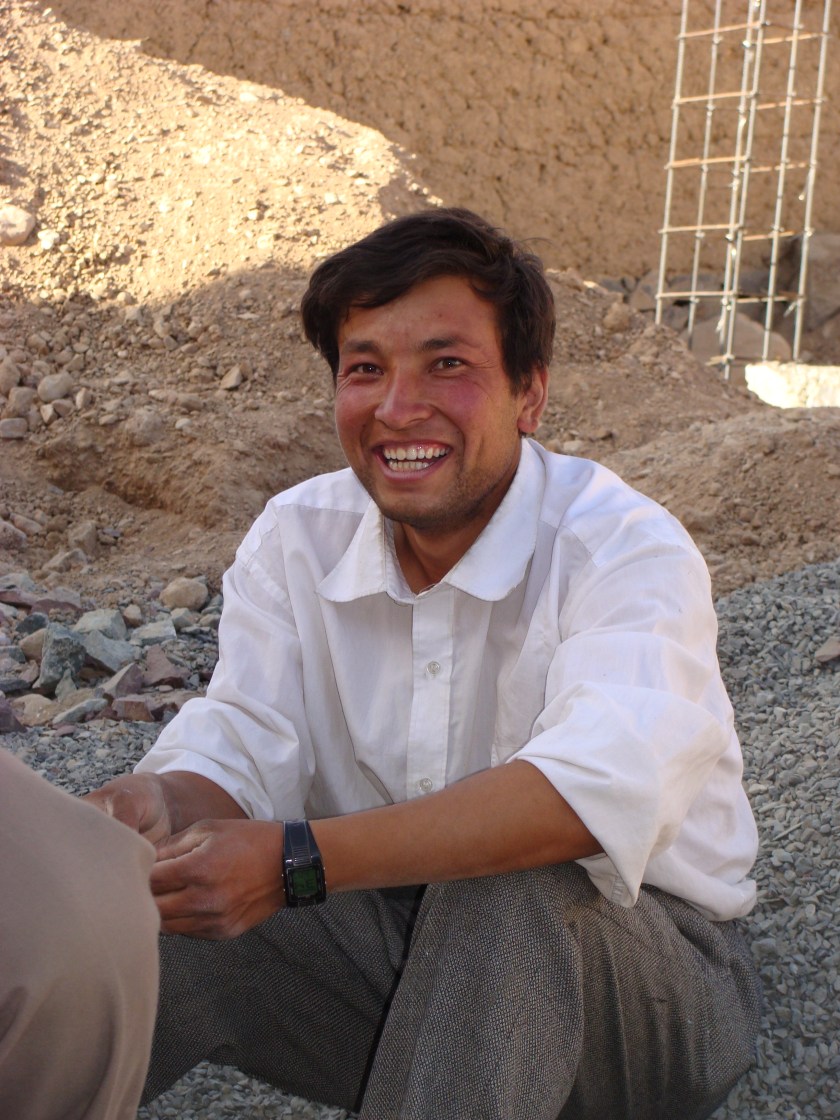
Khamad Jan at a construction site in Bamiyan, Afghanistan

Kabul– Khamad Jan, age 22, remembers that, as a youngster, he was a good student who enjoyed studying.  “Now, I can’t seem to think,” he said sadly, looking at the ground.  There was a long pause. “War does this to your mind.”

He and his family fled their village when Taliban forces began to attack the area. Bamiyan Province is home to a great number of Hazara families, and Khamad Jan’s is one of them. Traditionally, other Afghan ethnic groups have discriminated against Hazaras, regarding them as descendants of Mongolian tribes and therefore inferior.

During the Taliban attacks, Khamad Jan’s father was captured and killed.  As the eldest, Khamad Jan bore responsibility to help provide for his mother, two brothers and two sisters. But he struggled with debilitating depression, so much so that villagers, anxious to help, talked of exorcism. One day, he said he felt ready to give up on life.  Fortunately, community members and his friends in a local youth group, the “Afghan Youth Peace Volunteers,” have helped him come to terms with the pain he feels, assuring him that he can find a meaningful future.

Khamad Jan’s village is a particularly hard place in which to build houses, roads or farms. He and his family own a small plot of land which produces potatoes and wheat. The family works hard, but they only grow enough to feed themselves for seven months of the year. For a few months of every year, they must depend heavily on bread and potatoes, a carbo-diet which leads to malnutrition.  Like other women in the village, Khamad Jan’s mother and sisters are chronically anemic, suffering from headaches and leg cramps.

Continue reading ““War does this to your mind””

Bamiyan Diaries – Day Two

by David Smith-Ferri

Editor’s Note: American peace activists Kathy Kelly, Jerica Arents and David Smith-Ferri are part of a 3 person delegation currently travelling in Afghanistan. Read Smith-Ferri’s first piece on their experiences here.

Building Bamiyan Peace Park

The city of Bamiyan, with a population of roughly 60,000, has only one paved street, a wide, two-kilometer road without lanes that is a site of constant activity from 5 a.m. to curfew, at 10 p.m., and is referred to as the “Bazaar” because it is lined on both sides with shops.

In our short time here, we’ve been struck by how hard people, both in town and in the outlying villages, have to work to make a meager living. Children clearly work hard, too, seeming to participate fully in the livelihood of the family. At almost anytime of the day they can be seen at all manner of enterprise – helping set up the family street stall early in the morning, riding a donkey to fetch water in five-gallon plastic jugs, helping harvest potatoes, herding sheep or goats, collecting leaves for fuel, washing clothes in a creek, caring for younger siblings; and of course, they also attend school. Their work is as much a part of the landscape as the cottonwood trees and the red-rock cliffs which stand above the rivers.

Having had a chance to talk with members of the Afghan Youth Peace Volunteers (AYPV) and learn something about their significant commitments to home, family, and school, it was with delight and astonishment that we visited Bamiyan Peace Park today with nine proud members of the group and learned about their role in its development and use.

Continue reading “Bamiyan Diaries – Day Two”

Bamiyan Diaries – Day One

by David Smith-Ferri

Editor’s Note: American peace activists Kathy Kelly, Jerica Arents and David Smith-Ferri are part of a 3 person delegation currently travelling in Afghanistan. This is Smith-Ferri’s article written about their first day in Bamiyan province.

Bamiyan Province in Afghanistan, a stunningly beautiful mountainous region, is located in the center of the country, roughly 100 miles from Kabul. Most people here live in small, autonomous villages tucked into high mountain valleys, and work dawn to dusk just to scratch out a meager living as subsistence farmers, shepherds, or goatherds. The central government in Kabul and the regional government in Bamiyan City exercise little or no control over their lives. They govern themselves, and live for the most part in isolation.

Given this, who would imagine that Afghan youth from small villages across Bamiyan Province would come together to form a tight-knit, resilient, and effective group of peace activists, with a growing network of contacts and support that includes youth in other parts of the country and peace activists in the U.S. and in Palestine? I certainly wouldn’t have. In the United States, we may find it hard to believe that anything good can actually come out of Afghanistan, or we may have fallen into a trap of thinking that Afghans cannot accomplish anything useful without foreign aid and assistance. I confess that I struggle to live outside the shadow of this narrow-mindedness and ethno-centrism. Certainly, if the scope of our imaginations is limited by CNN and Fox News, we would not be likely to imagine an indigenous peace group forming in Bamiyan Province. But this is exactly what has happened.

Calling themselves the Afghan Youth Peace Volunteers (AYPV), they range in age from eight to twenty, and they have been active for over two years, translating their camaraderie and the horror of their families’ experience of war and displacement into a passionate and active pacifism. At an invitation from AYPV, three American peace activists from Voices for Creative Nonviolence have arrived in Bamiyan for five days to build bridges of friendship and support with these youth and their families. Over this time, we will write a daily diary of our experiences and interactions with the Afghan Youth Peace Volunteers.

Continue reading “Bamiyan Diaries – Day One”

Drones on Trial: Narrowing the Gap Between Law and Justice

by Jerica Arents

I received an education yesterday.

I wasn’t in a classroom.  I wasn’t laboring over a paper, strategizing in a small group, poring over a textbook or hustling across campus.  I was sitting as a spectator in the front row of Judge Jansen’s courtroom in Clark County, Nevada.

Fourteen peace activists were on trial for trying to hand-deliver a letter to the base commander at Creech Air Force Base in April of 2009. Their letter laid out concerns about usage of Unmanned Aerial Vehicles, or drones, for surveillance and combat purposes in Afghanistan. The Creech 14 believe that the usage of remote aerial vehicles to hunt down and kill people in other lands amounts to targeted assassination and is prohibited by international and U.S. law.  Soldiers carrying M16s stopped them after they had walked past the guardhouse at the base entrance and a few hours later Nevada state troopers handcuffed the Creech 14 and took them into custody.

The next day, they were charged with trespass to a military facility and released.  The charges were later dropped, then reinstated. Defendants, upon learning of a September 14, 2010 court date, had ten months to plan for their trial. They decided to represent themselves pro se and to call, as expert witnesses, former U.S. Attorney General Ramsey Clark, Colonel Ann Wright and Professor Bill Quigley, the Legal Director of the Center for Constitutional Rights.  What were the chances that a Las Vegas court that normally handles traffic violations and minor offenses would admit three expert witnesses to testify on behalf of defendants charged with a simple trespass?  Slim to zero in the view of most observers.

In an opening statement, Kathy Kelly summarized what defendants would prove regarding their obligations under international law and their exercise of rights protected by the U.S. constitution.  The judge told her, quite firmly, that any testimony unrelated to the charge of trespass would be disallowed.

Continue reading “Drones on Trial: Narrowing the Gap Between Law and Justice”

Banning Slaughter

by Kathy Kelly

In the early 1970’s, I spent two summers slinging pork loins in a Chicago meat-packing factory.  Rose Packing Company paid a handful of college students $2.25 an hour to process pork.  Donning combat boots, yellow rubber aprons, goggles, hairnets and floor length white smocks that didn’t stay white very long, we’d arrive on the factory floor. Surrounded by deafening machinery, we’d step over small pools of blood and waste, adjusting ourselves to the rancid odors, as we headed to our posts.  I’d step onto a milk crate in front of a huge bin full of thawing pork loins.  Then, swinging a big, steel T-hook, I’d stab a large pork loin, pull it out of the pile, and plop it on a conveyor belt carrying meat into the pickle juice machine.  Sometimes a roar from a foreman would indicate a switch to processing Canadian pork butts, which involved swiftly shoving metal chips behind rectangular cuts of meat. On occasion, I’d be assigned to a machine that squirted meat waste meat into a plastic tubing, part of the process for making hot dogs. I soon became a vegetarian.

But, up until some months ago, if anyone had ever said to me, “Kathy Kelly, you slaughtered animals,” I’m sure I would have denied it, and maybe even felt a bit indignant.  Recently, I realized that in fact I did participate in animal slaughter. It’s similar, isn’t it, to widely held perceptions here in the United States about our responsibility for killing people in Afghanistan, in Pakistan, in Iraq and other areas where the U.S. routinely kills civilians.

Continue reading “Banning Slaughter”

“Americans Don’t Flinch” – They Duck!

by Kathy Kelly and Dan Pearson

June 24, 2010

Yesterday, accepting General McChrystal’s resignation, President Obama said that McChrystal’s departure represented a change in personnel, not a change in policy. “Americans don’t flinch in the face of difficult truths or difficult tasks.” he stated, “We persist and we persevere.”

Yet, President Obama and the U.S. people don’t face up to the ugly truth that, in Afghanistan, the U.S. has routinely committed atrocities against innocent civilians. By ducking that truth, the U.S. reinforces a sense of exceptionalism, which, in other parts of the world, causes resentment and antagonism.

While on the campaign trail and since taking office, President Obama has persistently emphasized his view that attacks against civilians are always criminal, unless the U.S. is the attacker, in which case they are justified. We heard this again, yesterday, as the President assured the U.S. people that we will persevere in Afghanistan. “We will not tolerate a safe haven for terrorists who want to destroy Afghan security from within, and launch attacks against innocent men, women, and children in our country and around the world.”

In considering the security of Afghan civilians, it’s crucial to ask why, on May 12, 2009, General McChrystal was selected to replace General McKiernan as the top general in Afghanistan. News reports said it was because he had experience in coordinating special operations in Iraq. That experience involved developing death squads, planning night raids, and coordinating undercover assassinations. McChrystal proved, since his appointment, that he could organize atrocities against Afghan civilians and simultaneously present himself as a protector of Afghan civilians. In doing so, he relied on collaboration and cooperation from Defense Secretary Gates, General Petraeus and President Obama. They are united in their culpability.

Continue reading ““Americans Don’t Flinch” – They Duck!”

Witnessing Against Torture: Why We Must Act

by Kathy Kelly

Congress shall make no law… abridging the freedom of speech, or of the press; or the right of the people peaceably to assemble, and to petition the Government for a redress of grievances.
–U.S. Constitution –  Amendment I

An old cliché says that anyone who has herself for a lawyer has a fool for a client.  Nevertheless, going to trial in Washington, D.C., this past June 14, I and twenty-three other defendants prepared a pro se defense.  Acting as our own lawyers in court, we aimed to defend a population that finds little voice in our society at all, and to bring a sort of prosecution against their persecutors.

Months earlier, on January 21st, we had held a memorial vigil for three innocent Guantanamo prisoners, recently revealed to have been in all probability tortured to death by our government with what would turn out to be utter impunity – and because we had wished the culpable parties to take notice, we’d staged a vigil where they worked, specifically on the Capitol Steps and in the Rotunda of the U.S. Capitol Building. We had been charged with causing a “breach of the peace,” a technical legal term for a situation that might risk inciting people to violence. In abetting Administration use of torture, Congress had been inciting others to horrendous violence, and we’d been protesting perhaps one of the gravest imaginable breaches of the peace.  Now we were making our small attempt to take these crimes to court, in the course of defending ourselves against what we felt to be a misdirected charge.

Continue reading “Witnessing Against Torture: Why We Must Act”

Unrest in Pakistan

Moving Beyond the U.S. National Interest

by Josh Brollier and Kathy Kelly

June 18, 2010

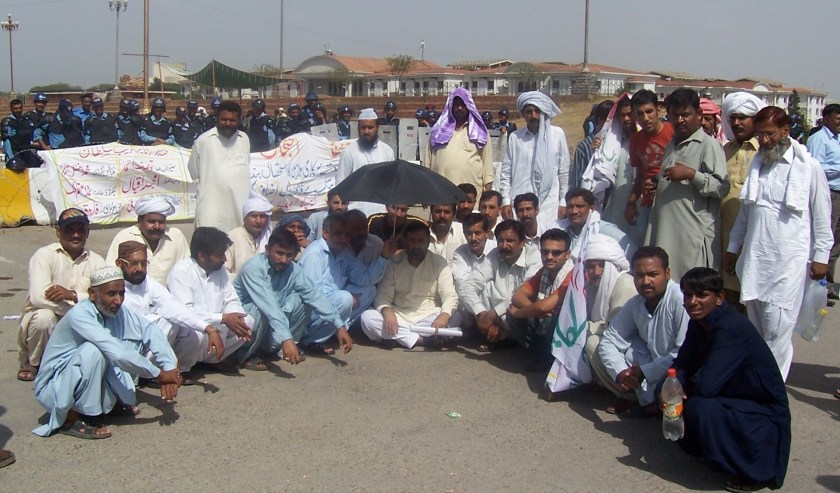
All Pakistan Clerks Association Protest at Parliament in Islamabad

“The military is the muscle that protects the ruling elite from the wrath of the people,” says Pakistani political analyst Dr. Mubashir Hassan. “Right now, people are out on the street; blocking roads, attacking railway stations, etc. If you read the papers, it seems as though a general uprising has started all over Pakistan.”

Dr. Hassan says that sporadic outbursts of anger in Pakistan won’t coalesce into a people’s revolution anytime soon. The demonstrators are too disorganized. But, the sheer volume of daily protests shows that many sectors of Pakistani society have pressing needs and priorities that do not include enlistment as foot soldiers in a proxy force for the United States’ War on Terror.

Dr. Hassan, a co-founder of the People’s Party of Pakistan, is a respected scholar and statesman. Last year, when we met with him, he had just returned from a visit, in the U.S., with Professors Noam Chomsky and Howard Zinn, his contemporaries in seeking to build just and fair social structures. Last month, in Lahore, he spoke with us about U.S. interference in the region and changing dynamics in Pakistan.

Continue reading “Unrest in Pakistan”

I Want to Live with my Family

by Kathy Kelly and Josh Brollier

May 24, 2010

Refugee family living in Shah Mansoor

Islamabad–Abir Mohammed, a refugee from Bajaur, says that the battles which raged in his home province since 2008 have dramatically changed his life. We met him in a crowded Islamabad café where he politely approached customers, offering to shine their shoes. He isn’t accustomed to shoeshine work. But, he needs to earn as much money as possible before reuniting with family members who await him, near Peshawar, in a tent encampment for displaced people.

Formerly, he lived with his wife, his five children, his mother and four brothers in a home near the Afghanistan border. “We were very satisfied with our life,” says Abir Mohammed. “My brothers and I cultivated wheat crops and maintained orchards.” His land is full of rich soil. “But, in these days,” says Abir, “due to disasters and lack of water and electricity, there is no chance of cultivating crops.”

Continue reading “I Want to Live with my Family”