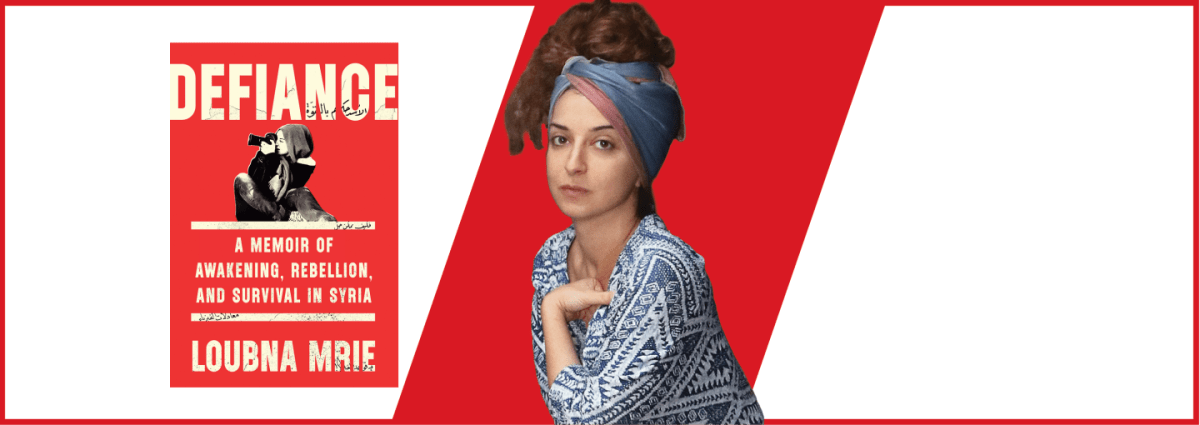
A Review of Loubna Mrie’s Defiance: A Memoir of Awakening, Rebellion, and Survival in Syria
by Rashad Ali
Loubna Mrie’s life reflects the fractures of her homeland. The Syrian writer, activist, and photojournalist was born into a position of privilege within Syria’s former social arrangement. She belongs to the Alawite religious minority—the same sect as the Assad regime. Her father was a powerful, sinister figure embedded in the state’s security apparatus and rumored to be an assassin. Raised in Damascus and the coastal town of Jableh, Mrie was subjected to strict Ba’ath party indoctrination alongside an intensely abusive home life.¹
During the 2011 Arab Spring, her life changed dramatically when she broke with her family to join the pro-democracy resistance. Mrie became a citizen journalist, eventually working the frontlines for Reuters. This choice came at an immeasurable personal cost: she was branded a traitor by parts of her community and her mother was murdered in “retaliation”. Following years of harrowing frontline exposure and post-traumatic stress, Mrie sought asylum in New York City, where she now operates as a researcher and commentator on Middle Eastern affairs.²
Defiance: A Memoir of Awakening, Rebellion, and Survival in Syria (2026) is an unflinching, intimate exploration of the intersection between domestic tyranny and state-sponsored authoritarianism. The narrative charts Mrie’s journey from a sheltered, youth with certain convictions into a battle-hardened war photographer. The book purposefully avoids simplified hindsight, offering instead a raw, highly vulnerable look at personal mistakes, self-destructive coping mechanisms, and grief.³ Rather than presenting a clean, romanticised victory lap for the revolution, the memoir serves as a complex psychological excavation. It forces readers to grapple with the generational trauma of a fractured country, culminating in Mrie’s reflections in New York as she processes the historic collapse of the Assad regime.⁴
Syrian war literature has proliferated in the aftermath of the uprising. Mrie’s work shares a thematic foundation with broader resistance literature written by authors from minority communities. These texts provide a rare, insider perspective on how a dictatorship weaponizes minority fears of persecution to justify autocracy.⁵ Unlike other authors who maintain an investigative distance, relying heavily on interviews and second-hand testimony to map collective trauma, Mrie’s narrative is more personal and autobiographical. She focuses on how her defection tore her own family apart, anchoring the social and political tragedy within a deeply personal coming-of-age story, with the war in the foreground rather than a mere backdrop.
The parallel between totalitarian rule and domestic abuse is a recurring theme in modern memoirs of conflict, where writers utilise the domestic sphere to mirror the crumbling socio-political reality of a nation. These accounts seamlessly blend the struggle against state tyranny with a rebellion against patriarchal household violence.⁶ Yet, unlike authors who write with the wide-angle lens of a diaspora journalist returning to reclaim or document an ancestral family home, Mrie writes with the urgency and immediacy of a witness. Her domestic prison is active and threatening, rendering her escape from her father’s house a literal flight for survival.
Writers frequently capture the exhausting, bureaucratic horror of navigating a land carved up by checkpoints, airstrikes, and extremism, showcasing the numbing of the human spirit required to survive.⁷Mrie leans entirely into unfiltered transparency. She immerses readers in her flawed, youthful recklessness. Where fictional accounts abstract these wounds into philosophical commentary on human resilience, Mrie forces the reader to confront reality as she experienced it.
Mrie’s depiction of an omnipresent security apparatus has the resonances of classic prison literature. However, it differs in how it defines captivity. Unlike authors who focus strictly on physical incarceration and the claustrophobic walls of structural state prisons, Mrie treats her entire childhood environment, including her family home as a panoptic prison.⁸ Furthermore, these works differ in how they approach life after captivity. Unlike traditional conflict narratives that bind their focus tightly to surviving the immediate cells or battlezones, Mrie dedicates significant space to the exhausting, the messy afterlife of a survivor. She details her subsequent battle with PTSD and addiction in exile, broadening our understanding of war trauma to include the quiet, post-conflict collapse of the individual long after escaping the geographical locus of the conflict.
On the frontlines of Aleppo, Mrie’s photojournalism strongly mirrors the feminist lens found in raw wartime documentaries and frontline journalism. A common and unescapable reality is the documenting of the horrors of barrel bombs and targeted airstrikes, Mrie doesn’t take a detached, or so-called objective tone of conventional Western war reporting, rather she embeda her own stories and heartbreaks directly into the combat zones.⁹ Mrie’s narrative is driven by the perspective of a grieving daughter. Her family legacy is one of violent fracture, defined by her father’s orchestration of her mother’s murder. In contrast to some other accounts that have been well documented and present themselves as an act of devotion to a child’s future, Mrie is forced to look back.
The challenging non-linear journey of constructing an identity in exile links Defiance to broader anthropological and sociological compilations of displacement. These texts address the immense grief of refugee life and the challenge of navigating host nations that demand strict gratitude for basic survival.¹⁰ However, in contrast to other authors who act primarily as curators, stitching together a mosaic of dozens of diverse voices to represent a collective movement, Mrie’s approach is personal. Her narrative stands out precisely because it avoids a curated, generalised diaspora narrative. By diving inward to document her own self-destructive habits, specific heartbreaks, and eventual recovery in New York, Mrie provides a raw, individual case study that uniquely showcases the profound psychological cost of shifting loyalties.
Defiance: A Memoir of Awakening, Rebellion, and Survival in Syria is a vital addition to contemporary literature, serving as far more than a personal account of war. For the interested reader, Mrie delivers an exceptionally humanized perspective on a conflict often reduced to cold statistics or distant geopolitical commentary. By weaving together her personal coming-of-age story with the broader national uprising, she demonstrates how political choices dictate individual lives. Her unvarnished look at trauma, grief, and survival avoids the trap of clean, romanticized heroism, offering instead a deeply honest reflection on the emotional and physical costs of fighting for freedom.
For the policy maker, the memoir provides a rare, necessary look at the inner workings of an autocratic regime from a writer raised within its loyalist ranks. Mrie’s testimony reveals how deeply totalitarian states depend on internal indoctrination, familial control, and the systemic subjugation of women to maintain political power. Her insights highlight why standard, top-down diplomatic solutions often fail when dealing with regimes built upon entrenched domestic and state violence. The book serves as a stark reminder that international policy must account for the deep sectarian fears and psychological manipulation weaponized by authoritarian rulers to suppress democratic movements.
For human rights advocates, Defiance acts as an indispensable case study on the mechanics of dissent and the profound vulnerabilities faced by frontline citizen journalists. Mrie’s journey underscores the absolute necessity of protecting local, independent voices who risk everything to document atrocities when international media is barred from the ground. Her exploration of the messy, painful realities of exile and post-traumatic stress challenges advocacy groups to think beyond immediate physical rescue. It iss a call for the long-term psychological rehabilitation, dignity, and rebuilding of displaced survivors who continue to carry the heavy wounds of war.¹¹
¹ Loubna Mrie, Defiance: A Memoir of Awakening, Rebellion, and Survival in Syria (New York: Viking/Penguin, 2026), 12–45.
² Ibid., 50–75.
³ See critical receptions praising this unfiltered vulnerability, such as Sally Hayden, “Defiance by Loubna Mrie: A gripping, devastating account of a Syrian woman’s revolution,” The Irish Times, April 4, 2026; and Julia M. Klein, “Candid and absorbing,” The Los Angeles Times, February 24, 2026.
⁴ Mrie, Defiance, 280–312.
⁵ For a broader exploration of this internal defection from an Alawite perspective, see Samar Yazbek, A Woman in the Crossfire: Diaries of the Syrian Revolution (London: Haus Publishing, 2012) and The Crossing: My Journey to the Shattered Heart of Syria (London: Rider, 2015), which use journalistic and testimonial approaches to counter the regime’s sectarian propaganda.
⁶ The theme of utilizing the ancestral or domestic home as a micro-level mirror for the collapse of the state is a prominent literary device. For an expansive, multi-generational exploration of this theme, see Alia Malek, The Home That Was Our Country: A Memoir of Syria (New York: Nation Books, 2017).
⁷ For an alternative literary approach where the psychological exhaustion of navigating checkpoints and trauma is channeled into dark, existential fiction and road-trip allegory rather than direct memoir, see Khaled Khalifa, Death Is Hard Work (New York: Farrar, Straus and Giroux, 2019).
⁸ Traditional Syrian prison literature frequently limits its scope to the physical cells of structural state incarceration. For the seminal text detailing the architectural and psychological torture inside the state apparatus, see Mustafa Khalifa, The Shell: Memoirs of a Hidden Observer (London: Interlink Books, 2019).
⁹ This intimate, non-objective feminist gaze on frontline combat and civilian sieges closely mirrors visual documentation of the war, most notably the cinematic framing found in Waad Al-Kateab, dir., For Sama (Channel 4 Action Films, 2019). However, Al-Kateab frames the trauma around motherhood and the future of a child, whereas Mrie frames it around daughterhood and the loss of a mother.
¹⁰ For an expansive sociological collection that uses oral histories to curate a polyphonic, collective mosaic of the Syrian diaspora experience rather than an individual case study, see Wendy Pearlman, We Crossed a Bridge and It Trembled: Voices from Syria (New York: HarperCollins, 2017).
¹¹ For additional analysis on the intersection of human rights advocacy, trauma in exile, and Syrian frontline reporting, see critical policy reviews and humanitarian reception surrounding Mrie’s work, including the LSE Middle East Centre Blog review, January 22, 2026.
 P U L S E