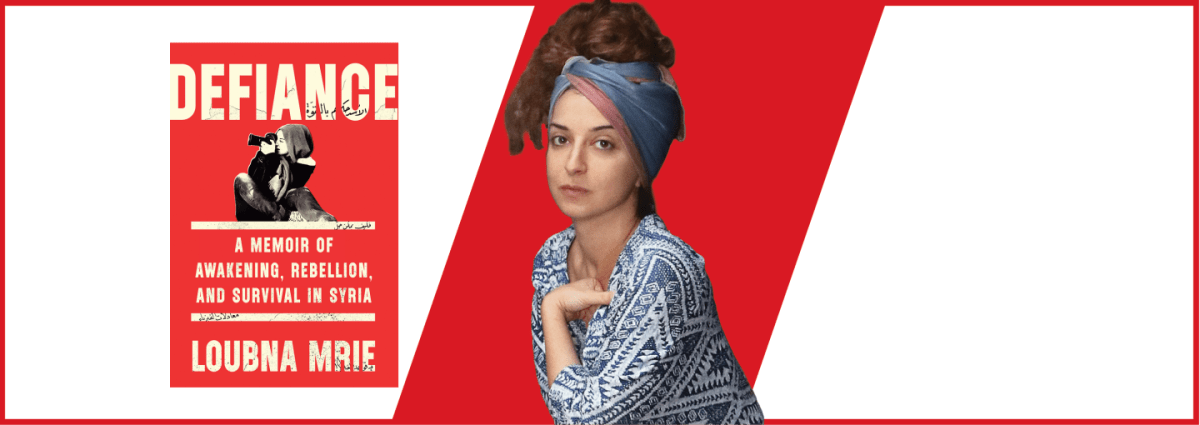
A Review of Loubna Mrie’s Defiance: A Memoir of Awakening, Rebellion, and Survival in Syria
by Rashad Ali
Loubna Mrie’s life reflects the fractures of her homeland. The Syrian writer, activist, and photojournalist was born into a position of privilege within Syria’s former social arrangement. She belongs to the Alawite religious minority—the same sect as the Assad regime. Her father was a powerful, sinister figure embedded in the state’s security apparatus and rumored to be an assassin. Raised in Damascus and the coastal town of Jableh, Mrie was subjected to strict Ba’ath party indoctrination alongside an intensely abusive home life.¹
During the 2011 Arab Spring, her life changed dramatically when she broke with her family to join the pro-democracy resistance. Mrie became a citizen journalist, eventually working the frontlines for Reuters. This choice came at an immeasurable personal cost: she was branded a traitor by parts of her community and her mother was murdered in “retaliation”. Following years of harrowing frontline exposure and post-traumatic stress, Mrie sought asylum in New York City, where she now operates as a researcher and commentator on Middle Eastern affairs.²
Defiance: A Memoir of Awakening, Rebellion, and Survival in Syria (2026) is an unflinching, intimate exploration of the intersection between domestic tyranny and state-sponsored authoritarianism. The narrative charts Mrie’s journey from a sheltered, youth with certain convictions into a battle-hardened war photographer. The book purposefully avoids simplified hindsight, offering instead a raw, highly vulnerable look at personal mistakes, self-destructive coping mechanisms, and grief.³ Rather than presenting a clean, romanticised victory lap for the revolution, the memoir serves as a complex psychological excavation. It forces readers to grapple with the generational trauma of a fractured country, culminating in Mrie’s reflections in New York as she processes the historic collapse of the Assad regime.⁴
Continue reading “Unveiling the Panoptic State”
 P U L S E