On Songs of Blood and Sword

by Saffi Ullah Ahmad

In her latest book, Songs of Blood and Sword: A Daughter’s Memoir, journalist Fatima Bhutto — better known as the niece of the late Benazir Bhutto — takes us through the dark history of one of the world’s best known political dynasties.

Fatima’s grandfather, founder of the Pakistan People’s Party (PPP) and Pakistan’s first democratically elected Prime Minister, Zuliqar Ali Bhutto, was sent to the gallows (1979) following a military coup orchestrated by General Zia Ul-Haq based on what were concocted charges, despite appeals for mercy from across the diplomatic world. As Henry Kissinger had ominously threatened some years earlier, a ‘horrible example’ was made of Mr. Bhutto. As the book’s cover informs us, in the years since Zulfiqar Ali Bhutto’s execution, all but one of his children have died; in circumstances mired in mystery, Shahnawaz Bhutto was poisoned in his flat in France (1985), Mir Murtaza Bhutto – Fatima’s father – was gunned down outside his home in Karachi (1996) and Benazir Bhutto was killed following a suicide attack in the garrison city, Rawalpindi (2007).

Above all, Songs of Blood and Sword is the tale of a grieving daughter’s frantic six year search for the truth surrounding her father’s life and death. Fatima describes a kind spirited and idealistic Murtaza, a man of the people, who had idolised Che Guevara in his youth, fittingly having adorned his bedroom walls with posters of the Cuban revolutionary. After completing studies at Harvard and an unsuccessful diplomatic battle to save his father’s life, Murtaza’s formation of a leftist guerrilla outfit bent on ousting General Zia earned him the title of a terrorist. Following the General’s own mysterious death (1988) and Benazir’s rise to power, Murtaza grew increasingly critical of his sister, who he felt had betrayed the socialist ideals upon which the PPP was founded. He eventually returned to Pakistan with political aspirations – having won a seat in a provincial assembly – only to face an uphill struggle against a hostile PPP government.


Continue reading “On Songs of Blood and Sword”

Chalmers Johnson, RIP

Chalmers Johnson

The great Chalmers Johnson is no more. An examplary scholar, Johnson metamorphosed from a hardline Cold Warrior into one of the most formidable critics of the American Empire, mapping its ever expanding imperium of bases. His 2000 book Blowback was prophetic, and his subsequent books The Sorrows of Empire and Nemesis have been equally prescient. Each one is a must read.

Here is (to the best of my knowledge) the last recorded interview with Johnson in which he discusses his latest book, Dismantling the Empire, which I haven’t had the pleasure of reading yet:

Continue reading “Chalmers Johnson, RIP”

Olbermann and Turley on the prospects of Bush being prosecuted

Outposts

Avocadoes

Whatever the Western media calls them, the illegal Jewish settlements on the West Bank are very far from being outposts. They are connected to Jerusalem and Tel Aviv by fast, Jews-only motorways. Their villas have swimming pools and lawns (a settler is allocated eight times more water than a Palestinian). Even the most recent and farflung of settlements are tooled-up enough to intimidate the Arabs on whose land they encroach.

It’s the Palestinian villages which feel like outposts, although some have been settled for thousands of years. Even when they’re close to major cities they are vulnerable, intermittently cut-off, and surrounded by wolves (or boars).

An example is Iraq Burin, a mountain-top village just a kilometre from Nablus but one trapped behind a checkpoint. Not only are the villagers unable to access city shops and services, they face violent harrassment from soldiers and armed men from the nearby Bracha settlement.

There’s an unarmed ‘popular’ struggle against land confiscation being waged here. It involves weekly demonstrations which are met by tear gas and sometimes bullets (in March two teenagers were killed). Similar protests are held in villages all over the West Bank, most famously in Bil’in, Nil’in and Budrus.

Continue reading “Outposts”

Labour or Tory: London doesn’t want Bush

Back in 2003, Mayor of London Ken Livingstone had declared George W. Bush ‘the greatest threat to life on earth,’ and said he was unwelcome in the great city. Now his Tory successor Boris Johnson has recorded his own displeasure at Bush’s prospective visit with equal eloquence. Here is the mayor in his own words:

It is not yet clear whether George W Bush is planning to cross the Atlantic to flog us his memoirs, but if I were his PR people I would urge caution. As book tours go, this one would be an absolute corker. It is not just that every European capital would be brought to a standstill, as book-signings turned into anti-war riots. The real trouble — from the Bush point of view — is that he might never see Texas again.

One moment he might be holding forth to a great perspiring tent at Hay-on-Wye. The next moment, click, some embarrassed member of the Welsh constabulary could walk on stage, place some handcuffs on the former leader of the Free World, and take him away to be charged. Of course, we are told this scenario is unlikely. Dubya is the former leader of a friendly power, with whom this country is determined to have good relations. But that is what torture-authorising Augusto Pinochet thought. And unlike Pinochet, Mr Bush is making no bones about what he has done.

Unless the 43rd president of the United States has been grievously misrepresented, he has admitted to authorising and sponsoring the use of torture. Asked whether he approved of “waterboarding” in three specific cases, he told his interviewer that “damn right” he did, and that this practice had saved lives in America and Britain. It is hard to overstate the enormity of this admission.

Continue reading “Labour or Tory: London doesn’t want Bush”

Catch the London Russell Tribunal on Palestine Live

Watch the Russell Tribunal on Palestine London Session live on November 20/21. Find more information here. Video by Leah Borromeo.

Miral

It will not come to a threatre near you soon; it might if you insist.

Our friend Adam Horowitz thinks it has the potential to become this generation’s Exodus.

On Guantánamo, Obama Hits Rock Bottom

by Andy Worthington

(Photo: AP/Brennan Linsley)

On national security issues, there are now two Americas. In the first, which existed from January to May 2009, the rule of law flickered briefly back to life after eight years of the Bush administration.

In this first America, President Obama swept into office issuing executive orders promising to close Guantánamo and to uphold the absolute ban on torture, and also suspended the much-criticized system of trials by Military Commission used by the Bush administration to secure just three contentious convictions in seven years.

In addition, in April 2009 he complied with a court order to release four “torture memos” issued in 2002 and 2005 by lawyers in the Justice Department’s Office of Legal Counsel, which purported to redefine torture so that it could be used by the CIA (in 2002), or broadly upheld that decision (in 2005). As well as confirming the role of the courts in upholding the law, these documents contained important information for those hoping to hold senior Bush administration officials and lawyers accountable for their actions in the “War on Terror.”

The final flourish of this period was the decision to move a Guantánamo prisoner to New York to face a federal court trial, which took place in May 2009. Ahmed Khalfan Ghailani, a Tanzanian seized in Pakistan in July 2004, was held in secret CIA custody for over two years, until he was moved to Guantánamo in September 2006, with 13 other men regarded as “high-value detainees.”

Continue reading “On Guantánamo, Obama Hits Rock Bottom”

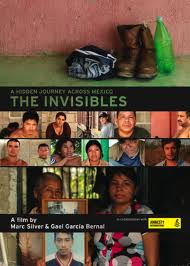
The Invisibles: A Hidden Journey Across Mexico

Mexican actor/director Gael García Bernal and British director Marc Silver have recently collaborated with Amnesty International in a series of four short films, entitled “The Invisibles”. The films draw attention to the plight of Central American immigrants traveling across Mexico in order to reach the U.S.

Watch “The Invisibles” here, and read Amnesty’s full 2010 report entitled “Invisible Victims: Migrants on the Move in Mexico“.

Following is a brief excerpt from Amnesty’s website, which gives an idea of the situation currently faced by migrants:

Kidnappings of migrants, mainly for ransom, reached new heights in 2009, with the National Human Rights Commission (CNDH) reporting that nearly 10,000 were abducted over six months and almost half of interviewed victims saying that public officials were involved in their kidnapping.

An estimated six out of 10 migrant women and girls experience sexual violence, allegedly prompting some people smugglers to demand that women receive contraceptive injections ahead of the journey, to avoid them falling pregnant as a result of rape.

Continue reading “The Invisibles: A Hidden Journey Across Mexico”

Epilogue on Tony Benn

Me chewing the fat with Ken Livingstone and Nadifa Mohamed.

More after the break..

Continue reading “Epilogue on Tony Benn”