This film tells the story of five days in January 2011 when the people of Egypt broke through a barrier of fear they had known for a generation and rose in revolt against their president. Egypt Burning captures those critical moments as history unfolded through interviews with Al Jazeera correspondents on the ground. Their coverage of this popular uprising, which has once again proven Al Jazeera’s indispensable role in today’s global media landscape, made them the target of a state campaign to get their channel off the air.
Month: February 2011
Breaking Knees

Zakaria Tamer’s “Breaking Knees” tugs us rushing straight into the Big Topics: religion, politics, sex and death. It deals with imprisonment, literal and figurative, its characters entrapped in unhappy marriages and by their personal inadequacies, ignorances and fears, as well as by dictatorship, bureaucracy and corrupt tradition. It sounds grim, but “Breaking Knees” is a very funny book.
Tamer is a well-known Syrian journalist and writer of children’s books. His literary reputation, however, rests on his development of the very short story (in Arabic, al-qissa al-qasira jiddan), of which there are 63 here. Each is a complex situational study, a flash of life or nightmare, each with at least one beginning, middle and end. Some are as clear as day; some are seriously puzzling. Some are no more than extended, taboo-breaking jokes.
It’s certainly satire. Tamer uses an elegant, euphemistic language (referring, for instance, to “that which men have, but not women”) to tell some very plain tales. Delicious irony abounds. In bed an adulterous woman begs her lover “not to soil the purity of her ablutions.” In the street afterwards she frowns at a woman without a headscarf and says “in a voice full of sadness that immoral behaviour had become widespread.”
Departure Day
a poem by Naomi Foyle

for Egypt
Everywhere, the revolution
nods off in the wings, misses its cue
and the long-scripted farce bangs another door
in the face of the people
Here, the people resist
each other, the television flattens
and expands against the wall
until it is the wall
and its cold grey plasma
seeps like damp into our lungs.
There, it is blood that rises
in the back of the throat
spills on the pavement
with the little girl’s mango juice
and as she cries, the revolution
jerks awake, not too late
to bring the house down.
Revolution In The Head And The Art Of Protest
A documentary about Rage Against The Machine by See of Sound.
Arguably the most provocative band of the last 20 years, Rage Against The Machine have since their explosive debut, been the group most associated with the American protest movement. This film dissects the work and career of RATM and looks at their place in this always fascinating lineage of artists and performers who have spoken out on behalf of, and drawn attention to, the world’s marginalised, downtrodden and oppressed. Picking up the flame from a linear musical tradition going back to the War Of Independence, with the best known protagonists coming up during the 1950s and 60s civil rights movement via artists such as Pete Segar and the young Bob Dylan, the anger remained as brutal as ever during the final decade of the 20th Century in Rage and contemporaries like Public Enemy. FEATURING: Brand new interviews with; renowned Rage producer and engineer, Garth Richardson; RATM Biographer, Colin Devenish; the band’s live sound engineer, Dave ‘Rat’ Levine and the man who signed them Michael Goldstone. With further contributions from folk-protest singer and author Jerry Silverman, ex-‘Rolling Stone’ editor Joe Levy, and Professor of American Studies and English at Washington State University, T.V. Reed.
Democracy in Action
The Guardian publishes Ahdaf Soueif’s dairy from Cairo. “What we have here,” she writes, “is the opposite of a vacuum; we have democracy in action on the ground in Tahrir Square. We are full of hope and ideas, and our gallant young people are guarding our periphery.”
As you start reading this, you will know something I don’t: you will know how this day – Friday 4 February – has turned out for us. I’m writing this at 7am. I slept in my brother’s house last night, so now I’m hearing different patterns of birdsong and muffled conversation from the street. The renewed pro-democracy protests are set to start soon and we shall all make our way to Tahrir Square. We shall be families – with the young people in the lead. We’ve called friends who’ve spent the night in the square. They say everything’s quiet.
On Thursday the new vice-president said the protests had to end. And the new prime minister stated he had no idea how violence came to happen on Wednesday in Tahrir, but that it would be investigated and, meanwhile, he was apologising to the people. And meanwhile, also, the government’s battalions of violent-crime-record personnel and plainclothes security forces were being moved around the city, yelling and brandishing banners and weapons and confronting protesters.
But let’s do this in sequence. These are short extracts from my diaries of these days …
Egyptian unrest and US media bias
The coverage of Egyptian uprising in the TV Channels across US have been criticised for being both pessimistic and superficial. Since the pro-democracy protests began, the mainstream American media has focused sharply on what it all means for the U.S. and its allies in the region.
Zizek and Ramadan on future of Egypt
Zizek is in fine form on the Riz Khan Show. In a recent op-ed he noted that
the most shameful and dangerously opportunistic reaction was that of Tony Blair as reported on CNN: change is necessary, but it should be a stable change. Stable change in Egypt today can mean only a compromise with the Mubarak forces by way of slightly enlarging the ruling circle. This is why to talk about peaceful transition now is an obscenity: by squashing the opposition, Mubarak himself made this impossible. After Mubarak sent the army against the protesters, the choice became clear: either a cosmetic change in which something changes so that everything stays the same, or a true break.
The revolutionary chants on the streets of Egypt have resonated around the world, but with a popular uprising without a clear direction and an unpopular leader refusing to concede, Egypt’s future hangs in the balance. Riz Khan talks to Muslim scholar Tariq Ramadan and Slovenian philosopher Slavoj Zizek about the power of popular dissent, the limits of peaceful protest and the future of Egyptian politics.
The Dogs of The State
At 0.50 a police vehicle drives into a peaceful crowd, eliciting cries such as “the dogs of the state!” This is the regime apparatus that co-opted sections of the Egyptian elite and their international backers are trying to save, with or without Husni Mubarak.
‘Little’ Protests, Big Erasures
In a recent interview with Guantanamo reporter Carol Rosenberg, Col. Thomas, a Joint Detention Group Commander at Guantanamo Bay, has stated that Guantanamo Bay detainees are not, in fact, engaged in protests. His claims emerge in response to a joint press release issued by the Center for Constitutional Rights and CUNY Law School on Jan 27th. In that report, lawyers in conversation with their clients at GTMO confirmed that detainees had, in light of the protests taking place across the Middle East, been staging sit-ins protesting their ongoing indefinite detention at GTMO.
But according to Col. Thomas, detainees are neither holding sit-ins, nor particularly moved by the events unfolding across the Middle East. Instead, Col. Thomas — in an attempt to “set the record straight”– tells us that detainees are actually far more engrossed in following soccer tournaments. I suppose it’s no coincidence that in presenting this as the ‘real’ state of affairs, Guantanamo Bay gets fashioned as an entertainment-complex, the kind of place where violations of the law could not possibly be occurring.
Col. Thomas’ statements are not only remarkably pithy, but also remarkably incoherent: “Of course they’re aware of what’s going on in Egypt, but, no, they are not participating in the unrest that is going on in those countries.” “Signs that go up from time to time in the cell blocks are focused on “discontent” — not the faraway protests.” “We deal with detainee complaints every day. It’s not related to anything that’s going on in any way in Egypt or Tunisia.”
What are we to make of these statements? Nowhere in the reports by lawyers, or in the press release issued by CUNY Law and the Center for Constitutional Rights, is the claim being made that detainees were protesting against Egypt’s Hosni Mubarak or Tunisia’s Ben Ali, and yet each and every one of Thomas’ statements appears to be in response to this non-existent claim. A sneaky maneuver, no doubt, that enables Thomas to evade the accusation of lying, even if the ‘truth’ being told pertains to matters that no-one is contesting.
What CCR and CUNY’s joint press release does suggest, and what Col. Thomas does not address, is the fact that detainees have been following the events unfolding in Middle East, and that their own sit-ins were ‘inspired’ by events abroad. While it is true that the statements of detainees, and the signs they are reported to have made, express discontent, this discontent should be interpreted not — as Col. Thomas would have us believe– as an unremarkable everyday occurrence, but as a direct response to the U.S. administration’s actions in freezing the transfer of detainees cleared for release, and their ongoing indefinite imprisonment.
To frame the recent protests at GTMO in any other light, is an act of negation or, more strongly, erasure.
Egyptian Riot Grrls: Finding the Feminine Face of Fury
by Beenish Ahmed
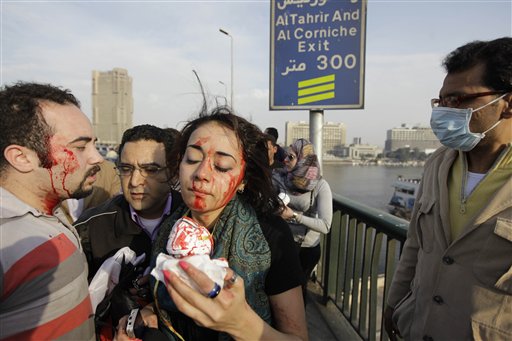
Much has been aflutter on twitter about the very visible presence of women among the protests that have taken Egypt by storm over the last few weeks, but images of them have remained sparse amid the digital slideshows strung together by major media outlets, portraying mainly dense crowds of the manly.
What falls within these frames does not necessarily paint a full picture, since as Egyptian Organization for Human Rights activist Ghada Shahbandar claims, the crowd in downtown Cairo is up to 20 percent female. Others have put the number much higher, at 50 percent.
Although they are less prevalent, some efforts have been made to depict the role of women this popular uprising. The Global Post put together a slideshow on the Women of Egypt among the March of Millions in Tahrir Square, and a compilation of photographs from various sources can be found on sawt al niswa, a self-described “feminist webspace.”
A quick look through the reels of these images reveals the feminine side of fury and eliminates any remaining shred of doubt that the issues of unemployment and corruption that are widely cited as the primary causes for this unrest effect only men.
Continue reading “Egyptian Riot Grrls: Finding the Feminine Face of Fury”
 P U L S E