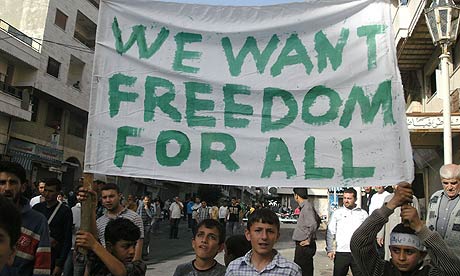
Spontaneous Expression of Love

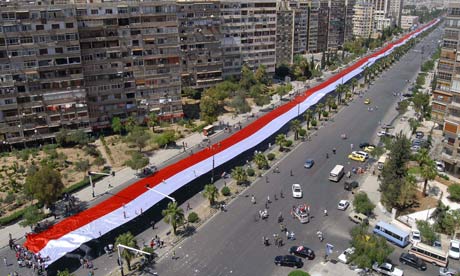
photo by Muzaffar Salman/AP

The regime brought thousands of supporters onto the streets of Damascus today. The picture shows them carrying a two-kilometre-long flag along Mezzeh Autostrade – this supposedly proves that the regime, despite its mass murder of Syrian civilians, is a patriotic one. Some of the loyalist demonstrators will be genuine supporters of the president. Many will be civil servants, teachers and schoolchildren told to do their duty. That’s how official demonstrations work in Syria.

I remember the run-up to the final referendum on Hafez al-Asad’s reign. Every night extended news bulletins screened grim-faced crowds shaking their fists on snowy hillsides or stiffly dancing debke in enormous stadiums. The newsreaders described these spectacles as spontaneous expressions of joy and loyalty. When the president won 99.something percent of the vote, the newsreaders called it ‘a marriage of people and leader.’

In honour of today’s occasion, I’m reposting the short story below. It’s inspired by an organised riot which I witnessed in Damascus in the late 1990s.

The Screen

There were no classes. Instead we marched down to the square and began to shout slogans. At first the teachers led us but soon we got into a group with no teachers and we could shout what we wanted.

Ya Blair Ya haqeer

dumak min dum al-khanzeer

O Blair, you are mud

Your blood is swine’s blood

Continue reading “Spontaneous Expression of Love”

‘Iran got no nukes and US knows that’

Lucy Kafanov of RT interviews legendary journalist Seymour Hersh about his most recent article on Iran and the Obama administration’s attempts to discredit him.

Washington is ignoring its own intelligence because it is hell-bent on finding nuclear weapons that do not exist, Pulitzer-winning investigative journalist Seymour Hersh told RT.

War of 33, Letters from Beirut

The War of 33, a Big Noise Film production, is “an intimate, personal and powerful telling of the story of the 2006 war in Lebanon.”

Continue reading “War of 33, Letters from Beirut”

The magical realism of body counts

The following article appeared on Al Jazeera. (in Spanish in Rebelión). You can hear my interview with PressTV here. Andrew Sullivan quotes me on his influential blog the Daily Dish and Natasha Lennard quotes me over at Salon.

Gravediggers of Afghanistan and Pakistan have been kept busy as the US drone war has expanded, but civilian deaths remain undercounted as mendacious officials build a myth of technological accuracy and violent ‘justice’ (REUTERS)

A gypsy named Melquiades who died many years ago in Singapore returned to live with the family of Colonel Aureliano Buendia in Macondo, because he could no longer bear the tedium of death. These are the kinds of characters that populate Gabriel Garcia Marquez’s magnificent work One Hundred Years of Solitude. Today they also seem to occupy the tribal badlands of Pakistan’s north-western frontier.

On June 3, when Ilyas Kashmiri was killed in a US drone strike, he had already been dead for over a year. In September 2009, the CIA claimed that it killed Kashmiri along with two other senior Taliban leaders in North Waziristan. But the lure of the limelight was seemingly irresistible even in death, because on October 9, Kashmiri returned to give an interview to the late Syed Saleem Shahzad of Asia Times Online.

Baitullah Mehsud, the former commander of the Tehreek-e-Taliban Pakistan (TTP), also rose from the dead many times. On at least 16 occasions, Mehsud was in the gun-sights when CIA drones loosed their Hellfire missiles. Yet, until August 2009, he proved unable to settle into the afterlife. Mullah Sangeen also experienced at least two resurrections.

Death is clearly not what it used to be.

Or perhaps the people who were killed in the other attacks were not Kashmiri, Sangeen or Mehsud. Indeed, the attack on a funeral procession on June 23, 2009, which killed Sangeen was supposedly aimed at the TTP chief. It killed 83 people who certainly were not who they were supposed to be.

These are not isolated events. At the end of 2009, the Pakistani daily Dawn calculated that, of the 708 people killed in 44 drone attacks that year, only 5 were known militants. Earlier that year, The News, Pakistan’s other major English-language daily, had calculated that between January 14, 2006, and April 8, 2009, 60 drone attacks killed 701 people – of whom only 14 were known militants.

You can read the rest here

Selmiyyeh?

This piece was published at Foreign Policy.

Selmiyyeh, selmiyyeh” — “peaceful, peaceful” — was one of the Tunisian revolution’s most contagious slogans. It was chanted in Egypt, where in some remarkable cases protesters defused state violence simply by telling policemen to calm down and not be scared. In both countries, largely nonviolent demonstrations and strikes succeeded in splitting the military high command from the ruling family and its cronies, and civil war was avoided. In both countries, state institutions proved themselves stronger than the regimes that had hijacked them. Although protesters unashamedly fought back (with rocks, not guns) when attacked, the success of their largely peaceful mass movements seemed an Arab vindication of Gandhian nonviolent resistance strategies. But then came the much more difficult uprisings in Bahrain, Libya, and Syria.

Even after at least 1,300 deaths and more than 10,000 detentions, according to human rights groups, “selmiyyeh” still resounds on Syrian streets. It’s obvious why protest organizers want to keep it that way. Controlling the big guns and fielding the best-trained fighters, the regime would emerge victorious from any pitched battle. Oppositional violence, moreover, would alienate those constituencies the uprising is working so hard to win over: the upper-middle class, religious minorities, the stability-firsters. It would push the uprising off the moral high ground and thereby relieve international pressure against the regime. It would also serve regime propaganda, which against all evidence portrays the unarmed protesters as highly organized groups of armed infiltrators and Salafi terrorists.
Continue reading “Selmiyyeh?”

The murder of Syed Saleem Shahzad

I’ll be reviewing Syed Saleem Shahzad’s book here shortly. Meanwhile here is ‘Pakistan: The most dangerous place to report from,’ an episode of  Al Jazeera’s Listening Post which focuses on his assassination.

JPost editor David Horovitz embarrasses himself

On Friday, editor of The Jerusalem Post David Horovitz published a comment piece under the title, ‘Guess what: Our enemies lie‘. Discussing the recent Nakba and Naksa protests, the emphasis of the op-ed was that the IDF “continues to pay a high price for its incomprehensible refusal to counter, in real time, the relentless distortion of unfolding events and, especially, the falsehoods about death tolls”.

Horovitz eventually gets round to expanding on his allegation of “the false reporting of death tolls”, and he starts by citing the example of Jenin in 2002, when, in his words, the IDF “was despicably accused by the Palestinian leadership, in numerous international media outlets, of killing hundreds if not thousands of unarmed Palestinians”.

He goes on:

The ultimately confirmed figures indicated some 55 armed Palestinian and 23 IDF fatalities in Jenin, but by the time those numbers emerged Israel had been besmirched worldwide as an indiscriminate mass killer, its name blackened even by some of its erstwhile supporters.

Now if you’re going to write an article on false death tolls, you had better make sure you get your own facts right. Unfortunately for Horovitz, he didn’t.

In their report on events in Jenin, Human Rights Watch documented that “at least twenty-two of those confirmed dead were civilians, including children, physically disabled, and elderly people”. Moreover, “many of the civilian deaths” amounted to “unlawful or willful killings by the IDF” – and some “amounted to summary executions”.

An early assessment by Physicians for Human Rights, using hospital figures of 45 dead, noted that “children under the age of 15 years, women and men over the age of 50 years accounted for nearly 38% of all fatalities.” Amnesty International also recorded “unlawful killings” by the IDF in Jenin.

But for Horovitz, the “ultimately confirmed figure” was “55 armed Palestinians”. As with so much propaganda by Israel’s apologists, this latest complaint about ‘false death tolls’ turns out to be a case of projection.

Peace Caravan Encounters Massacres, Military Abuses and Disappearances in Torreón

Man beaten by Mexican soldiers

by Kristin Bricker

This article first appeared at the Americas Program.

Gunmen armed with AR-15 and AK-47 assault rifles massacred thirteen people in a Torreón drug rehabilitation center on Wednesday. The massacre occurred less than twenty-four hours before poet Javier Sicilia and his Citizens Caravan for Peace with Justice and Dignity were scheduled to arrive in Torreón for a rally against the drug war. The rehabilitation center is located just three blocks from the rally site.

Despite suspicions amongst some caravan participants that the massacre was an attempt to scare them away from Torreón, Sicilia refused to cancel the event in that city. “The march absolutely will not be postponed,” Sicilia told a press conference in Monterrey just before the caravan left for Torreón.

When the caravan arrived in Torreón, puddles of dried blood still filled the bullet-ridden rehabilitation center and ran out the door onto the sidewalk.

Sicilia had no choice but to hold the event as planned in Torreón. In a city ravaged by massacres, military abuses, journalist assassinations, and disappearances, residents risked their lives by simply organizing the anti-war rally.

According to participants, the massacre did have an impact on turnout though. “We live in constant fear,” said one protester. “There were people who wanted to be here today, but yesterday’s attack made them want to stay shut inside their homes.”

Olga Reyes Salazar, who has suffered the murder of six family members over the past two-and-a-half years in Ciudad Juarez, told Torreón residents that they can’t let fear overcome them. “We’re all afraid,” she told the crowd. “But if they keep intimidating us, we’re all just going to lock ourselves in our homes, and they’ll go there to kill us. So let’s leave our homes now and raise our voices against this government that is cruelly killing us.”

Continue reading “Peace Caravan Encounters Massacres, Military Abuses and Disappearances in Torreón”

Mexican Community Uses Barricades to Drive Out Organized Crime and Political Parties

by Kristin Bricker

This article first appeared at Upside Down World.

Armed with machetes, sticks, and farm tools, residents of Cherán, Michoacan, covered their faces with bandanas and set up barricades around their community on April 15. It is a scene reminiscent of Oaxaca in 2006, except this time, the barricades aren’t meant to keep out paramilitary death squads; they keep out organized crime.

The barricades have come at a cost for the town’s 12,600 residents. Schools have been shut down since Easter, and the economy has come to a standstill. However, without the barricades, kidnappers and illegal loggers who are in league with organized crime would continue to prey upon the town with complete impunity. For Cherán’s residents, unabated impunity is unacceptable, because in addition to the usual laundry list of drug war crimes–murder, kidnapping, extortion, and torture–the illegal loggers, protected by organized crime, have destroyed an estimated 80% of Cherán’s woodlands.

When the municipal, state, and federal governments refused to protect Cherán from organized crime, the community took matters into its own hands. Now, not only are they driving organized crime out of they’re community, they’re also kicking out the political parties, whom they blame for allowing insecurity and crime in Cherán to spiral out of control.

Continue reading “Mexican Community Uses Barricades to Drive Out Organized Crime and Political Parties”

The Specter of Syrian Civil War

PULSE editor Robin Yassin-Kassab was on the BBC’s Radio 4 last night to comment on the situation in Syria. You can read his recent post on the subject here.

UPDATE: Jeb Sharp of the BBC interviews Robin for PRI’s The World.