US president Barack Obama today welcomes arguably his least favourite foreign leader to the White House. Israeli prime minister Benjamin Netanyahu’s visit neatly coincides with the annual policy conference of the American Israel Public Affairs Committee (Aipac). That event offers both men a chance to appeal to some of Israel’s most ardent American supporters. We can therefore expect to hear repeated references to the “common interests”, “unshakeable bonds” and “shared values” of the two countries.
This familiar rhetoric is misleading at best and at worst simply wrong. No states have identical interests, and Israel and America are at odds on two vital issues: Iran and the Israeli-Palestinian conflict. Mr Obama should continue to rebuff Israel’s efforts to push him into military confrontation with Tehran, while reminding Mr Netanyahu the true danger to Israel lies in its refusal to allow a viable Palestinian state…
The February TaxCast is out. Once again, I encourage readers to tune in to this excellent program produced by the Tax Justice Network. Hosted by Naomi Fowler, each 15 minute podcast follows the latest news relating to tax evasion, tax avoidance and the shadow banking system. The show will feature discussions with experts in the field to help analyse the top stories each month.
In this month’s show TaxCast asks: Are City of London Police really serious about prosecuting financial crimes? Are bankers paying fair taxes on their bonuses? And how Facebook is saving billions in tax via Ireland and Bermuda.
Two foreign journalists have been killed in Homs, activists say, as shelling of a district of the Syrian city continued amid warnings of an escalating humanitarian crisis.
Omar Shakir, an activist in the city, told Al Jazeera that the deaths of Marie Colvin, a US reporter working for the UK’s Sunday Times newspaper, and French photographer Remi Ochlik occurred as a building used by activists as a media centre was shelled on Wednesday.
Speaking before students at NorthernVirginiaCommunityCollege on February 13, President Obama unveiled his 2013 budget request, in which he proposed “some difficult cuts that, frankly, I wouldn’t normally make if they weren’t absolutely necessary. But they are.” These budget cuts are unavoidable, the President argued, because “the truth is we’re going to have to make some tough choices in order to put this country back on a more sustainable fiscal path.” In a sad commentary on the misplaced priorities of the Obama Administration, however, these “tough choices” will affect the delivery of basic services to U.S. citizens while the Israeli military hits the jackpot at taxpayer expense.
As part of its budget request, the White House released a 205-pagedocument detailing the cuts, consolidations, and savings the Obama Administration is proposing. These proposed cuts include $5 million to the USDA to analyze food-borne pathogens, potentially making the U.S. food supply even less safe than it already is after 30 people died last year after eatinglisteria–infectedcantaloupe; a $359 million cut to the EPA to provide grants to states for water infrastructure projects when an estimated 1.7 million Americans shockingly lack access to basic water and sanitation services according to the WaterInfrastructureNetwork; and a whopping $360 billion cut over ten years in Medicare, Medicaid, and other health programs even though the WorldHealthOrganization rates the U.S. health system as only 37th globally in health care performance.
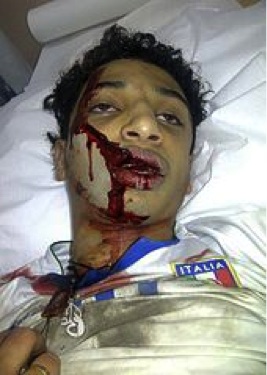
14-year-old Ali Jawad died when a tear gas canister fired at close range smashed his face.
John Timoney is the controversial former Miami police chief well known for orchestrating brutal crackdowns on protests in Miami and Philadelphia- instances with rampant police abuse, violence, and blatant disregard for freedom of expression. It should be of great concern that the Kingdom of Bahrain has brought Timoney and John Yates, former assistant commissioner of Britain’s Metropolitan Police, to “reform” Bahrain’s security forces.
Since assuming his new position, Timoney has claimed that Bahrain has been reforming it brutal police tactics in response to recommendations issued by the Bahrain Independent Commission of Inquiry. He says that there is less tear gas being used and that while tear gas might be “distasteful,” it’s not really harmful.
I have no idea what country Chief Timoney is talking about, because it’s certainly not the Bahrain I saw this past week, a week that marked the one-year anniversary since the February 14, 2011 uprising.
I was in Bahrain for five days before being deported for joining a peaceful women’s march. During my stay, I accompanied local human rights activists to the villages where protests were raging and police cracking down. Every day, I inhaled a potent dose of tear gas, and came close to being hit in the head with tear gas canisters. Every evening I saw the fireworks and smelled the noxious fumes as hundreds of tear gas canisters were lobbed into the village of Bani Jamrah, next door to where I was staying. The villagers would get on their roofs yelling “Down, Down Hamad” (referring to the King). In exchange, as a form of collective punishment, the whole village would be doused in tear gas. I went to bed coughing, eyes burning, wondering how in the world the Bahrainis can stand this.
Christopher Lydon of the excellent Radio Open Source pays tribute to Anythony Shadid.
The death of the reporter Anthony Shadid in Syria — apparently of an acute asthma attack — is a tragic blow to our hope of grasping the Arab turmoil, also to the flickering idea of straight journalism. Three dimensions of our loss come immediately to mind. First, Anthony Shadid (with Nir Rosen on my honor roll) was the rarest instance of a mainstream reporter who gave some of his heart to people on the ground suffering through war in Iraq and chaos in North Africa. Second, in Iraq where he’d won two Pulitzers, he framed his work in the understanding that what American force was about was not liberating Iraq, much less democratizing it, but about destroying a country. Third, he had the temerity to speak with us about one further tragedy: that the honored brand of journalism he practiced had shockingly little impact on American consciousness…
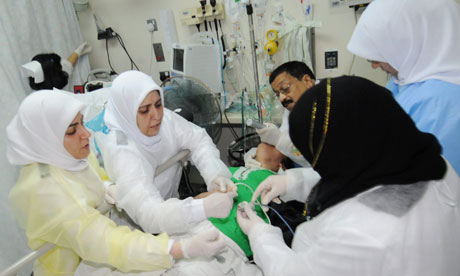
As part of an observer delegation in Bahrain with the peace group Code Pink, I visited the village of Bani Jamrah with local Bahraini human rights activists.
In one of the many horrific cases we heard, a 17-year-old boy Hasan, his friend and his 8-year-old brother left their home to go to the grocery store. As they were entering the store they noticed some other youngsters running. Fearing the police would be following them, they decided to wait in the store. The 8 year old hid behind a refrigerator. The police entered the store with face masks on. They grabbed the older boys, pulling them out of the store and into the street.
Once outside the shop the police began to beat them with their sticks and hit them on the head, shouting obscenities and accusations. The police were accusing them of having been involved with throwing Molotov cocktails, asking over and over “Where are the Molotov cocktails?”
The four policemen, all masked and wearing regulation police uniforms, took turns beating the boys while one was instructed to keep watch to make sure no one was video taping. They seemed to be very concerned that there be no witnesses. Quickly, they forced the boys into the waiting police car. Inside the police vehicle was another youth about 18 who appeared to be “Muhabharat,” or plain-clothes police thugs associated with many dictatorships in the Middle East.
The great Polish poet and Nobel laureate is no more. Katha Pollit of The Nation pays tribute.
In the way that you can be surprised when someone dies, no matter how rationally foreseeable the death is, I was startled to open my New York Times on February 2 and find an obituary for Wislawa Szymborska, the great Polish poet who won the Nobel Prize in 1996. Only 88, I wanted to say. Much too young.
Szymborska’s poems are mostly short, and her output was not voluminous—only around 400 published poems. And yet, she is one of the few contemporary poets you can call beloved and not have it be a condescension or an insult. In TheNew York Review of Books Charles Simic called her poems “poetry’s equivalent of expository writing,” which captures their accessibility, their logical clarity and their interest in facts (especially odd ones), stories, things and people, but doesn’t convey their charm or vitality. Expository writing is, after all, a required class for college freshmen—the opposite of fun, dazzle, originality, pathos. For me, Szymborska’s signature quality is the way she puts tragedy and comedy, the unique and the banal, the big and the little, the remembering and the forgetting, right next to each other and shows us that this is what life is:
After every war
someone has to tidy up.
Things won’t pick
themselves up, after all.
Someone has to shove
the rubble to the roadsides
so the carts loaded with corpses
can get by.


 The death of the reporter
  As part of an observer delegation in Bahrain with the peace group Code Pink, I visited the village of Bani Jamrah with local Bahraini human rights activists.
 In the way that you can be surprised when someone dies, no matter how rationally foreseeable the death is, I was startled to open my New York Times on February 2 and find an obituary for Wislawa Szymborska, the great Polish poet who won the Nobel Prize in 1996. Only 88, I wanted to say. Much too young.
 P U L S E