Conversations with History: Glenn Greenwald

Harry Kreisler talks to Glenn Greenwald in the latest episode of Conversations with History.

Conversations host Harry Kreisler welcomes writer Glenn Greenwald for a discussion of his new book, “With Liberty and Justice for Some.” Greenwald traces his intellectual odyssey; analyzes the relationship between principle, power, and law; and describes the erosion of the rule of law in the United States. Highlighting the degree to which the legal system frees the powerful from accountability while harshly treating the powerless, Greenwald describes the origins of the current system, its repudiation of American ideals, and the mechanisms which sustain it. He then analyzes the media’s abdication of its role as watchdog role. He concludes with a survey of the the record of the Obama administration in fulfilling its mandate, argues for an alternative politics, and offers advice for students as they prepare for the future. Series: “Conversations with History”
Israeli vs Palestinian Right to Protest

Lia Tarachansky reports for The Real News from Tel Aviv on the Israeli right to protest–which according to Benjamin Netanyahu is one of the reasons Israel is an example for “the entire democratic world”–versus the Palestinian lack thereof.

RIP Mustafa Tamimi.

Hagen Rether on Islamophobia

Hagen Rether, the German political cabaret artist, takes on casual Islam-bashing in this stellar monologue from one of his shows. It is sharp, intelligent and full of wry irony.

How to Occupy the World

A Call for True Internationalism

by Jason Hickel

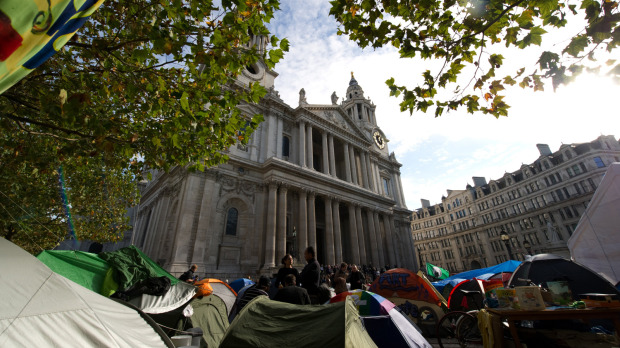
Leon Neal/AFP/Getty Images

The leading tagline of the Occupy Wall Street movement reads: “Protest for World Revolution.”  This is an ambitious claim, to be sure. And in most respects it seems to ring quite true: the movement has successfully taken root not only in cities and towns throughout the United States but also in major urban centers around the world.  On October 15, Occupy Wall Street’s success inspired a broad wave of coordinated occupations across Europe.  I was a founding participant in the one that began in London.

But the Occupy movement has been notably absent outside of North America and Europe.  Not for want of trying, of course: in southern Africa, where I am originally from, small groups of committed activists tried to instigate occupations in a few key regional cities, but without much success.  In South Africa, a society divided by violent inequalities that proceed directly from neoliberal policy, Occupy managed to attract only a few dozen souls – a poor showing for a country known for one of the highest protest rates in the world.

What accounts for the failure of Occupy to capture the imagination of the global South, which comprises precisely the people whose lives have been most brutally affected by the recent global financial crisis?  And in what sense can Occupy claim to be a world revolution if it leaves out – and in some cases even alienates – the vast, non-white majority of humanity?

Continue reading “How to Occupy the World”

Bradley Manning Heads for Trial; No One Charged for Murdered Civilians

Ray McGovern introduces a short documentary deconstructing events revealed by Wikileaks.

Bombing Savages in Law, in Fact, in Fiction

Professor Paul Gilroy chairs this event with Sven Lindqvist, the great Swedish author of over 30 widely translated books including A History of Bombing.

This lecture marks the centenary of aerial bombardment. More than just a military revolution, this development redrew the legal and moral boundaries between civilians and combatants and spread the theatre of war into cities and domestic spaces.

The lecture is part of a joint initiative of LSE Sociology and the Sociology Department at Goldsmiths, University of London.

UPDATE: In case you are having trouble listening to the whole lecture, you can hear it on the LSE website instead.

Hearts and Minds

Armed US drones have been blamed for more than 300 missile attacks in seven years in Pakistan’s tribal areas. Residents of Pakistan’s tribal areas say that they feel terrorised by the strikes, and doctors say that those who survive them often suffer from post-traumatic stress disorder (PTSD). Al Jazeera’s Kamal Hyder met with the survivors of one such strike at a hospital in the Pakistani city of Peshawar.

Philip Levine: A Workingman’s Voice

By Feroz Rather

With a serene and distant view of the hills of Sierra Nevada, on 9 August, 2011, I sat in a library at California State University Fresno, reading The Simple Truth, a collection of poems by Philip Levine. The day after, Mr. Levine, 83, was being nominated by the Library of Congress the next poet laureate of the United States. The felicitations, however, had made their way to the poet’s home here in Fresno and thrilled the entire community of writers in the Central Valley of California. Brandi Spaethe, a friend and fellow writer in our MFA program, broke the news to me. And while walking this beautiful campus dotted with maple trees, with an ecstatic gusto of a poet-in-the-making, she fell into long recitations of many touching poems from the book.

Philip Levine was born in Detroit, Michigan, to Russian-Jewish immigrant parents in 1928, a year before the Great Depression started paralyzing the economy of the US. Levine was educated in Detroit public schools and at Wayne State University, Michigan’s only urban public research university. After graduation, Levine worked a number of industrial jobs, including the night shift at the Cheverolet Gear and Axle factory in 1953, working on his poems in his off hours.   In the fall of the same year, he journeyed to the University of Iowa to attend a poetry workshop. In his autobiographical account, The Bread of Time, he recalls: “The attraction at Iowa was Robert Lowell, whose Lord’s Weary Castle had received the Pulitzer Prize.”Afterwards, he became Stegner Fellow at Stanford University. And then in 1958, he came to Fresno and began teaching English and writing at California State University and which went on for 34 years.

Continue reading “Philip Levine: A Workingman’s Voice”

London 2012 and the Bhopal Disaster

by Saffi Ullah Ahmad

As the 2012 London Olympics approach, a furore has erupted surrounding the £7m sponsorship of the games by the controversial Dow Chemical Company, which is connected with the world’s worst industrial catastrophe, in the Indian city of Bhopal. Lingering effects of the disaster continue to kill and maim people trapped by poverty.

The company has been commissioned to produce a specialized decorative wrap for the Olympic stadium.  Members of Parliament from across the political spectrum, former Mayor of London Ken Livingstone, and leading human rights groups including Amnesty International have expressed dismay at the London 2012 Organising Committee (LOCOG)’s decision and rumours have circulated regarding a possible Indian boycott. In protest to the deal, thousands of survivors of the disaster burned effigies of the chairman of London 2012, Lord Sebastian Coe, on Friday. A larger group of protestors blocked five of Bhopal’s train lines on Saturday 3 December, the 27th anniversary of the disaster, in the face of fierce police beatings.

Gross negligence on the part of the Union Carbide Corporation, now a wholly owned subsidiary of Dow, culminated in a fatal explosion in a pesticide factory on 2-3 December 1984, releasing 40 tonnes of highly toxic gas which laid waste to one of the poorest regions in India.

Continue reading “London 2012 and the Bhopal Disaster”

Anatol Lieven: how to end the US dust-up with Pakistan

Anatol Lieven, author of the excellent Pakistan: A Hard Country, on Christopher Lydon’s indispensable Radio Open Source, discussing the recent dust up between Pakistan and the US.

Anatol Lieven is explaining how the so-called allies in the so-called War on Terror have come to pot-shotting each other on the Pakistani side of the border with Afghanistan. In the Financial Times last May (“How American folly could destroy Pakistan“) Lieven was warning of the perverse logic of confrontation in US policy. The killing last weekend of 24 Pakistani soldiersin a NATO air strike for which President Obama is refusing to apologize can be taken as confirmation of the hazard. Ever since the US Navy swoop on OBL early in May, the risk in Lieven’s eyes was that the US would overplay its hand with demands on the thoroughly alienated Pakistani Army. The American demand-too-far (Lieven is saying emphatically today) is that the Pakistani Army go to war on the Taliban home bases in the Pashtun tribal wilderness. That demand cannot, will not, be met: (a) because the Taliban is a big part of the network that Pakistan counts on to protect and project its interest in Afghanistan when the US forces shrivel, then leave; and (b) because the big majority of Pakistanis — army, elite and masses — see the Taliban in Afghanistan as a legitimate resistance force fighting foreign occupation, like the mujahedeen who fought the Soviets, or Communist guerillas who fought Nazis in Europe. When Pakistan under Pres / Gen Musharraf undertook a half-way offensive against the Taliban in the border wilderness, “they set off an Islamist rebellion inside Pakistan which continues to this day… The Pakistanis do have a case: thanks to the U.S., they have a civil war inside Pakistan which has claimed far more Pakistani lives than Americans killed on 9.11. … We keep talking about wanting to support democracy. Well, the democratic majority in Pakistan wants us to go to hell.”

Continue reading “Anatol Lieven: how to end the US dust-up with Pakistan”