NYTimes eXaminer interviews Belén Fernández

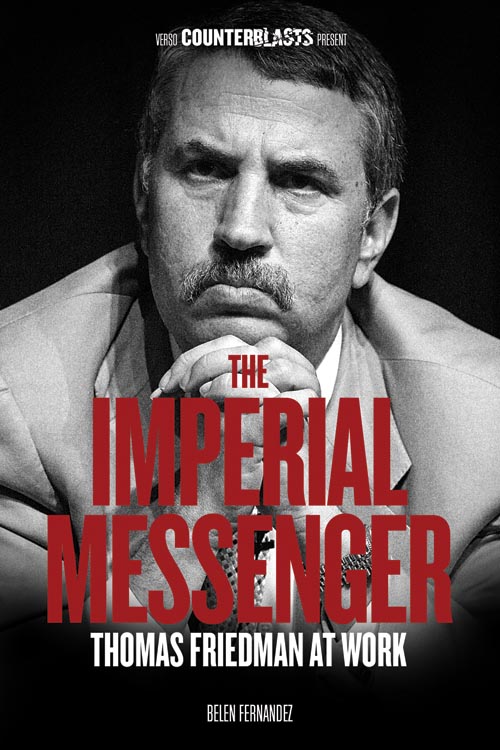
The following is a the first half of an interview conducted by the new NYTimes eXaminer with PULSE co-editor Belén Fernández about her book The Imperial Messenger: Thomas Friedman at Work.

Billed as “an antidote to the ‘paper of record'”, the NYTimes eXaminer‘s Advisory Council is composed of such distinguished figures as Richard Falk, Phyllis Bennis, and Edward Herman.

See Phil Weiss’ comment on the interview at Mondoweiss.

Q: Why Tom Friedman? And can you talk a little about how the book is organized? 

A: My decision to write the book was not the product of any sort of long-standing obsession with Thomas Friedman, whose journalistic exploits I remained mercifully immune to for most of my existence up until 2009.

Then, about midway through that year, the idea came to me suddenly when I noticed the $125 “Russian breakfast” option on the room-service menu at my five-star Havana hotel.

Kidding. In 2009 I watched with simultaneous fascination and horror as Friedman flitted on pedagogical missions from Lebanon to Iraq to Afghanistan to Palestine to Africa, where he discovered the root cause of oppression in Zimbabwe by going on safari in Botswana.

Later that same year, Friedman’s decades-long lecture to the Arab/Muslim world on how to behave reached new levels of absurdity with his pronouncement according to which:

A corrosive mind-set has taken hold since 9/11. It says that Arabs and Muslims are only objects, never responsible for anything in their world, and we are the only subjects, responsible for everything that happens in their world. We infantilize them.

Arab and Muslims are not just objects. They are subjects. They aspire to, are able to and must be challenged to take responsibility for their world.

Arab/Muslim subjectivity was of course called into question not only by the fact that Friedman in this very same article instructed the Islamic world to engage in a civil war equal in ferocity to the US civil war, but also by the fact that—approximately 10 days prior to criticizing the infantilizing of Arabs and Muslims—he had remarked to an amused Fareed Zakaria of CNN that Afghanistan was like a “special needs baby” adopted by the US. (Friedman had refrained in this case from throwing in his regular complaint that the US was “baby-sitting a civil war” in Iraq—a complaint he apparently felt was not irreconcilable with his own declaration of the need for an Iraqi civil war.)

Continue reading “NYTimes eXaminer interviews Belén Fernández”

Cape Town hosts Russell Tribunal on Palestine

Judge Richard Goldstone recently tried to refute comparisons between Israel and Apartheid South Africa. But a man who has established a reputation for having views so malleable that they change from one day to another is perhaps not the most reliable authority on the matter. That, however, is not something one can say about the great Bishop Desmond Tutu, a man who has a far more consistent recording of challenging oppression and injustice. Let us hear then what the great man has to say about Apartheid in Israel.

Panellists at the tribunal also include Alice Walker, Ronnie Kasrils, Mairead MacGuire, Pierre Galand and the former French resistance fighter and Holocaust survivor Stéphane Hessel. Respect is due to our fried Frank Barat for another important initiative successfully realized.

Lupe Fiasco talks Politics

The great hip-hop artist Lupe Fiasco talks about issues closest to his heart on Al Jazeera’s AJStream.

Jailed for Sailing to Gaza, Challenging the Blockade

by Medea Benjamin and Robert Naiman

Two boats full of courageous passengers were on their way to Gaza when they were intercepted on Friday, November 4, by the Israeli military in international waters. We call the passengers courageous because they sailed from Turkey on November 2 with the knowledge that at any moment they might be boarded by Israeli commandos intent on stopping them—perhaps violently, as the Israeli military did in 2010 when they killed nine humanitarian aid workers on the Turkish boat named Mavi Marmara.
The boats—one from Canada and one from Ireland—were carrying 27 passengers, including press and peace activists from Ireland, Canada, the United States, Australia and Palestine. They were unarmed, and the Israeli military knew that. They were simply peace activists wanting to connect with civilians in Gaza, and the Israeli military knew that. Yet naked aggression was used against them in international waters—something that is normally considered an act of piracy.

Continue reading “Jailed for Sailing to Gaza, Challenging the Blockade”

Dancing Into The Trap

By Raymond Deane

Recently the popular Israeli internet news service Ynet published an article by Itamar Eichner called Foreign Ministry beats Israel boycotts (7 October 2011).

The article tells us that ‘Pro-Palestinian groups calling for a cultural boycott against Israel have experienced several failures recently thanks to the Foreign Ministry’s work.’

Note that this ‘work’ is deemed important enough to be undertaken not by the Ministries of Culture or Public Diplomacy, as one might expect, but by the Foreign Ministry itself. This accords with what Nissim Ben-Sheetrit, a former Foreign Ministry deputy director general, said in 2005: ‘We see culture as a propaganda tool of the first rank, and…do not differentiate between propaganda and culture.’ (Ha’aretz, 21 September 2005).

The necessity for boycott is established by surveying the situation in Israel/Palestine: Israel continues forcibly to displace Palestinian communities from occupied East Jerusalem, the Jordan Valley and the Negev; it continues colonial settlement construction in defiance of international law; its ongoing siege of Gaza causes drastic denial of basic rights; dozens of apartheid laws in Israel discriminate against the state’s ‘non-Jewish’ citizens; finally, Israel continues to deny Palestinian their basic right to return home.

Continue reading “Dancing Into The Trap”

The Koch Brothers

Al Jazeera’s People and Power investigates the tycoon duo’s ununderground campaign to swing the balance of US power for Republicans.

Jadaliyya interview with Belén Fernández

Jadaliyya recently interviewed PULSE co-editor Belén Fernández about her book The Imperial Messenger: Thomas Friedman at Work, to be released by Verso Nov. 7. The interview appears in Jadaliyya’s New Texts Out Now (NEWTON) section and includes an excerpt from the book. The following is the start of the interview:

Jadaliyya: Why did you write this book?

Belén Fernández: I asked myself this question several thousand times, particularly during my third rereading of every Friedman column published since 1995.

The idea for the book came about in a far less climactic fashion than Friedman’s ideas tend to occur—i.e. it did not involve “Quarter-Pounder[ing] my way around the world,” being struck by a “bolt out of the blue that must have hit somewhere between the McDonald’s in Tiananmen Square in Beijing, the McDonald’s in Tahrir Square in Cairo and the McDonald’s off Zion Square in Jerusalem,” and unfurling the Golden Arches Theory of Conflict Prevention, according to which American fast food is the key to world peace.

Rather, in May of 2009, following a four-month hitchhiking trip through Colombia, Ecuador, and Venezuela, I returned to Buenos Aires, where my parents were living at the time. Though up to that point I had been blessedly sheltered from the phenomenon that is Thomas Friedman and had only read a smattering of his dispatches over the years, he happened to publish a spate of articles that summer which caught my attention.

Topics ranged from how Iraqis should appreciate the US military legacy of “a million acts of kindness and a profound example of how much people of different backgrounds can accomplish when they work together” in their country, to how Barack Obama had defeated Mahmoud Ahmadinejad in the Lebanese elections, which somehow indicated a triumph of Lebanese sovereignty. Also reported by Friedman that summer was the encouraging fact that the more than 50,000 Facebook fans of Iranian opposition leader Mir Hossein Mousavi far exceeded the capacity of a mosque, thus reiterating the positive role technology can play in the hands of proper Muslims, as opposed to those concerned with conducting “J.O.L.” (Jihad Online).

Continue reading “Jadaliyya interview with Belén Fernández”

Michael Moore on Occupy Wall Street

Michael Moore talks to CNN’s Piers Morgan about the OWS and more.

Continue reading “Michael Moore on Occupy Wall Street”

British Muslim Fictions

By Claire Chambers

What does it mean to be a writer of Muslim heritage in the UK today? Is there such a thing as ‘Muslim fiction’? If so, is it cultural background or belief that makes writing (or identity) Muslim?

My book, British Muslim Fictions: Interviews with Contemporary Writers (Basingstoke: Palgrave Macmillan, 2011), is the first in a two-part book project, which seeks answers to these complex questions. It is a collection of conversations with writers who live or work in Britain and have an intimate relationship with Islam, whether they are religious, cultural, or even – paradoxically – atheist Muslims, and whether South Asian, Arab, African, or European.

Over thirteen interviews, I talked to Anglophone writers including Aamer Hussein, Fadia Faqir, Hanif Kureishi, Leila Aboulela, Abdulrazak Gurnah, and PULSE’s own Robin Yassin-Kassab. This is a group of writers who are highly diverse but, like a loosely connected and often discordant family, they have much in common, through their connections both to Islam and the United Kingdom. As well as discussing their literary techniques and the impact that their Muslim heritage has had on them, I became increasingly persuaded that this body of writing shares certain preoccupations (relating to gender, class, the war on terror, al-Andalus, the Rushdie Affair, and a cosmopolitan outlook), and is some of the most important and politically engaged fiction of recent years.

As you can tell from my name, I am not from a Muslim background myself, although I was fortunate enough to grow up in Leeds in West Yorkshire, surrounded by many South Asian Muslim friends. As clichéd as it may sound, my worldview has also been crucially shaped by my gap year, 1993-94, which I spent teaching English in Peshawar, Pakistan, at the age of eighteen. I went on to specialize in South Asian literature in English as a postgraduate student, and continue to fuel my interest by return visits to the Indian subcontinent and by working with diasporic communities.

Continue reading “British Muslim Fictions”