A war of Western imperialism?

by Ahmed Moor

Photo: Scott Nelson

There is a lot about the Western intervention in Libya that could go wrong – and it remains to be seen whether bombing Gaddafi and his mercenaries is a good decision.

However, large numbers of people around the world appear to support the objectives of the anti-regime forces. Also, the indigenous resistance movement – which requested help – would have been annihilated in the absence of those air strikes.

George Bush’s legacy of destruction extends beyond the piles of brick, flesh and mortar that we have been tallying for a decade now in Iraq and Afghanistan.

More than any other figure in the post-war 20th century, the last American president did more to erode the gains in legitimacy made by supranational institutions and their proponents.

After the Iraq war, the United Nations began to be perceived as a US rubberstamp body – or worse – as a meaningless exercise in bureaucracy.

The UN can only function legitimately through consensus (or consensus-lite) decision-making and it was clear that the US was strong-arming weaker states in 2003.

George Bush and the neoconservatives hijacked the legitimate language of consensus-based intervention for their own ill use.

So activists are not wrong to react cynically when they hear that language today; I don’t believe that bombing Gaddafi is a humanitarian gesture.
Continue reading “A war of Western imperialism?”

On the Anti-Cuts Protest in London, 500,000 Say No to the Coalition Government’s Arrogant, Ideological Butchery of the British State

by Andy Worthington

Posted at www.andyworthington.co.uk on 26.3.11

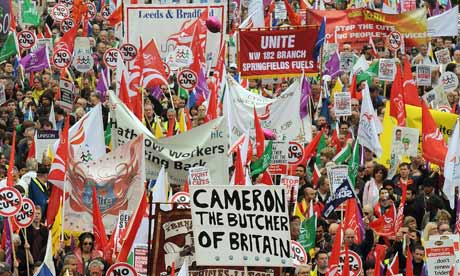
Today was the long awaited TUC-led “March for the Alternative” in London, calling for jobs, growth and justice, in the face of the savage programme of public sector cuts imposed by the Tory-led coalition government, which I have been covering since October in a series of hard-hitting articles under the heading, Battle for Britain: Fighting the Coalition Government’s Vile Ideology.

Those of you who have been following my work closely will understand that I was not able to be on the march today, as I’m in St. Thomas’ Hospital, where I’m undergoing treatment for a serious and painful blocking of the blood supply to the toes of my right foot, caused by arterial damage. However, with my magnificent overview of the march from the 11th floor window of my hospital room, overlooking the Houses of Parliament, Westminster Bridge and today — crucially — the Embankment, where the march began at 12 noon, I’m able to confirm that this was undoubtedly the biggest protest I’ve ever seen, with the noble but ultimately doomed exception of the February 2003 demonstration against the Iraq War, which, with an estimated two million attendees, was by far the largest protest in British history.

Continue reading “On the Anti-Cuts Protest in London, 500,000 Say No to the Coalition Government’s Arrogant, Ideological Butchery of the British State”

Gaddafi’s assassins and rapists

Recently, there have been numerous assassination attempts on leading rebels in their eastern stronghold of Benghazi. Some documents have been found, detailing those set to be killed. And many more so-called ‘Gadaffi lists’ are thought to exist.

Continue reading “Gaddafi’s assassins and rapists”

PLO: History of a Revolution

1. Masters of their Own Destiny

Masters of their own Destiny is the first episode in Al Jazeera’s six-part series on the history of the Palestine Liberation Organisation. It looks at the challenges encountered as Palestinians sought to wrest control of their own destiny from Arab regimes and create an independent Palestinian organisation that would lead the struggle for a national home.

Continue reading “PLO: History of a Revolution”

The muzzling of Israel critics in European universities

David Cronin, author of the recently released Europe’s Alliance with Israel: Aiding the Occupation, writes in his latest piece for Mondoweiss:

If imitation is the best form of flattery, then the activists behind Israeli Apartheid Week have been paid an immense tribute. As students belonging to Palestine support groups across Britain held events to mark the annual March event, they learned of a rival initiative. A network of on-campus Zionist societies have declared their own Israeli Awareness Week over the same period.

The awareness week has relied heavily on gimmicks to try and counter impressions that Israel has a war addiction. Stalls staffed by visiting Israeli students have offered sugary delights labelled “Peace of Cake”; signatures have been collected for a “we support a two-state solution” petition.

Continue reading “The muzzling of Israel critics in European universities”

Syrian security forces open fire on protesters

Syrian security forces are reported to be cracking down hard on anti-government protesters across the country.

Witnesses say at least 20 have been killed on Friday, the day activists were calling the ‘Day of Dignity’.

Al Jazeera’s Zeina Khodr has this exclusive report from the city of Dara’a.

The Brotherhood

Al Jazeera’s Empire on the history and politics of the Muslim Brotherhood.

After decades in the political wilderness, the Muslim Brotherhood became an integral part of the popular upheavals that swept through the Arab world – and while they may not have initiated the recent revolution in Egypt, the overthrow of Mubarak’s regime leaves a power vacuum that the Brotherhood are now well-positioned to fill. How will the Muslim Brotherhood reconcile their ideology with democracy?

Fight for Ajdabiya continues

Forces loyal to Libyan leader Muammar Gaddafi are said to have taken up key positions around the opposition-held city of Ajdabiya.

The eastern city has been fought over now for more than two weeks.

Many people have fled and others are hiding indoors.

Al Jazeera’s James Bays reports on the desperate conditions for people who have chosen to stay.

Continuing Colonialism: World Bank Funds Mining in Africa

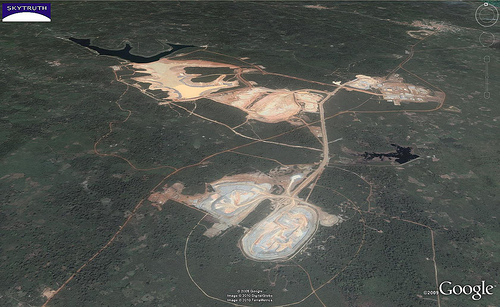
The Ahafo gold mine in Ghana, which displaced over 10,000 people

by Cyril Mychalejko

The private finance sector arm of the World Bank Group announced last month that it would invest $300 million to promote mining in Africa.

“Mining is a critically important yet challenging sector and [the International Finance Corporation] IFC has a role to play in supporting responsible companies that will bring jobs, related infrastructure and government revenues to Africa,” said Andrew Gunther, IFC’s Senior Manager of Infrastructure and Natural Resources in Africa and Latin America.

Dr. Aaron Tesfaye, a professor of International Political Economy and African Politics at William Paterson University, said he is not surprised by the announcement because of the economic and security implications mining and strategic metals have for industrialized nations.

Continue reading “Continuing Colonialism: World Bank Funds Mining in Africa”