Author: alannahpriestley
The New Media and the Palestine Question
The Palestine Center hosted a panel entitled The New Media and the Palestine Question. In Part One, Professor Jerome Slater and Adam Horowitz discuss how blogging changes the public discussion. In Part Two (over the fold), MJ Rosenberg and Professor Stephen Walt discuss how blogging affects policy change.
Part One
Obama’s UN speech ‘nothing new’
Barack Obama, the US president, has urged countries in the United Nations to get behind Middle East peace efforts in an address at the UN General Assembly. But Ali Hasan Abunimah, a Palestinian-American journalist and co-founder of Electronic Intifada, an independent web site about the Israeli-Palestinian Conflict, said Obama’s speech did not represent anything new. “That bodes very ill for the peace process that he’s so invested in,” Abunimah told Al Jazeera’s Shihab Rattansi, speaking from the US state of Indiana.
“Let’s judge him not by what he says, but what he does.”
Omar Khadr has lost one third of his Life in US Custody
by Andy Worthington
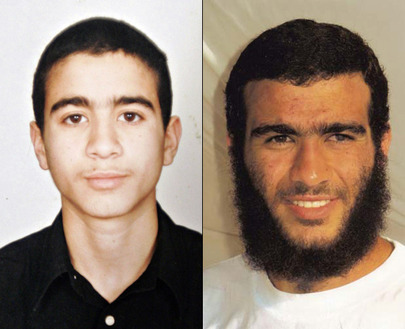 Omar Khadr, the only Canadian citizen in Guantánamo, was seized in Afghanistan on July 27, 2002, when he was just 15 years old. On September 19 he turned 24, and has grown, physically, into a man during the eight years and two months he has spent in US custody, first at Bagram airbase in Afghanistan, and, since October 2002, at Guantánamo. At heart, however, he remains a child, whose youth has been stolen from him by the US authorities responsible for detaining him, and by the Canadian government, which has refused to demand his return.
I don’t want you to reflect, however, particularly on the abuse to which he has been subjected throughout his detention, or on the US government’s shameful refusal to rehabilitate him, rather than punishing him, as required by its obligations under the Optional Protocol to the UN Convention on the Rights of the Child on the involvement of children in armed conflict, which includes the agreement that all States Parties who ratify the Protocol “[r]ecogniz[e] the special needs of those children who are particularly vulnerable to recruitment or use in hostilities,” and are “[c]onvinced of the need [for] the physical and psychosocial rehabilitation and social reintegration of children who are victims of armed conflict.”
I don’t want you to reflect particularly on the Canadian government’s shameful refusal to demand his return to his homeland, despite severe criticism by the Canadian courts, or on the Obama administration’s shameful refusal to cancel his scheduled trial by Military Commission, on war crimes charges that — even if the allegations are true — are not war crimes at all, as Lt. Col. David Frakt, the military defense attorney for another former child at Guantánamo, Mohamed Jawad (who was released last August), has explained.
Continue reading “Omar Khadr has lost one third of his Life in US Custody”
American Public Opinion and the ‘Special Relationship’
by John Mearsheimer
 There is no question that the United States has a relationship with Israel that has no parallel in modern history. Washington gives Israel consistent, almost unconditional diplomatic backing and more foreign aid than any other country. In other words, Israel gets this aid even when it does things that the United States opposes, like building settlements. Furthermore, Israel is rarely criticized by American officials and certainly not by anyone who aspires to high office. Recall what happened last year to Charles Freeman, who was forced to withdraw as head of the National Intelligence Council because he had criticized certain Israeli policies and questioned the merits of the special relationship.
Steve Walt and I argue that there is no good strategic or moral rationale for this special relationship, and that it is largely due to the enormous influence of the Israel lobby. Critics of our claim maintain that the extremely tight bond between the two countries is the result of the fact that most Americans feel a special attachment to Israel. The American people, so the argument goes, are so deeply committed to supporting Israel generously and unreservedly that politicians of all persuasions have no choice but to support the special relationship.
Continue reading “American Public Opinion and the ‘Special Relationship’”
Government ‘politicising’ Pakistan aid
It has been over six weeks since heavy rains caused devastating floods across Pakistan and the UN has launched an unprecedented disaster appeal for $2bn. Pakistan has already received more than $1bn in emergency donations but some opposition politicians accuse the government of playing politics with international aid money. Al Jazeera’s Kamal Hyder asked the politicians representing both the opposition and the government if the flood victims are receiving aid regardless of their political affinity.
Nablus Limited
A soap factory and an olive oil business in Nablus deal with the harsh realities of the Israeli occupation and its impact on the economy.
Drones on Trial: Narrowing the Gap Between Law and Justice
by Jerica Arents
 I received an education yesterday.
I wasn’t in a classroom. I wasn’t laboring over a paper, strategizing in a small group, poring over a textbook or hustling across campus. I was sitting as a spectator in the front row of Judge Jansen’s courtroom in Clark County, Nevada.
Fourteen peace activists were on trial for trying to hand-deliver a letter to the base commander at Creech Air Force Base in April of 2009. Their letter laid out concerns about usage of Unmanned Aerial Vehicles, or drones, for surveillance and combat purposes in Afghanistan. The Creech 14 believe that the usage of remote aerial vehicles to hunt down and kill people in other lands amounts to targeted assassination and is prohibited by international and U.S. law. Soldiers carrying M16s stopped them after they had walked past the guardhouse at the base entrance and a few hours later Nevada state troopers handcuffed the Creech 14 and took them into custody.
The next day, they were charged with trespass to a military facility and released. The charges were later dropped, then reinstated. Defendants, upon learning of a September 14, 2010 court date, had ten months to plan for their trial. They decided to represent themselves pro se and to call, as expert witnesses, former U.S. Attorney General Ramsey Clark, Colonel Ann Wright and Professor Bill Quigley, the Legal Director of the Center for Constitutional Rights. What were the chances that a Las Vegas court that normally handles traffic violations and minor offenses would admit three expert witnesses to testify on behalf of defendants charged with a simple trespass? Slim to zero in the view of most observers.
In an opening statement, Kathy Kelly summarized what defendants would prove regarding their obligations under international law and their exercise of rights protected by the U.S. constitution. The judge told her, quite firmly, that any testimony unrelated to the charge of trespass would be disallowed.
Continue reading “Drones on Trial: Narrowing the Gap Between Law and Justice”
On Gaza, Artists Speak Out
Terry Jones, Annie Lennox, Thandie Newton, Alexei Sayle, Mike Figgis, Katharine Hamnett and Jason Flemyng, voice their support for Amnesty International’s ongoing efforts to secure justice for both Palestinians and Israelis and make an impassioned plea for Israel to cease its illegal siege of Gaza. Find out more here.
Iraq War reparations
You thought it won’t happen. You were wrong. Finally reparations for the suffering caused by the war are in order…by the Iraqis to the United States! Yes–you heard it right. The United States–which has killed over 2.4 million Iraqis since 1991 and displaced 5 million more–will be paid $400 million by the Iraqis in war reparations.
 P U L S E